Department of Plant Sciences, Rothamsted Research, Harpenden, Hertfordshire, AL5 2JQ, UK.
Department of Plant Sciences, University of Cambridge, Downing Street, Cambridge, CB2 3EA, UK.
Plant Reprod. 2018 Jun;31(2):171-191. doi: 10.1007/s00497-017-0320-3. Epub 2017 Dec 20.
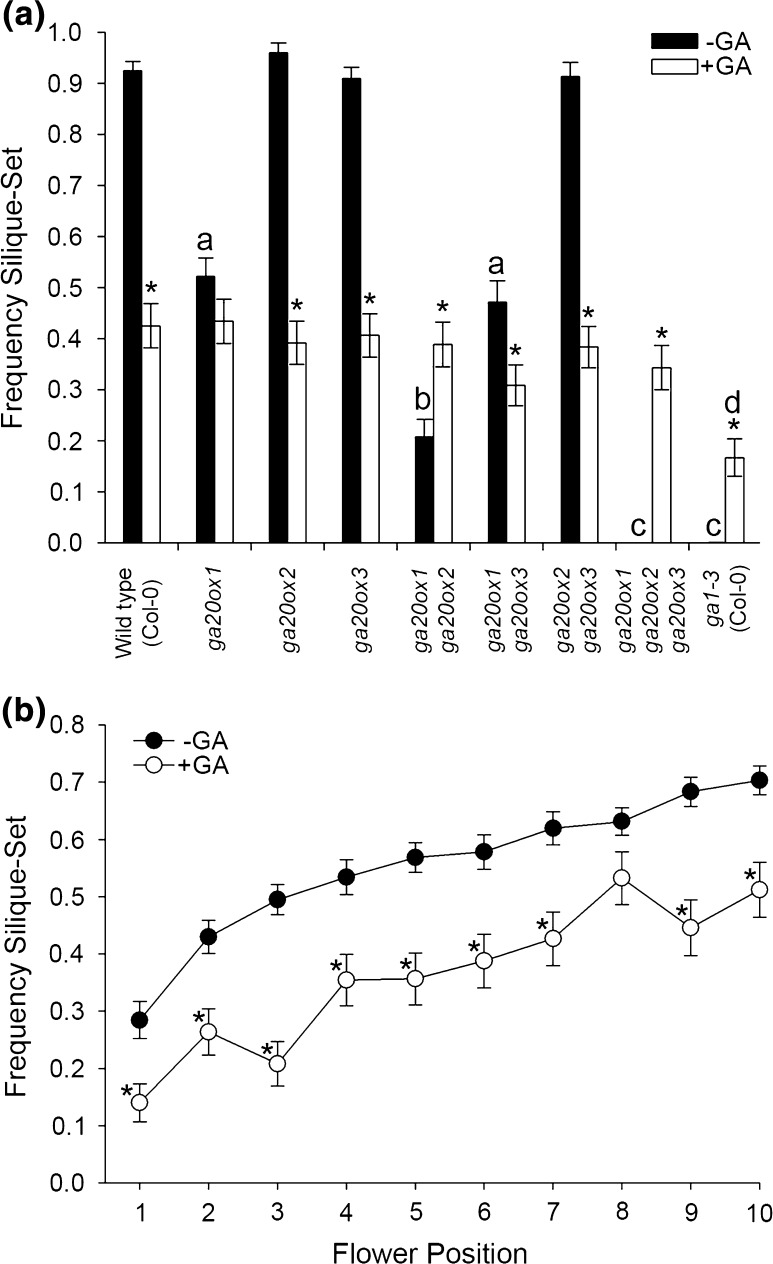
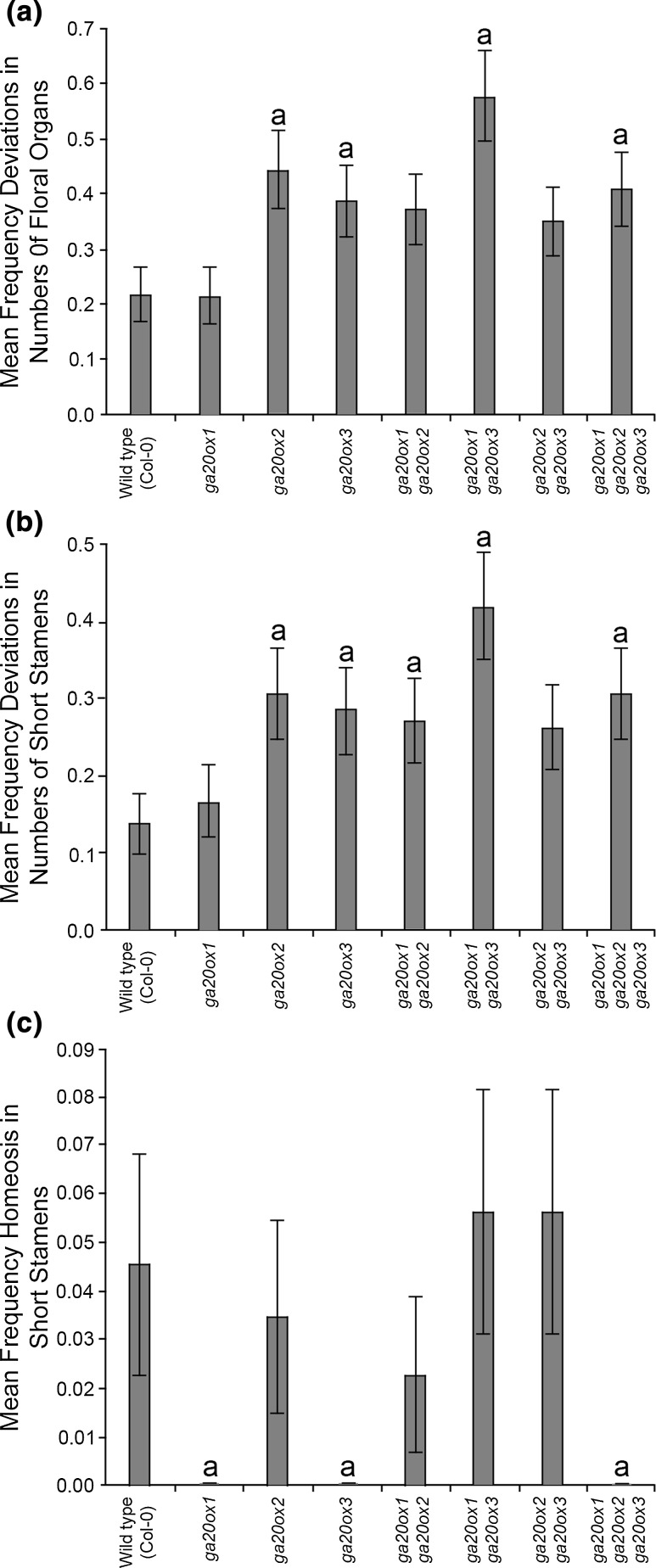
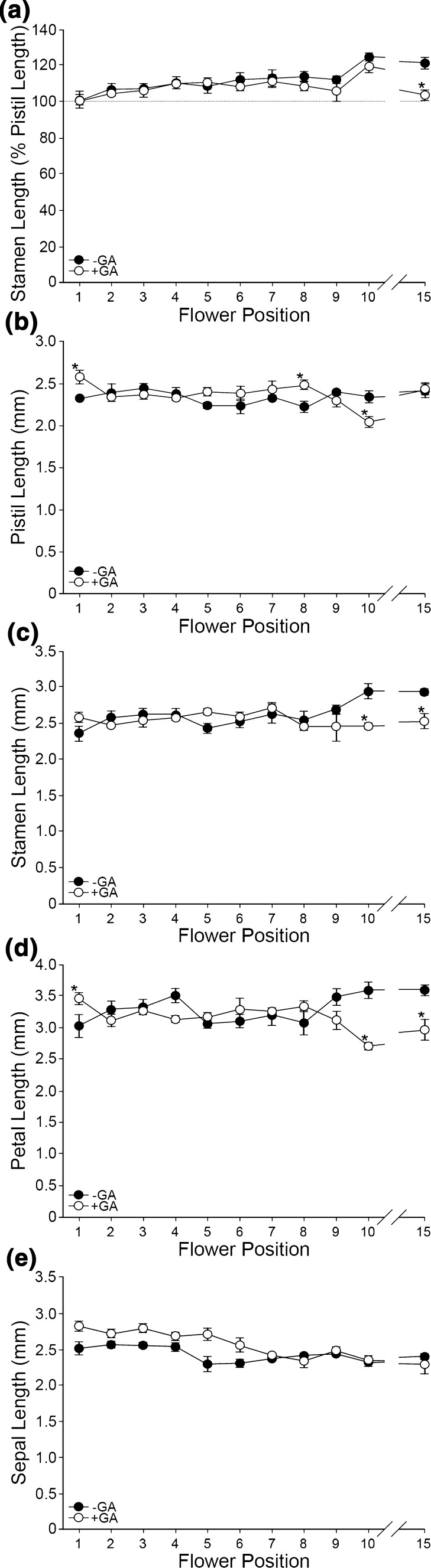
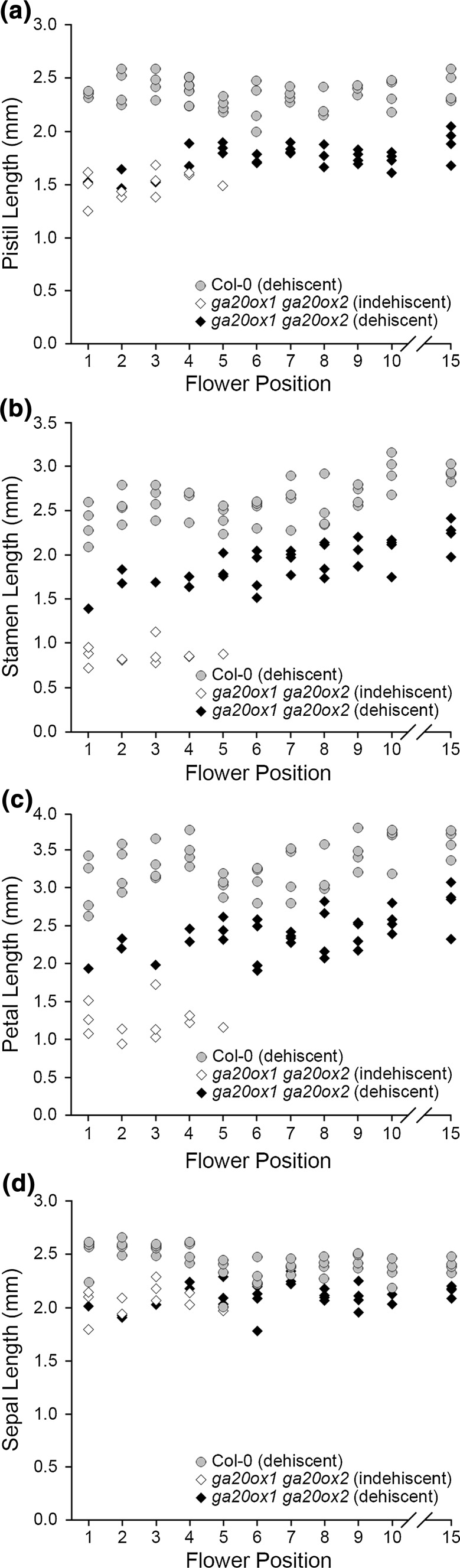
Linear modelling approaches detected significant gradients in organ growth and patterning across early flowers of the Arabidopsis inflorescence and uncovered evidence of new roles for gibberellin in floral development. Most flowering plants, including the genetic model Arabidopsis thaliana, produce multiple flowers in sequence from a reproductive shoot apex to form a flower spike (inflorescence). The development of individual flowers on an Arabidopsis inflorescence has typically been considered as highly stereotypical and uniform, but this assumption is contradicted by the existence of mutants with phenotypes visible in early flowers only. This phenomenon is demonstrated by mutants partially impaired in the biosynthesis of the phytohormone gibberellin (GA), in which floral organ growth is retarded in the first flowers to be produced but has recovered spontaneously by the 10th flower. We presently lack systematic data from multiple flowers across the Arabidopsis inflorescence to explain such changes. Using mutants of the GA 20-OXIDASE (GA20ox) GA biosynthesis gene family to manipulate endogenous GA levels, we investigated the dynamics of changing floral organ growth across the early Arabidopsis inflorescence (flowers 1-10). Modelling of floral organ lengths identified a significant, GA-independent gradient of increasing stamen length relative to the pistil in the wild-type inflorescence that was separable from other, GA-dependent effects. It was also found that the first flowers exhibited unstable organ patterning in contrast to later flowers and that this instability was prolonged by exogenous GA treatment. These findings indicate that the development of individual flowers is influenced by hitherto unknown factors acting across the inflorescence and also suggest novel functions for GA in floral patterning.
线性建模方法在拟南芥花序的早期花中检测到器官生长和模式的显著梯度,并揭示了赤霉素在花发育中的新作用。包括遗传模式植物拟南芥在内的大多数开花植物,从生殖枝顶部长出多个花,形成花穗(花序)。拟南芥花序上单个花的发育通常被认为是高度定型和一致的,但这种假设与只有早期花中可见表型的突变体的存在相矛盾。这种现象在赤霉素(GA)生物合成部分受损的突变体中得到证明,其中第一朵花的花器官生长受到抑制,但到第 10 朵花时已自发恢复。我们目前缺乏来自拟南芥花序多个花的系统数据来解释这些变化。我们使用赤霉素 20-氧化酶(GA20ox)赤霉素生物合成基因家族的突变体来操纵内源性 GA 水平,研究了早期拟南芥花序(花 1-10)中不断变化的花器官生长动态。花器官长度的建模确定了一个显著的、与野生型花序中雌蕊相比雄蕊长度增加的 GA 独立梯度,该梯度与其他 GA 依赖性效应是可分离的。还发现第一朵花的器官模式不稳定,与后来的花形成对比,并且这种不稳定性通过外源 GA 处理而延长。这些发现表明,单个花的发育受到迄今未知的跨花序作用的因素的影响,并且还表明 GA 在花模式形成中的新作用。