Safy M, de Hair M J H, Jacobs J W G, Buttgereit F, Kraan M C, van Laar J M
Department of Rheumatology & Clinical Immunology, University Medical Center Utrecht, Utrecht, the Netherlands.
Department of Rheumatology and Clinical Immunology, Charité-Universitätsmedizin Berlin, Berlin, Germany.
PLoS One. 2017 Dec 21;12(12):e0188810. doi: 10.1371/journal.pone.0188810. eCollection 2017.
Long-term treatment with glucocorticoids (GCs) plays an important role in the management of arthritis patients, although the efficacy/safety balance is unfavorable. Alternatives with less (severe) adverse effects but with good efficacy are needed. Selective GC receptor modulators (SGRMs) are designed to engage the GC receptor with dissociative characteristics: transactivation of genes, which is mainly responsible for unwanted effects, is less strong while trans-repression of genes, reducing inflammation, is maintained. It is expected that SGRMs thus have a better efficacy/safety balance than GCs. A systematic review providing an overview of the evidence in arthritis is lacking.
To systematically review the current literature on efficacy and safety of oral SGRMs in comparison to GCs in arthritis.
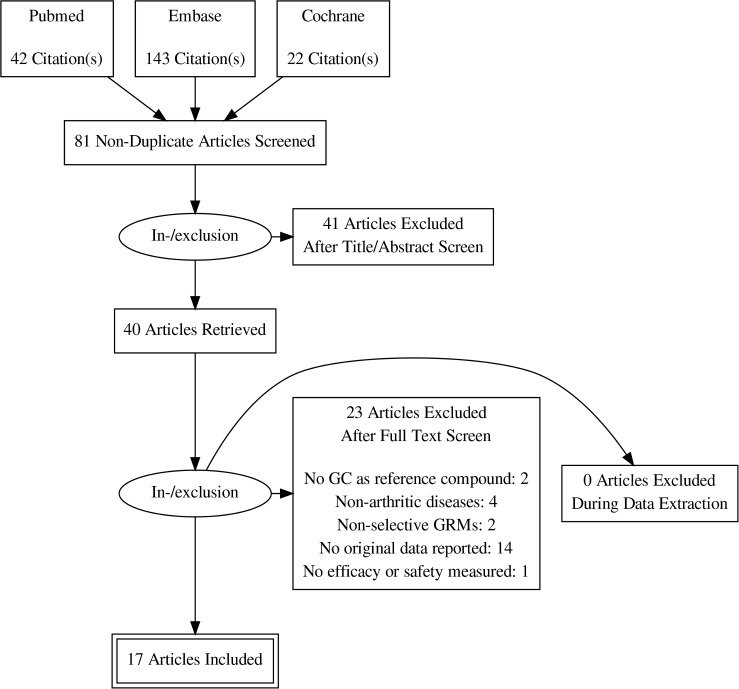
A search was performed in Medline, Embase and the Cochrane Library, from inception dates of databases until May 2017. Experimental studies involving animal arthritis models or human material of arthritis patients, as well as clinical studies in arthritis patients were included, provided they reported original data. All types of arthritis were included. Data was extracted on the SGRM studied and on the GC used as reference standard; the design or setting of the study was extracted as well as the efficacy and safety results.
A total of 207 articles was retrieved of which 17 articles were eligible for our analysis. Two studies concerned randomized controlled trials (RCT), five studies were pre-clinical studies using human material, and 10 studies involved pre-clinical animal models (acute and/or chronic arthritis induced in mice or rats). PF-04171327, the only compound investigated in a clinical trial setting, had a better efficacy/safety balance compared to GCs: better clinical anti-inflammatory efficacy and similar safety.
Studies assessing both efficacy and safety of SGRMs are scarce. There is limited evidence for dissociation of anti-inflammatory and metabolic effects of the SGRMs studied. Development of many SGRMs is haltered in a preclinical phase. One SGRM showed a better clinical efficacy/safety balance.
长期使用糖皮质激素(GCs)在关节炎患者的治疗中发挥着重要作用,尽管其疗效与安全性的平衡并不理想。因此,需要研发具有较少(严重)不良反应且疗效良好的替代药物。选择性糖皮质激素受体调节剂(SGRMs)旨在以解离特性作用于糖皮质激素受体:主要导致不良作用的基因反式激活作用较弱,而减轻炎症的基因反式抑制作用得以维持。因此,预计SGRMs比GCs具有更好的疗效/安全性平衡。目前尚缺乏一项系统性综述来概述有关关节炎的证据。
系统综述口服SGRMs与GCs相比在关节炎中的疗效和安全性的现有文献。
在Medline、Embase和Cochrane图书馆进行检索,检索时间从各数据库建库起至2017年5月。纳入涉及动物关节炎模型或关节炎患者人体材料的实验研究以及关节炎患者的临床研究,前提是这些研究报告了原始数据。纳入所有类型的关节炎。提取所研究的SGRM以及用作参考标准的GC的数据;提取研究的设计或背景以及疗效和安全性结果。
共检索到207篇文章,其中17篇符合我们的分析标准。两项研究为随机对照试验(RCT),五项研究为使用人体材料的临床前研究,十项研究涉及临床前动物模型(小鼠或大鼠诱导的急性和/或慢性关节炎)。PF-04171327是唯一在临床试验环境中研究的化合物,与GCs相比具有更好的疗效/安全性平衡:临床抗炎疗效更好且安全性相似。
评估SGRMs疗效和安全性的研究较少。关于所研究的SGRMs的抗炎和代谢作用解离的证据有限。许多SGRMs的研发在临床前阶段受阻。一种SGRM显示出更好的临床疗效/安全性平衡。