Simons Inge, Mulder Eva, Breuk René, Mos Kees, Rigter Henk, van Domburgh Lieke, Vermeiren Robert
Department of Child and Adolescent Psychiatry, Curium-Leiden University Medical Center, Post Box 15, 2300 AA Leiden, The Netherlands.
Intermetzo-Pluryn, Post Box 53, 6500 AB Nijmegen, The Netherlands.
Child Adolesc Psychiatry Ment Health. 2017 Dec 19;11:61. doi: 10.1186/s13034-017-0203-2. eCollection 2017.
To provide successful treatment to detained adolescents, staff in juvenile justice institutions need to work in family-centered ways. As juvenile justice institutions struggled to involve parents in their child's treatment, we developed a program for family-centered care.
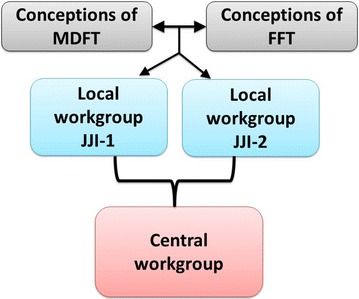
The program was developed in close collaboration with staff from the two juvenile justice institutions participating in the Dutch Academic Workplace Forensic Care for Youth. To achieve an attainable program, we chose a bottom-up approach in which ideas for family-centered care were detailed and discussed by workgroups consisting of group leaders, family therapists, psychologists, other staff, researchers, and a parent.
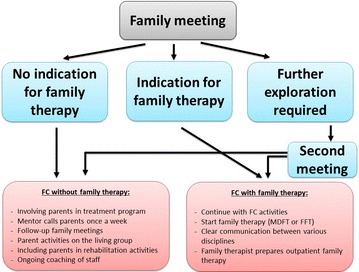
The family-centered care program distinguishes four categories of parental participation: (a) informing parents, (b) parents meeting their child, (c) parents meeting staff, and (d) parents taking part in the treatment program. Additionally, the family-centered care program includes the option to start family therapy during detention of the youths, to be continued after discharge from the juvenile justice institutions. Training and coaching of staff are core components of the family-centered care program.
The combination of training and the identification of attainable ways for staff to promote parental involvement makes the family-centered care program valuable for practice. Because the program builds on suggestions from previous research and on the theoretical background of evidence-based family therapies, it has potential to improve care for detained adolescents and their parents. Further research is required to confirm if this assumption is correct.
为了成功治疗被拘留的青少年,少年司法机构的工作人员需要以家庭为中心开展工作。由于少年司法机构在促使家长参与孩子的治疗方面面临困难,我们制定了一项以家庭为中心的照护计划。
该计划是与参与荷兰学术工作场所青少年法医照护的两家少年司法机构的工作人员密切合作制定的。为了制定一个切实可行的计划,我们采用了自下而上的方法,由组长、家庭治疗师、心理学家、其他工作人员、研究人员和一名家长组成的工作组详细讨论并阐述了以家庭为中心的照护理念。
以家庭为中心的照护计划区分了家长参与的四类情况:(a) 告知家长;(b) 家长与孩子见面;(c) 家长与工作人员见面;(d) 家长参与治疗计划。此外,以家庭为中心的照护计划还包括在青少年被拘留期间开始家庭治疗,并在从少年司法机构出院后继续进行的选项。工作人员的培训和指导是以家庭为中心的照护计划的核心组成部分。
培训与确定工作人员促进家长参与的可行方法相结合,使得以家庭为中心的照护计划在实践中具有价值。由于该计划基于先前研究的建议以及循证家庭治疗的理论背景,它有潜力改善对被拘留青少年及其家长的照护。需要进一步研究来证实这一假设是否正确。