Mosomtai Gladys, Evander Magnus, Mundia Charles, Sandström Per, Ahlm Clas, Hassan Osama Ahmed, Lwande Olivia Wesula, Gachari Moses K, Landmann Tobias, Sang Rosemary
International Centre of Insect Physiology and Ecology, P. O. Box 30772-00100, Nairobi, Kenya.
Institute of Geomatics, GIS & Remote Sensing, Dedan Kimathi University of Technology, P.O. Box 657-10100, Nyeri, Kenya.
Data Brief. 2017 Dec 6;16:762-770. doi: 10.1016/j.dib.2017.11.097. eCollection 2018 Feb.
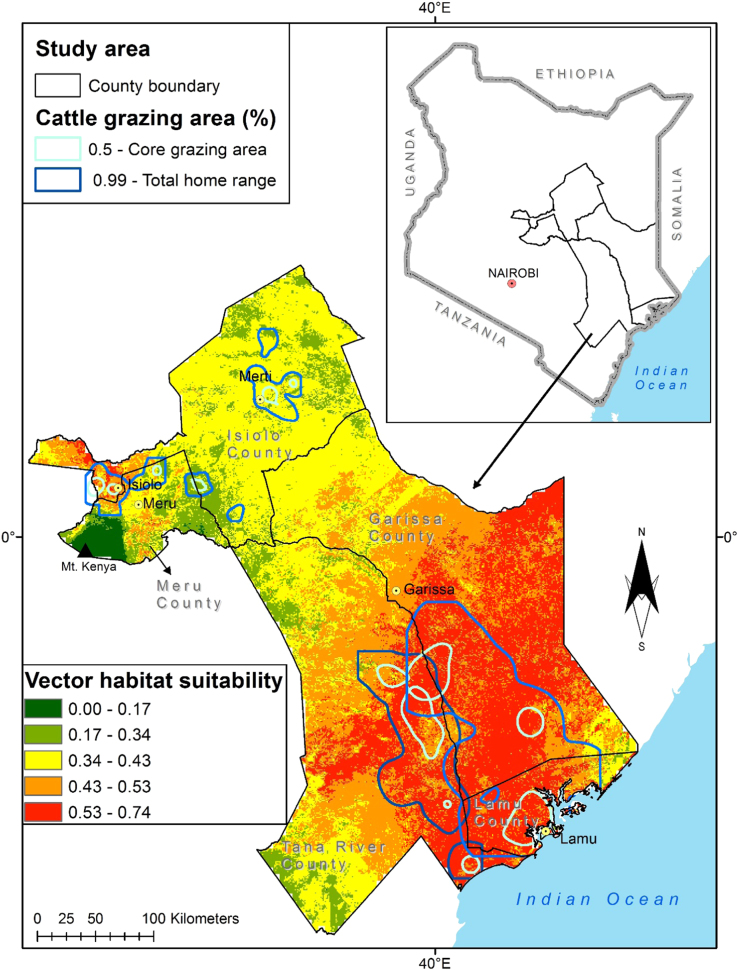
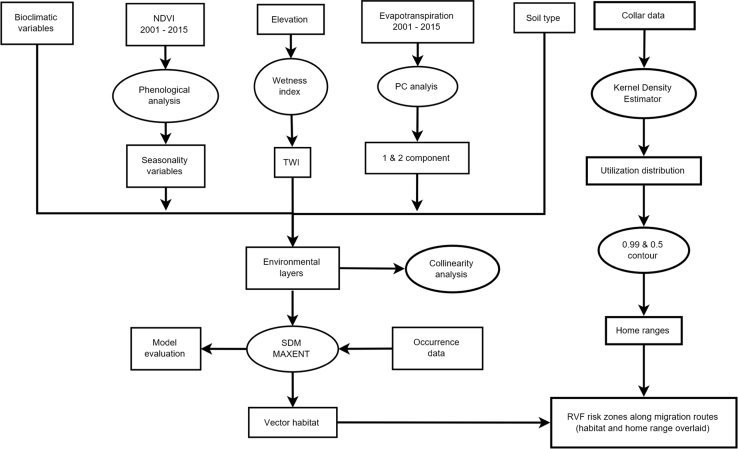
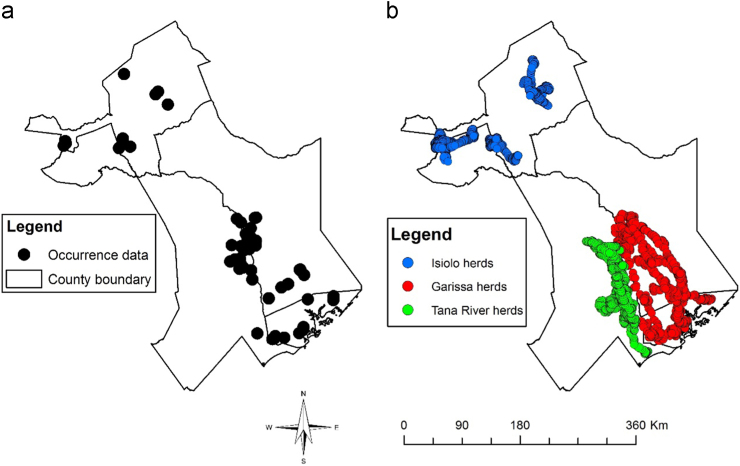
Rift Valley fever (RVF) is a zoonotic disease affecting humans and animals. It is caused by RVF virus transmitted primarily by mosquitoes. The data presented in this article propose environmental layers suitable for mapping RVF vector habitat zones and livestock migratory routes. Using species distribution modelling, we used RVF vector occurrence data sampled along livestock migratory routes to identify suitable vector habitats within the study region which is located in the central and the north-eastern part of Kenya. Eleven herds monitored with GPS collars were used to estimate cattle utilization distribution patterns. We used kernel density estimator to produce utilization contours where the 0.5 percentile represents core grazing areas and the 0.99 percentile represents the entire home range. The home ranges were overlaid on the vector suitability map to identify risks zones for possible RVF exposure. Assimilating high spatial and temporal livestock movement and vector distribution datasets generates new knowledge in understanding RVF epidemiology and generates spatially explicit risk maps. The results can be used to guide vector control and vaccination strategies for better disease control.
裂谷热(RVF)是一种影响人类和动物的人畜共患病。它由主要通过蚊子传播的裂谷热病毒引起。本文所呈现的数据提出了适合绘制裂谷热媒介栖息地和牲畜迁徙路线的环境图层。利用物种分布模型,我们使用了沿牲畜迁徙路线采集的裂谷热媒介出现数据,以确定位于肯尼亚中部和东北部的研究区域内合适的媒介栖息地。使用带有GPS项圈监测的11个畜群来估计牛的利用分布模式。我们使用核密度估计器来生成利用等值线,其中第0.5百分位数代表核心放牧区,第0.99百分位数代表整个活动范围。将活动范围叠加在媒介适宜性地图上,以确定可能接触裂谷热的风险区域。整合高时空分辨率的牲畜移动和媒介分布数据集,能产生有关裂谷热流行病学的新知识,并生成空间明确的风险地图。这些结果可用于指导媒介控制和疫苗接种策略,以更好地控制疾病。