International Centre of Insect Physiology and Ecology, Nairobi, Kenya.
Center for Virus Research, Kenya Medical Research Institute, Nairobi, Kenya.
PLoS Negl Trop Dis. 2020 Feb 21;14(2):e0007979. doi: 10.1371/journal.pntd.0007979. eCollection 2020 Feb.
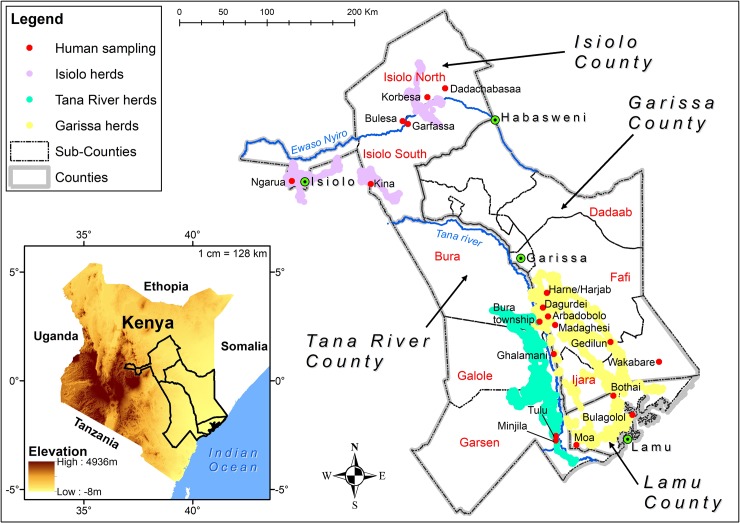
Multiple outbreaks of Rift Valley Fever (RVF) with devastating effects have occurred in East Africa. These outbreaks cause disease in both livestock and humans and affect poor households most severely. Communities living in areas practicing nomadic livestock movement may be at higher risk of infection. This study sought to i) determine the human exposure to Rift Valley fever virus (RVFV) in populations living within nomadic animal movement routes in Kenya; and ii) identify risk factors for RVFV infection in these communities.
A cross-sectional descriptive study design was used. Samples were collected from the year 2014 to 2015 in a community-based sampling exercise involving healthy individuals aged ≥18 years from Isiolo, Tana River, and Garissa counties. In total, 1210 samples were screened by ELISA for the presence of immunoglobulin IgM and IgG antibodies against RVFV. Positive results were confirmed by plaque reduction neutralization test.
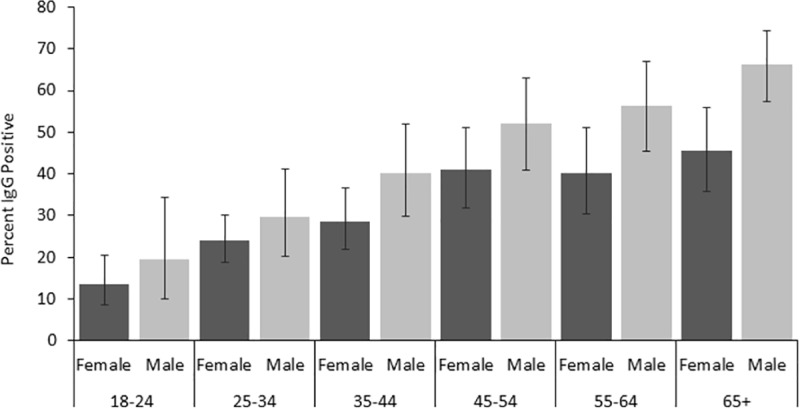
Overall, IgM and IgG prevalence for all sites combined was 1.4% (95% CI 0.8-2.3%) and 36.4% (95% CI 33.8-39.2%), respectively. Isiolo County recorded a non-significant higher IgG prevalence of 38.8% than Garissa 35.9% and Tana River 32.2% (Chi square = 2.5, df = 2, p = 0.287). Males were significantly at higher risk of infection by RVFV than females (OR = 1.67, 95% CI 1.17-2.39, p<0.005). Age was significantly associated with RVFV infection (Wald Chi = 94.2, df = 5, p<0.0001). Individuals who had regular contact with cattle (OR = 1.38, 95%CI 1.01-1.89) and donkeys (OR = 1.38, 95%CI 1.14-1.67), or contact with animals through birthing (OR = 1.69, 95%CI 1.14-2.51) were significantly at a greater risk of RVFV infection than those who did not.
This study demonstrated that although the Isiolo County has been classified as being at medium risk for RVF, virus infection appeared to be as prevalent in humans as in Tana River and Garissa, which have been classified as being at high risk. Populations in these counties live within nomadic livestock movement routes and therefore at risk of being exposed to the RVFV. Interventions to control RVFV infections therefore, should target communities living along livestock movement pathways.
裂谷热(RVF)多次爆发,对东非造成毁灭性影响。这些疫情不仅会导致牲畜患病,也会影响到贫困家庭。生活在实行游牧牲畜迁徙地区的社区可能面临更高的感染风险。本研究旨在:i)确定肯尼亚游牧动物迁徙路线上的人群中裂谷热病毒(RVFV)的人类暴露情况;ii)确定这些社区中 RVFV 感染的危险因素。
采用横断面描述性研究设计。2014 年至 2015 年期间,在以社区为基础的抽样研究中,从伊西罗、塔纳河和加里萨县的 18 岁以上健康人群中采集样本。共 1210 例样本通过 ELISA 检测 RVFV 免疫球蛋白 IgM 和 IgG 抗体,以确定其存在情况。阳性结果通过蚀斑减少中和试验进行确认。
总体而言,所有地点的 IgM 和 IgG 阳性率分别为 1.4%(95%CI 0.8-2.3%)和 36.4%(95%CI 33.8-39.2%)。与加里萨(35.9%)和塔纳河(32.2%)相比,伊西罗县的 IgG 阳性率(38.8%)无显著升高,但明显高于加里萨(Chi 平方=2.5,df=2,p=0.287)。男性感染 RVFV 的风险明显高于女性(OR=1.67,95%CI 1.17-2.39,p<0.005)。年龄与 RVFV 感染显著相关(Wald Chi=94.2,df=5,p<0.0001)。与未接触牛(OR=1.38,95%CI 1.01-1.89)和驴(OR=1.38,95%CI 1.14-1.67)的个体相比,经常接触牛(OR=1.38,95%CI 1.01-1.89)和驴(OR=1.38,95%CI 1.14-1.67)的个体,或通过分娩接触动物(OR=1.69,95%CI 1.14-2.51)的个体,感染 RVFV 的风险明显更高。
本研究表明,尽管伊西罗县被归类为 RVF 中度风险地区,但病毒感染在人类中的流行程度与塔纳河和加里萨县相似,这两个地区被归类为高度风险地区。这些县的居民生活在游牧牲畜迁徙路线上,因此面临感染 RVFV 的风险。因此,控制 RVFV 感染的干预措施应针对生活在牲畜迁徙路径上的社区。