Center for Population and Development Studies, Harvard University, Cambridge, MA, USA.
Medical Research Council/Wits University Rural Public Health and Health Transitions Research Unit, School of Public Health, Faculty of Health Sciences, University of the Witwatersrand, Johannesburg, South Africa.
BMC Geriatr. 2017 Dec 28;17(1):293. doi: 10.1186/s12877-017-0694-y.
Frailty is a key predictor of death and dependency, yet little is known about frailty in sub-Saharan Africa despite rapid population ageing. We describe the prevalence and correlates of phenotypic frailty using data from the Health and Aging in Africa: Longitudinal Studies of an INDEPTH Community cohort.
We analysed data from rural South Africans aged 40 and over. We used low grip strength, slow gait speed, low body mass index, and combinations of self-reported exhaustion, decline in health, low physical activity and high self-reported sedentariness to derive nine variants of a phenotypic frailty score. Each frailty category was compared with self-reported health, subjective wellbeing, impairment in activities of daily living and the presence of multimorbidity. Cox regression analyses were used to compare subsequent all-cause mortality for non-frail (score 0), pre-frail (score 1-2) and frail participants (score 3+).
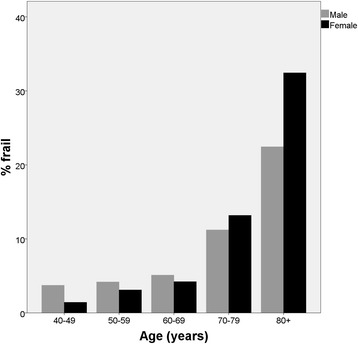
Five thousand fifty nine individuals (mean age 61.7 years, 2714 female) were included in the analyses. The nine frailty score variants yielded a range of frailty prevalences (5.4% to 13.2%). For all variants, rates were higher in women than in men, and rose steeply with age. Frailty was associated with worse subjective wellbeing, and worse self-reported health. Both prefrailty and frailty were associated with a higher risk of death during a mean 17 month follow up for all score variants (hazard ratios 1.29 to 2.41 for pre-frail vs non-frail; hazard ratios 2.65 to 8.91 for frail vs non-frail).
Phenotypic frailty could be measured in this older South African population, and was associated with worse health, wellbeing and earlier death.
衰弱是死亡和依赖的关键预测因素,但尽管撒哈拉以南非洲人口迅速老龄化,人们对该地区的衰弱情况知之甚少。我们使用来自非洲健康与老龄化纵向研究:深入社区队列的资料描述表型衰弱的流行率及其相关因素。
我们分析了南非农村地区 40 岁及以上人群的数据。我们使用低握力、慢步速、低体重指数以及自我报告的疲惫、健康下降、低体力活动和高自我报告的久坐不动等综合因素来得出 9 种表型衰弱评分的变体。将每种衰弱类别与自我报告的健康状况、主观幸福感、日常生活活动受损以及多种疾病的存在进行比较。使用 Cox 回归分析比较非衰弱(评分 0)、衰弱前期(评分 1-2)和衰弱(评分 3+)参与者随后的全因死亡率。
共纳入 5059 人(平均年龄 61.7 岁,2714 名女性)进行分析。9 种衰弱评分变体的衰弱患病率范围为 5.4%至 13.2%。对于所有变体,女性的患病率均高于男性,且随年龄增长急剧上升。衰弱与较差的主观幸福感和较差的自我报告健康状况相关。所有评分变体中,衰弱前期和衰弱均与较高的死亡风险相关(与非衰弱相比,衰弱前期的危险比为 1.29 至 2.41;衰弱的危险比为 2.65 至 8.91)。
在这个南非老年人群中可以测量表型衰弱,且与较差的健康、幸福感和更早的死亡相关。