UCL Institute of Child Health, University College London, London, UK.
University College London Hospital, London, UK.
BMC Pregnancy Childbirth. 2017 Dec 28;17(1):439. doi: 10.1186/s12884-017-1627-7.
Few data are available to guide biological sample collection around the time of birth for large-scale birth cohorts. We are designing a large UK birth cohort to investigate the role of infection and the developing immune system in determining future health and disease. We undertook a pilot to develop methodology for the main study, gain practical experience of collecting samples, and understand the acceptability of sample collection to women in late pregnancy.
Between February-July 2014, we piloted the feasibility and acceptability of collecting maternal stool, baby stool and cord blood samples from participants recruited at prolonged pregnancy and planned pre-labour caesarean section clinics at University College London Hospital. Participating women were asked to complete acceptability questionnaires.
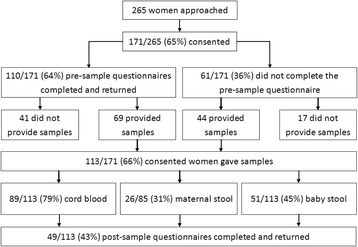
Overall, 265 women were approached and 171 (65%) participated, with ≥1 sample collected from 113 women or their baby (66%). Women had a mean age of 34 years, were primarily of white ethnicity (130/166, 78%), and half were nulliparous (86/169, 51%). Women undergoing planned pre-labour caesarean section were more likely than those who delivered vaginally to provide ≥1 sample (98% vs 54%), but less likely to provide maternal stool (10% vs 43%). Pre-sample questionnaires were completed by 110/171 women (64%). Most women reported feeling comfortable with samples being collected from their baby (<10% uncomfortable), but were less comfortable about their own stool (19% uncomfortable) or a vaginal swab (24% uncomfortable).
It is possible to collect a range of biological samples from women around the time of delivery, and this was acceptable for most women. These data inform study design and protocol development for large-scale birth cohorts.
目前可用于指导大型出生队列在分娩前后采集生物样本的资料有限。我们正在设计一个英国大型出生队列研究,以调查感染和正在发育的免疫系统在决定未来健康和疾病中的作用。我们进行了一项试点研究,以制定主要研究的方法,获得采集样本的实际经验,并了解在妊娠晚期对女性进行样本采集的可接受性。
2014 年 2 月至 7 月,我们在伦敦大学学院医院的延长妊娠和计划产前剖宫产诊所,对采集参与者的母体粪便、婴儿粪便和脐血样本的可行性和可接受性进行了试点研究。参与的女性被要求完成可接受性问卷。
共有 265 名女性被接触,其中 171 名(65%)参与了研究,113 名女性或其婴儿采集了至少 1 份样本(66%)。女性的平均年龄为 34 岁,主要为白人(130/166,78%),其中一半为初产妇(86/169,51%)。与阴道分娩的女性相比,计划行剖宫产的女性更有可能提供至少 1 份样本(98%比 54%),但提供母体粪便的可能性较小(10%比 43%)。171 名女性中有 110 名(64%)填写了采样前问卷。大多数女性表示对采集婴儿样本感到舒适(<10%感到不适),但对采集自身粪便(19%感到不适)或阴道拭子(24%感到不适)的接受度较低。
可以在分娩前后从女性身上采集一系列生物样本,大多数女性对此表示接受。这些数据为大型出生队列研究的设计和方案制定提供了信息。