Chen Jin-Bor, Lee Wen-Chin, Cheng Ben-Chung, Moi Sin-Hua, Yang Cheng-Hong, Lin Yu-Da
Division of Nephrology, Department of Internal Medicine, Kaohsiung Chang Gung Memorial Hospital and Chang Gung University College of Medicine, Kaohsiung, 83301, Taiwan.
Department of Electronic Engineering, National Kaohsiung University of Applied Sciences, Kaohsiung, 80778, Taiwan.
Eur J Med Res. 2017 Dec 28;22(1):54. doi: 10.1186/s40001-017-0298-1.
To survey by measuring patient's functional status which is crucial when end-stage renal disease patients begin a dialysis program. The influence of the disease on patients can be examined by the measurement of Karnofsky Performance Status (KPS) scores, together with a quality of life survey, and clinical variables.
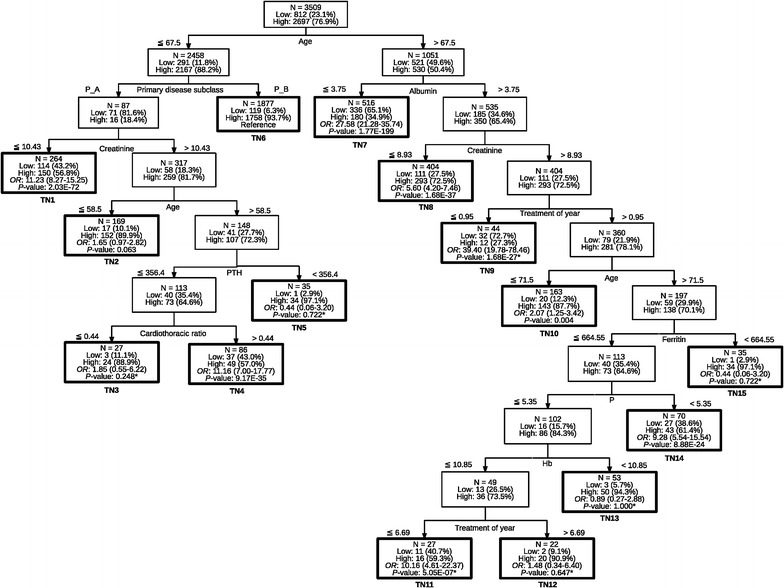
The details for the dataset in the study were collected from patients receiving regular hemodialysis (HD) in one hospital, which were available retrospectively for 1166 patients during the 5-year study period. KPS scores were applied for quantifying functional status. To identify risk factors for functional status, clinical factors including demographics, laboratory data, and HD vintage were selected. This study applied a classification and regression tree approach (CART) and logistic regression to determine risk factors on functional impairment among HD patients.
Ten risk factors were identified by CART and regression model (age, primary kidney disease subclass, treatment years, hemoglobin, albumin, creatinine, phosphorus, intact parathyroid hormone, ferritin, and cardiothoracic ratio). The results of logistic regression with selected interaction models showed older age or higher hematocrit, blood urea nitrogen, and glucose levels could significantly increase the log-odds of obtaining low KPS scores at in-person visits.
In interaction results, the combination of older age with higher albumin level and higher creatinine level with longer HD treatment years could significantly decrease the log-odds of a low KPS score assessment during in-person visits. Age, hemoglobin, albumin, urea, creatinine levels, primary kidney disease subclass, and HD duration are the major determinants for functional status in HD patients.
通过测量患者的功能状态进行调查,这在终末期肾病患者开始透析治疗时至关重要。可以通过测量卡诺夫斯基功能状态(KPS)评分、进行生活质量调查以及结合临床变量来研究疾病对患者的影响。
该研究的数据细节收集自一家医院接受定期血液透析(HD)的患者,在5年研究期间可追溯到1166例患者。应用KPS评分来量化功能状态。为了确定功能状态的危险因素,选择了包括人口统计学、实验室数据和透析龄等临床因素。本研究采用分类回归树方法(CART)和逻辑回归来确定HD患者功能损害的危险因素。
通过CART和回归模型确定了10个危险因素(年龄、原发性肾病亚类、治疗年限、血红蛋白、白蛋白、肌酐、磷、全段甲状旁腺激素、铁蛋白和心胸比)。所选交互模型的逻辑回归结果显示,年龄较大或血细胞比容、血尿素氮和血糖水平较高,在门诊就诊时获得低KPS评分的对数几率会显著增加。
在交互结果中,年龄较大与白蛋白水平较高以及肌酐水平较高与HD治疗年限较长的组合,在门诊就诊时可显著降低低KPS评分评估的对数几率。年龄、血红蛋白、白蛋白、尿素、肌酐水平、原发性肾病亚类和HD持续时间是HD患者功能状态的主要决定因素。