Xie XueCheng, Zeng XiaoChun, Cao SuJuan, Hu XiaoMao, Shi QiaoJing, Li Dan, Zhou ShiYuan, Gu Ping, Zhang ZhongShan
Department of Oncology, The Affiliated Hospital of XiangNan University, Chenzhou, China.
Department of Nuclear Medicine, The Affiliated Hospital of XiangNan University, Chenzhou, China.
Oncotarget. 2017 Nov 20;8(62):106089-106097. doi: 10.18632/oncotarget.22528. eCollection 2017 Dec 1.
Previous studies have demonstrated that platelets play a multifaceted role in cancer progression and metastasis. However, the value of platelet indices for predicting survival in nasopharyngeal carcinoma (NPC) patients remains unknown. The aim of this study was to evaluate the predictive significance of platelet indices in NPC cases.
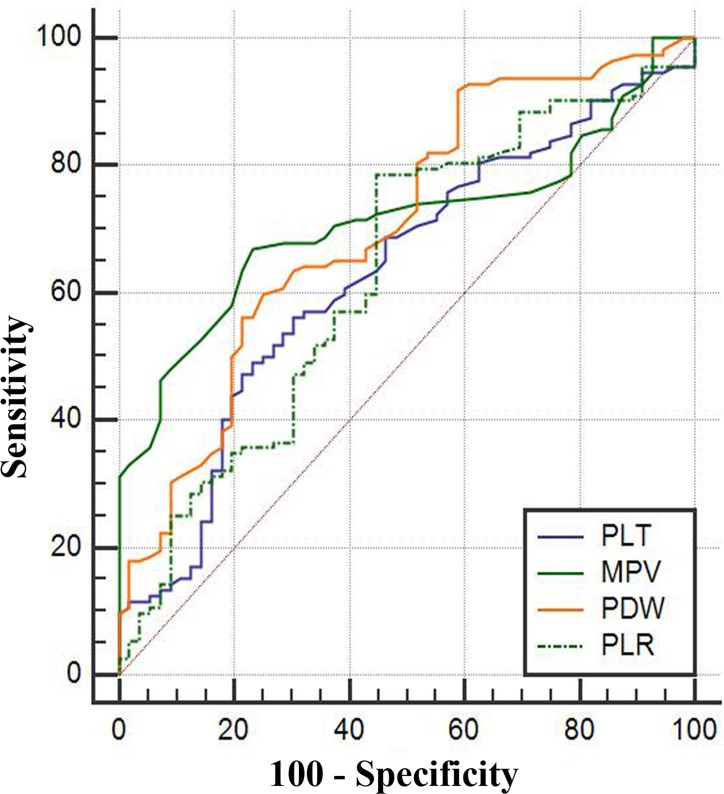
A total of 168 patients who were diagnosed with NPC between January 2011 and June 2012 were recruited. The optimal cut-off values for the platelet indices were determined using a receiver operating characteristic curve. The Kaplan-Meier method and Cox regression were used to evaluate the prognostic impact of the potential predictors.
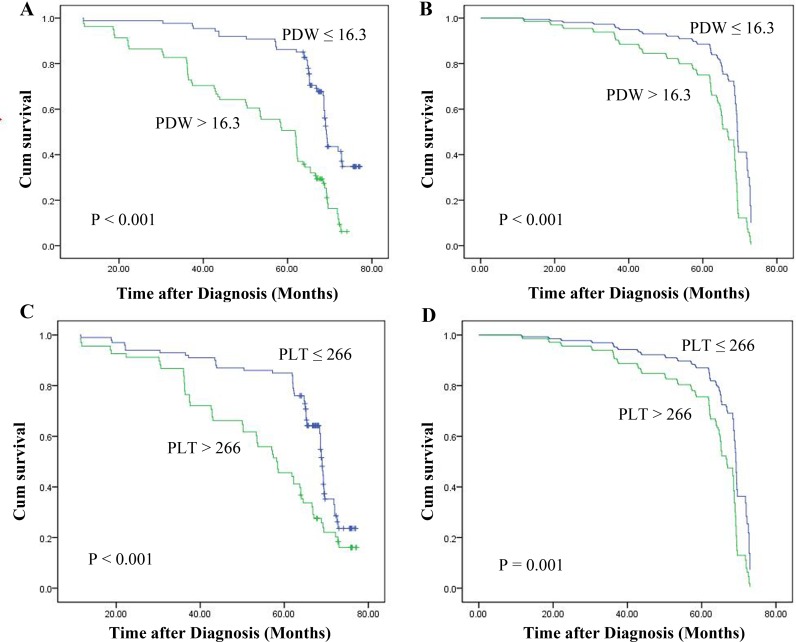
Of the 168 patients, high platelet distribution width (PDW) and platelet count (PLT) levels were observed in 81 (48.21%) and 68 (40.48%) of the patients, respectively. An increased PDW was associated with the depth of invasion (T stage, P = 0.019), lymph node metastasis (N stage, P = 0.026), and clinical stage (P < 0.001). Moreover, the survival analysis showed that the overall survival of the patients with a PDW > 16.3 fL or platelet count > 266 × 10/L was associated with a poorer prognosis (both P < 0.001). In the multivariate Cox regression model, the PDW (P < 0.001), PLT (P = 0.001), T stage (P < 0.001), N stage (P = 0.006), clinical stage (P = 0.005), and Epstein-Barr virus DNA (P = 0.039) were independent prognostic factors for the overall survival.
The PDW and PLT are easily available via a routine blood test, and our study showed that the PDW and PLT could be prognostic predictors in NPC patients. However, further studies are required to confirm this conclusion.
既往研究表明血小板在癌症进展和转移中发挥多方面作用。然而,血小板指标对鼻咽癌(NPC)患者生存的预测价值尚不清楚。本研究旨在评估血小板指标在NPC病例中的预测意义。
招募了2011年1月至2012年6月期间诊断为NPC的168例患者。使用受试者工作特征曲线确定血小板指标的最佳截断值。采用Kaplan-Meier法和Cox回归评估潜在预测因素的预后影响。
168例患者中,分别有81例(48.21%)和68例(40.48%)观察到高血小板分布宽度(PDW)和血小板计数(PLT)水平。PDW升高与侵袭深度(T分期,P = 0.019)、淋巴结转移(N分期,P = 0.026)和临床分期(P < 0.001)相关。此外,生存分析显示,PDW > 16.3 fL或血小板计数> 266×10⁹/L的患者总生存期预后较差(均P < 0.001)。在多变量Cox回归模型中,PDW(P < 0.001)、PLT(P = 0.001)、T分期(P < 0.001)、N分期(P = 0.006)、临床分期(P = 0.005)和爱泼斯坦-巴尔病毒DNA(P = 0.039)是总生存期的独立预后因素。
PDW和PLT可通过常规血液检查轻松获得,我们的研究表明PDW和PLT可能是NPC患者的预后预测指标。然而,需要进一步研究来证实这一结论。