Department of VIP and Geriatrics, Xi'an Gaoxin Hospital, Gaoxin Industrial Development Distinct, Xi'an, Shanxi 710075, P.R. China.
Department of Respiratory Medicine, Baoji Central Hospital, Baoji, Shanxi 721008, P.R. China.
Int J Mol Med. 2018 Mar;41(3):1377-1384. doi: 10.3892/ijmm.2017.3332. Epub 2017 Dec 19.
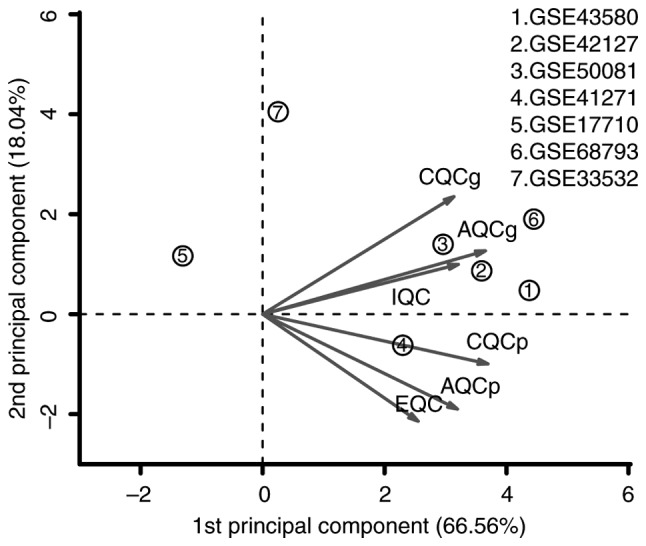
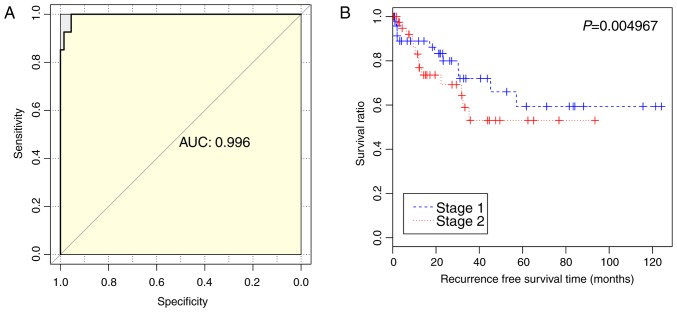
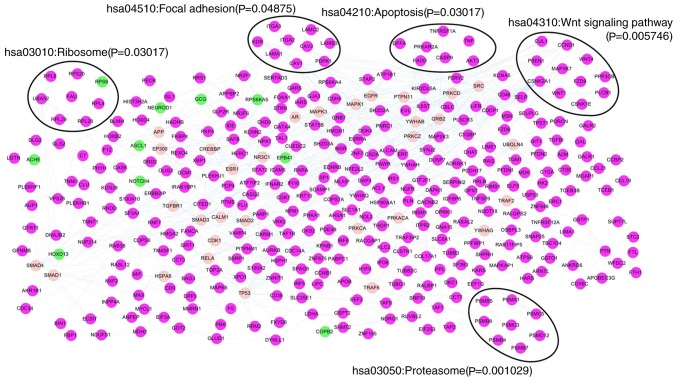
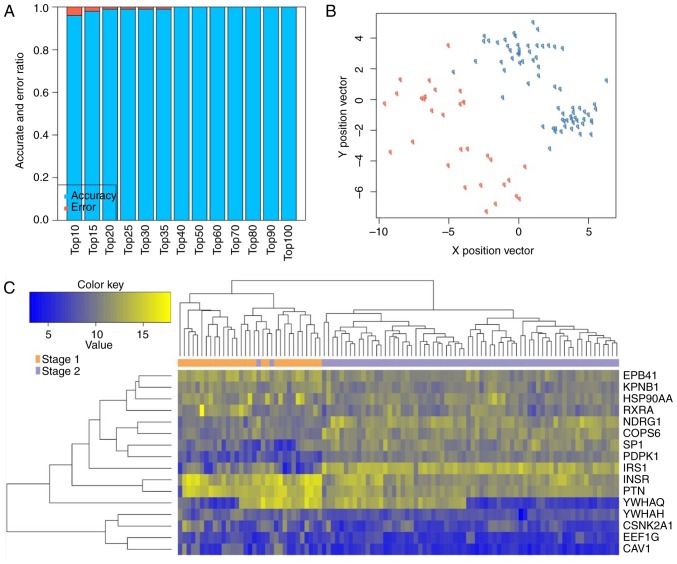
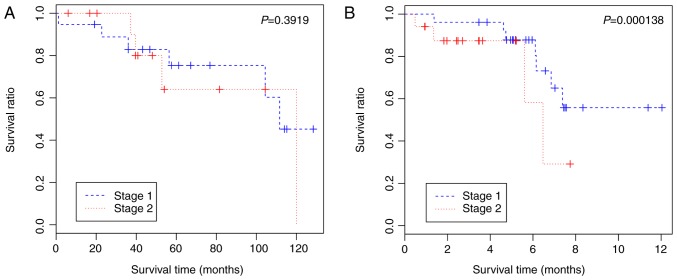
The present study aimed to perform screening of a gene signature for the discrimination and prognostic prediction of stage I and II lung squamous carcinoma. A microarray meta‑analysis was performed to identify differentially expressed genes (DEGs) between stage I and II lung squamous carcinoma samples in seven microarray datasets collected from the Gene Expression Omnibus database via the MetaQC and MetaDE package in R. The important DEGs were selected according to the betweenness centrality value of the protein‑protein interaction (PPI) network. Support vector machine (SVM) analysis was performed to screen the feature genes for discrimination and prognosis. One independent dataset downloaded from The Cancer Genome Atlas was used to validate the reliability. Pathway enrichment analysis was also performed for the feature genes. A total of 924 DEGs were identified to construct a PPI network consisting of 392 nodes and 686 edges. The top 100 of the 392 nodes were selected as crucial genes to construct an SVM classifier, and a 16‑gene signature (caveolin 1, eukaryotic translation elongation factor 1γ, casein kinase 2α1, tyrosine 3-monooxygenase/tryptophan 5-monooxygenase activation η, tyrosine 3‑monooxygenase/tryptophan 5‑monooxygenase activation θ, pleiotrophin, insulin receptor, insulin receptor substrate 1, 3‑phosphoinositide‑dependent protein kinase‑1, specificity protein 1, COP9 signalosome subunit 6, N‑myc downstream regulated gene 1, retinoid X receptor α, heat shock protein 90α A1, karyopherin subunit β1 and erythrocyte membrane protein band 4.1) with high discrimination accuracy was identified. This 16‑gene signature had significant prognostic value, and patients with stage II lung squamous carcinoma exhibited shorter survival rates, compared with those with stage I disease. Seven DEGs of the 16-gene signature were significantly involved in the phosphoinositide 3‑kinase‑Akt signaling pathway. The 16‑gene signature identified in the present study may be useful for stratifying the patients with stage I or II lung squamous carcinoma and predicting prognosis.
本研究旨在筛选用于区分和预测 I 期和 II 期肺鳞癌的基因特征。通过 MetaQC 和 MetaDE 包在 R 中对来自基因表达综合数据库的七个微阵列数据集进行荟萃分析,以鉴定 I 期和 II 期肺鳞癌样本之间的差异表达基因(DEG)。根据蛋白质-蛋白质相互作用(PPI)网络的介数中心度值选择重要的 DEG。通过支持向量机(SVM)分析筛选用于区分和预后的特征基因。从癌症基因组图谱下载一个独立数据集用于验证可靠性。还对特征基因进行了途径富集分析。鉴定出 924 个 DEG 来构建一个包含 392 个节点和 686 个边的 PPI 网络。选择前 100 个节点作为关键基因构建 SVM 分类器,得到一个 16 基因特征(窖蛋白 1、真核翻译延伸因子 1γ、酪蛋白激酶 2α1、酪氨酸 3-单加氧酶/色氨酸 5-单加氧酶激活 η、酪氨酸 3-单加氧酶/色氨酸 5-单加氧酶激活θ、多效蛋白、胰岛素受体、胰岛素受体底物 1、3-磷酸肌醇依赖性蛋白激酶 1、特异性蛋白 1、COP9 信号osome 亚基 6、N-肌球蛋白下游调节基因 1、视黄醇 X 受体α、热休克蛋白 90α A1、核孔蛋白亚基β1 和红细胞膜蛋白带 4.1),具有较高的鉴别准确率。该 16 基因特征具有显著的预后价值,与 I 期疾病相比,II 期肺鳞癌患者的生存率更短。16 基因特征中的 7 个 DEG 显著参与了磷酸肌醇 3-激酶-Akt 信号通路。本研究中鉴定的 16 基因特征可能有助于对 I 期或 II 期肺鳞癌患者进行分层,并预测预后。