U.S. Environmental Protection Agency, Office of Research and Development, National Exposure Research Laboratory, 109 T.W. Alexander Drive, Research Triangle Park, NC, 27709, USA.
U.S. Environmental Protection Agency, Office of Research and Development, National Center for Computational Toxicology, 109 T.W. Alexander Drive, Research Triangle Park, NC, 27709, USA.
J Expo Sci Environ Epidemiol. 2018 Sep;28(5):411-426. doi: 10.1038/s41370-017-0012-y. Epub 2017 Dec 29.
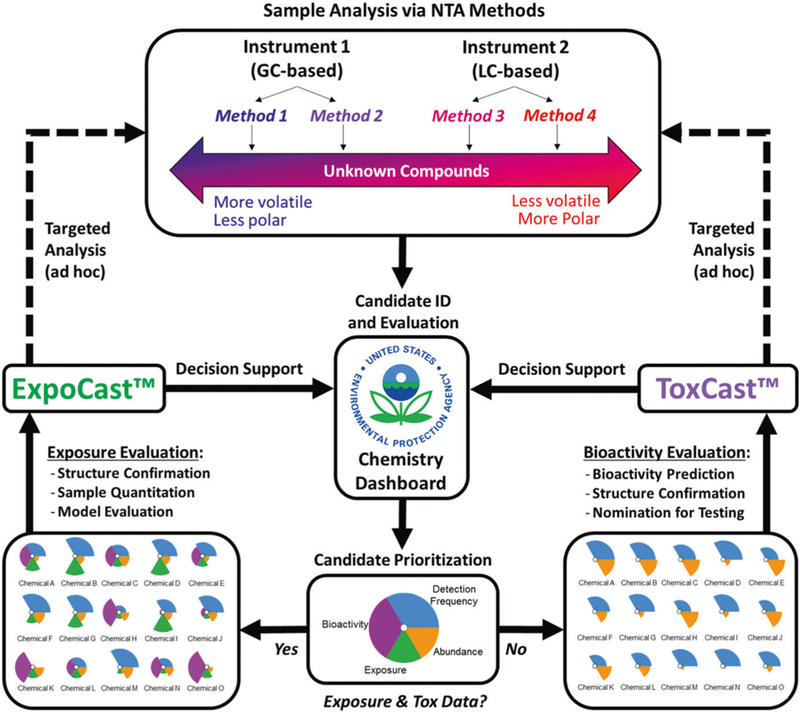
Tens-of-thousands of chemicals are registered in the U.S. for use in countless processes and products. Recent evidence suggests that many of these chemicals are measureable in environmental and/or biological systems, indicating the potential for widespread exposures. Traditional public health research tools, including in vivo studies and targeted analytical chemistry methods, have been unable to meet the needs of screening programs designed to evaluate chemical safety. As such, new tools have been developed to enable rapid assessment of potentially harmful chemical exposures and their attendant biological responses. One group of tools, known as "non-targeted analysis" (NTA) methods, allows the rapid characterization of thousands of never-before-studied compounds in a wide variety of environmental, residential, and biological media. This article discusses current applications of NTA methods, challenges to their effective use in chemical screening studies, and ways in which shared resources (e.g., chemical standards, databases, model predictions, and media measurements) can advance their use in risk-based chemical prioritization. A brief review is provided of resources and projects within EPA's Office of Research and Development (ORD) that provide benefit to, and receive benefits from, NTA research endeavors. A summary of EPA's Non-Targeted Analysis Collaborative Trial (ENTACT) is also given, which makes direct use of ORD resources to benefit the global NTA research community. Finally, a research framework is described that shows how NTA methods will bridge chemical prioritization efforts within ORD. This framework exists as a guide for institutions seeking to understand the complexity of chemical exposures, and the impact of these exposures on living systems.
在美国,有成千上万种化学物质被注册用于无数的工艺和产品中。最近的证据表明,这些化学物质中有许多在环境和/或生物系统中是可测量的,这表明存在广泛暴露的可能性。传统的公共卫生研究工具,包括体内研究和靶向分析化学方法,已经无法满足旨在评估化学安全性的筛选计划的需求。因此,已经开发了新的工具来快速评估潜在有害化学物质暴露及其伴随的生物反应。一类工具被称为“非靶向分析”(NTA)方法,它允许在各种环境、住宅和生物介质中快速表征数千种以前从未研究过的化合物。本文讨论了 NTA 方法的当前应用,以及在化学筛选研究中有效使用这些方法所面临的挑战,以及共享资源(例如化学标准、数据库、模型预测和介质测量)如何促进它们在基于风险的化学优先排序中的应用。简要回顾了 EPA 研究与开发办公室(ORD)内的资源和项目,这些资源和项目为 NTA 研究工作提供了益处,并从中受益。还介绍了 EPA 的非靶向分析协作试验(ENTACT),该试验直接利用 ORD 资源使全球 NTA 研究界受益。最后,描述了一个研究框架,展示了 NTA 方法将如何在 ORD 内弥合化学优先排序工作。该框架旨在为寻求了解化学暴露的复杂性及其对生命系统的影响的机构提供指导。