Teixeira Farinha Hugo, Grass Fabian, Labgaa Ismaïl, Pache Basile, Demartines Nicolas, Hübner Martin
Department of Visceral Surgery, University Hospital of Lausanne (CHUV), Switzerland.
J Cancer. 2018 Jan 1;9(1):13-20. doi: 10.7150/jca.21460. eCollection 2018.
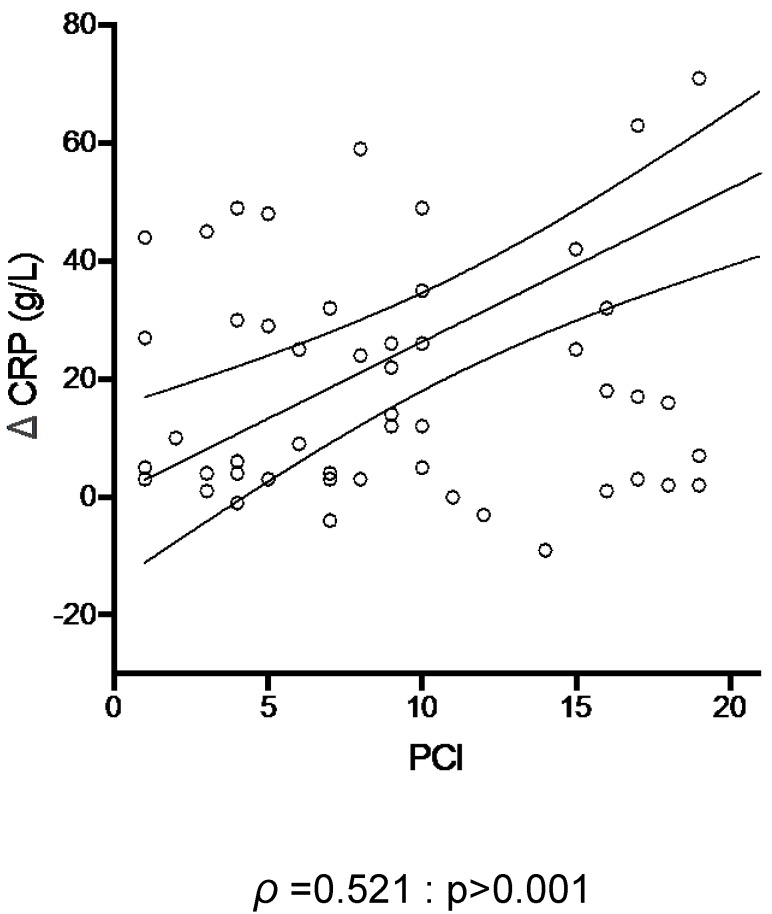
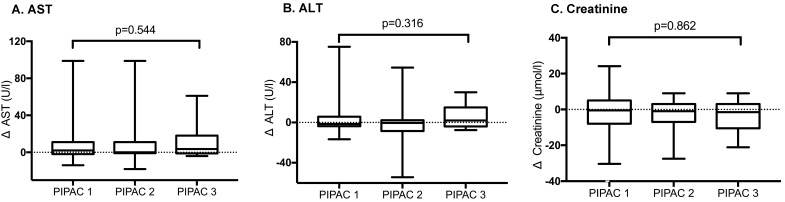
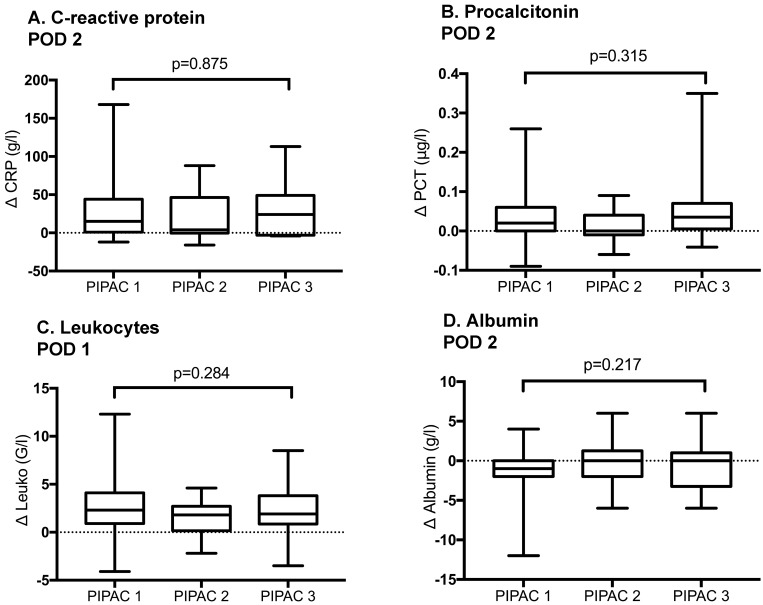
Pressurized Intraperitoneal Aerosol Chemotherapy (PIPAC) is a novel mode of intraperitoneal (IP) drug delivery claiming high IP tissue concentrations with low systemic uptake. The aim was to study inflammatory response and systemic toxicity after PIPAC. Retrospective monocentric analysis of a consecutive cohort of PIPAC patients between January 2015 and April 2016. Detailed hematological and biochemical analysis was performed the day before surgery and once daily until discharge. Comparative statistics were performed using Mann-Whitney U test and Wilcoxon signed ranked test. Fourty-two consecutive patients underwent a total of 91 PIPAC procedures. Twenty patients received oxaliplatin and 22 cisplatin+doxorubicin (37 54 procedures). Creatinine, AST and ALT were not significantly altered after PIPAC (p=0.095, p= p=0.153 and p=0.351) and not different between oxaliplatin and cisplatin+doxorubicin regimens (p=0.371, p=0.251 and p=0.288). C-reactive protein (CRP) and procalcitonin (PCT) increased on post-operative day (POD) 2: ∆max 29±5 mg/L (p<0.001) and ∆max 0.05±0.01 μg/L (p=0.005), respectively. Leucocytes increased at POD 1: ∆max 2.2±0.3 G/L (p<0.001). Albumin decreased at POD 2: ∆max -6.0±0.5 g/L (p<0.001). CRP increase correlated positively with Peritoneal Cancer Index (tumor load) (ρ =0.521, p<0.001). PIPAC was followed by a modest and transitory inflammatory response that was commensurate to the disease extent. No hematological, renal or hepatic toxicity was observed even after repetitive administration.
腹腔加压气溶胶化疗(PIPAC)是一种新型的腹腔内给药方式,其特点是腹腔组织药物浓度高且全身摄取量低。本研究旨在探讨PIPAC后的炎症反应和全身毒性。对2015年1月至2016年4月期间连续接受PIPAC治疗的患者进行回顾性单中心分析。在手术前一天及术后每天直至出院进行详细的血液学和生化分析。采用Mann-Whitney U检验和Wilcoxon符号秩检验进行比较统计。42例连续患者共接受了91次PIPAC治疗。20例患者接受奥沙利铂治疗,22例患者接受顺铂+阿霉素治疗(分别为37次和54次治疗)。PIPAC后肌酐、谷草转氨酶和谷丙转氨酶无明显变化(p=0.095、p=0.153和p=0.351),奥沙利铂与顺铂+阿霉素治疗方案之间也无差异(p=0.371、p=0.251和p=0.288)。术后第2天C反应蛋白(CRP)和降钙素原(PCT)升高:最大变化分别为29±5mg/L(p<0.001)和0.05±0.01μg/L(p=0.005)。术后第1天白细胞升高:最大变化为2.2±0.3G/L(p<0.001)。术后第2天白蛋白降低:最大变化为-6.0±0.5g/L(p<0.001)。CRP升高与腹膜癌指数(肿瘤负荷)呈正相关(ρ=0.521,p<0.001)。PIPAC后出现适度且短暂的炎症反应,与疾病程度相符。即使重复给药,也未观察到血液学、肾脏或肝脏毒性。