Su Zhendong, Kishida Satoshi, Tsubota Shoma, Sakamoto Kazuma, Cao Dongliang, Kiyonari Shinichi, Ohira Miki, Kamijo Takehiko, Narita Atsushi, Xu Yinyan, Takahashi Yoshiyuki, Kadomatsu Kenji
Department of Biochemistry, Nagoya University Graduate School of Medicine, Nagoya, Aichi, Japan.
Research Institute for Clinical Oncology, Saitama Cancer Center, Saitama, Saitama, Japan.
Oncotarget. 2017 Nov 15;8(63):106296-106310. doi: 10.18632/oncotarget.22435. eCollection 2017 Dec 5.
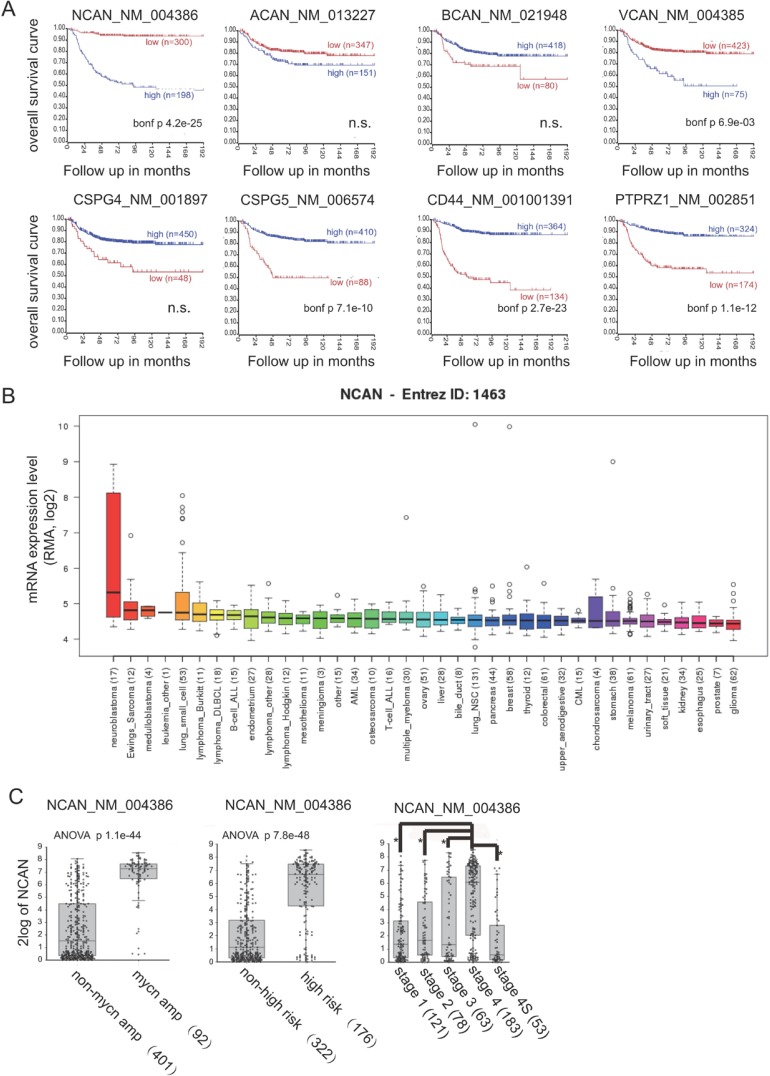
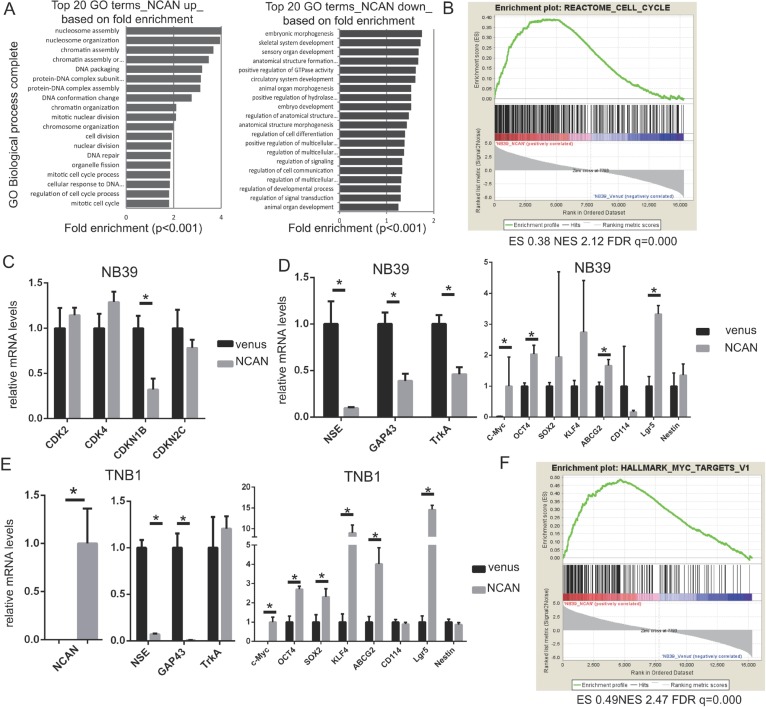
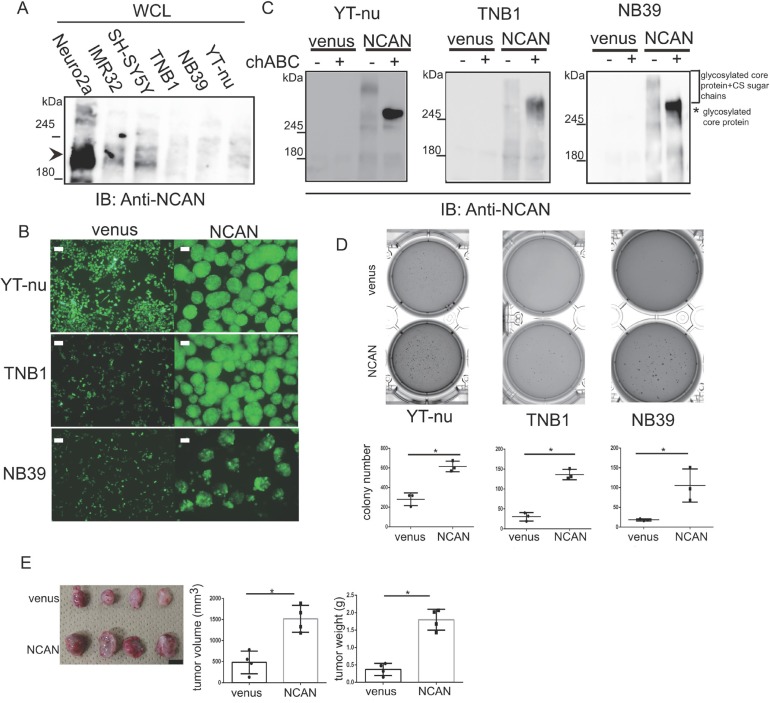
Neurocan (NCAN), a secreted chondroitin sulfate proteoglycan, is one of the major inhibitory molecules for axon regeneration in nervous injury. However, its role in cancer is not clear. Here we observed that high NCAN expression was closely associated with the unfavorable outcome of neuroblastoma (NB). NCAN was also highly and ubiquitously expressed in the early lesions and terminal tumor of TH- mice, a NB model. Interestingly, exogenous NCAN (i.e., overexpression, recombinant protein and conditioned medium) transformed adherent NB cells into spheres whose malignancies (anchorage-independent growth and chemoresistance) and (xenograft tumor growth) were potentiated. Both chondroitin sulfate sugar chains and NCAN's core protein were essential for the sphere formation. The CSG3 domain was essential in the moiety of NCAN. Our comprehensive microarray analysis and RT-qPCR of mRNA expression suggested that NCAN treatment promoted cell division, and urged cells to undifferentiated state. The knockdown of NCAN in tumor sphere cells cultured from TH- mice resulted in growth suppression and . Our findings suggest that NCAN, which stimulates NB cells to promote malignant phenotypes, is an extracellular molecule providing a growth advantage to cancer cells.
神经黏蛋白(NCAN)是一种分泌型硫酸软骨素蛋白聚糖,是神经损伤中轴突再生的主要抑制分子之一。然而,其在癌症中的作用尚不清楚。在此我们观察到,高NCAN表达与神经母细胞瘤(NB)的不良预后密切相关。在NB模型TH-小鼠的早期病变和终末期肿瘤中,NCAN也高度且广泛表达。有趣的是,外源性NCAN(即过表达、重组蛋白和条件培养基)将贴壁的NB细胞转化为球体,其恶性特征(不依赖贴壁生长和化疗耐药性)以及(异种移植瘤生长)增强。硫酸软骨素糖链和NCAN的核心蛋白对于球体形成均必不可少。CSG3结构域在NCAN部分中至关重要。我们全面的微阵列分析和mRNA表达的RT-qPCR表明,NCAN处理促进细胞分裂,并促使细胞进入未分化状态。在从TH-小鼠培养的肿瘤球体细胞中敲低NCAN导致生长抑制以及。我们的研究结果表明,刺激NB细胞促进恶性表型的NCAN是一种为癌细胞提供生长优势的细胞外分子。