
交通网络的弹性与效率。
Resilience and efficiency in transportation networks.
作者信息
Ganin Alexander A, Kitsak Maksim, Marchese Dayton, Keisler Jeffrey M, Seager Thomas, Linkov Igor
机构信息
Department of Systems and Information Engineering, University of Virginia, 151 Engineer's Way, P.O. Box 400747, Charlottesville, VA 22904, USA.
Engineer Research and Development Center, U.S. Army Corps of Engineers, 696 Virginia Road, Concord, MA 01742, USA.
出版信息
Sci Adv. 2017 Dec 20;3(12):e1701079. doi: 10.1126/sciadv.1701079. eCollection 2017 Dec.
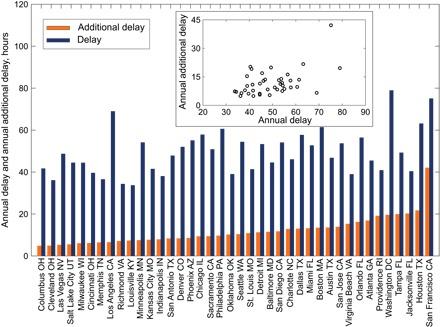
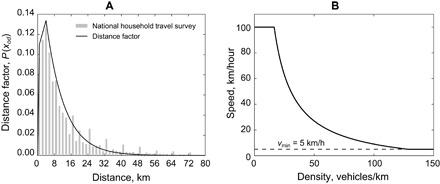
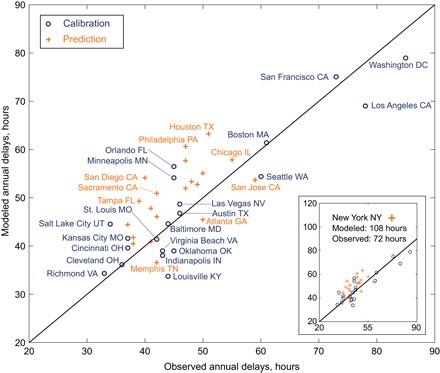
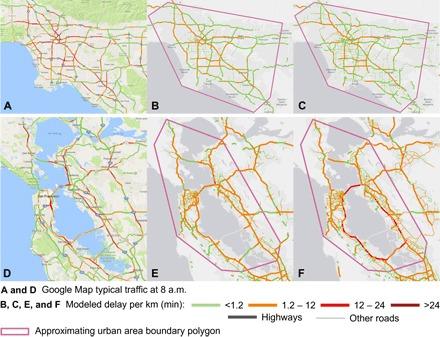
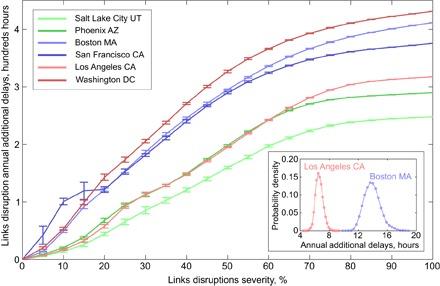
Urban transportation systems are vulnerable to congestion, accidents, weather, special events, and other costly delays. Whereas typical policy responses prioritize reduction of delays under normal conditions to improve the efficiency of urban road systems, analytic support for investments that improve resilience (defined as system recovery from additional disruptions) is still scarce. In this effort, we represent paved roads as a transportation network by mapping intersections to nodes and road segments between the intersections to links. We built road networks for 40 of the urban areas defined by the U.S. Census Bureau. We developed and calibrated a model to evaluate traffic delays using link loads. The loads may be regarded as traffic-based centrality measures, estimating the number of individuals using corresponding road segments. Efficiency was estimated as the average annual delay per peak-period auto commuter, and modeled results were found to be close to observed data, with the notable exception of New York City. Resilience was estimated as the change in efficiency resulting from roadway disruptions and was found to vary between cities, with increased delays due to a 5% random loss of road linkages ranging from 9.5% in Los Angeles to 56.0% in San Francisco. The results demonstrate that many urban road systems that operate inefficiently under normal conditions are nevertheless resilient to disruption, whereas some more efficient cities are more fragile. The implication is that resilience, not just efficiency, should be considered explicitly in roadway project selection and justify investment opportunities related to disaster and other disruptions.
城市交通系统容易受到拥堵、事故、天气、特殊活动及其他造成高昂延误的因素影响。尽管典型的政策应对措施将正常情况下减少延误作为优先事项,以提高城市道路系统的效率,但对于提高恢复力(定义为系统从额外干扰中恢复的能力)的投资,分析支持仍然匮乏。在这项工作中,我们通过将十字路口映射为节点,并将十字路口之间的路段映射为链路,将铺面道路表示为一个交通网络。我们为美国人口普查局定义的40个城市地区构建了道路网络。我们开发并校准了一个模型,以使用链路负荷来评估交通延误。这些负荷可被视为基于交通的中心性度量,用于估计使用相应路段的人数。效率被估计为每个高峰时段汽车通勤者的年均延误,并且发现模型结果与观测数据接近,但纽约市是个显著例外。恢复力被估计为道路中断导致的效率变化,并且发现其在不同城市之间存在差异,道路连接随机损失5%导致的延误增加幅度从洛杉矶的9.5%到旧金山的56.0%不等。结果表明,许多在正常情况下运行效率低下的城市道路系统对干扰却具有恢复力,而一些效率更高的城市反而更脆弱。这意味着在道路项目选择中,不仅应明确考虑效率,还应考虑恢复力,并为与灾害及其他干扰相关的投资机会提供依据。

 Zotero 插件