Parra Carolina, Montero-Silva Francisco, Gentil Dana, Del Campo Valeria, Henrique Rodrigues da Cunha Thiago, Henríquez Ricardo, Häberle Patricio, Garín Carolina, Ramírez Cristian, Fuentes Raúl, Flores Marcos, Seeger Michael
Laboratorio de Nanobiomateriales, Departamento de Física, Universidad Técnica Federico Santa María, Valparaíso 2390123, Chile.
Departamento de Física, Universidad Técnica Federico Santa María, Valparaíso 2390123, Chile.
Materials (Basel). 2017 Dec 8;10(12):1406. doi: 10.3390/ma10121406.
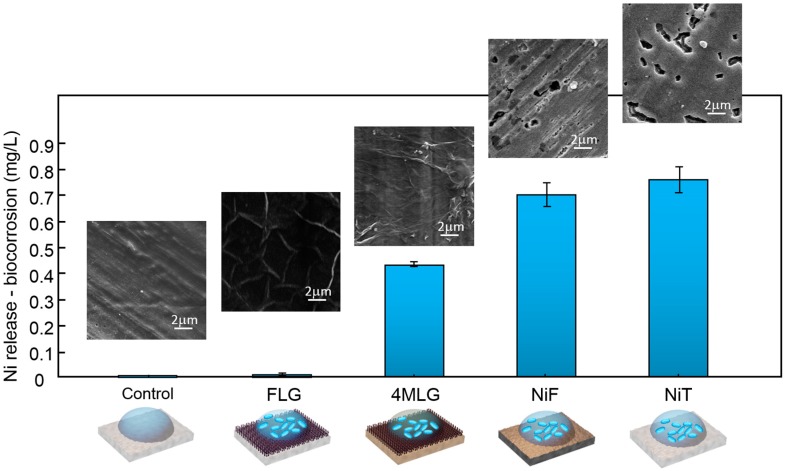
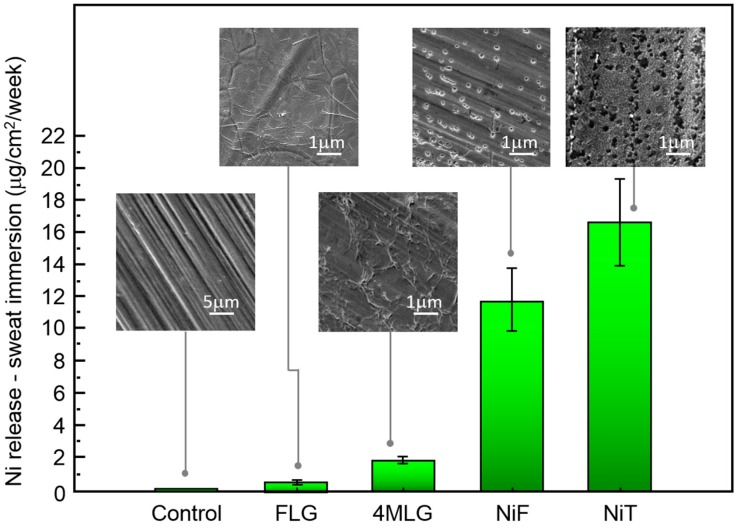
In this work we present a study on the performance of CVD (chemical vapor deposition) graphene coatings grown and transferred on Ni as protection barriers under two scenarios that lead to unwanted metal ion release, microbial corrosion and allergy test conditions. These phenomena have a strong impact in different fields considering nickel (or its alloys) is one of the most widely used metals in industrial and consumer products. Microbial corrosion costs represent fractions of national gross product in different developed countries, whereas Ni allergy is one of the most prevalent allergic conditions in the western world, affecting around 10% of the population. We found that grown graphene coatings act as a protective membrane in biological environments that decreases microbial corrosion of Ni and reduces release of Ni ions (source of Ni allergic contact hypersensitivity) when in contact with sweat. This performance seems not to be connected to the strong orbital hybridization that Ni and graphene interface present, indicating electron transfer might not be playing a main role in the robust response of this nanostructured system. The observed protection from biological environment can be understood in terms of graphene impermeability to transfer Ni ions, which is enhanced for few layers of graphene grown on Ni. We expect our work will provide a new route for application of graphene as a protection coating for metals in biological environments, where current strategies have shown short-term efficiency and have raised health concerns.
在这项工作中,我们展示了一项关于化学气相沉积(CVD)生长并转移到镍上的石墨烯涂层性能的研究,该涂层在导致有害金属离子释放的两种情况下作为保护屏障,即微生物腐蚀和过敏测试条件。考虑到镍(或其合金)是工业和消费产品中使用最广泛的金属之一,这些现象在不同领域产生了重大影响。在不同的发达国家,微生物腐蚀造成的损失占国民生产总值的一定比例,而镍过敏是西方世界最普遍的过敏病症之一,影响着约10%的人口。我们发现,生长的石墨烯涂层在生物环境中起到保护膜的作用,可减少镍的微生物腐蚀,并在与汗液接触时减少镍离子(镍过敏性接触超敏反应的来源)的释放。这种性能似乎与镍和石墨烯界面存在的强烈轨道杂化无关,这表明电子转移可能在这个纳米结构系统的强大响应中并不起主要作用。从石墨烯对镍离子转移的不渗透性方面可以理解所观察到的对生物环境的保护作用,对于在镍上生长的几层石墨烯,这种不渗透性会增强。我们期望我们的工作将为石墨烯在生物环境中作为金属保护涂层的应用提供一条新途径,在这种环境中,目前的策略已显示出短期效率并引发了健康问题。