Zurob Elsie, Dennett Geraldine, Gentil Dana, Montero-Silva Francisco, Gerber Ulrike, Naulín Pamela, Gómez Andrea, Fuentes Raúl, Lascano Sheila, Rodrigues da Cunha Thiago Henrique, Ramírez Cristian, Henríquez Ricardo, Del Campo Valeria, Barrera Nelson, Wilkens Marcela, Parra Carolina
Laboratorio Nanobiomateriales, Departamento de Física, Universidad Técnica Federico Santa María, Avenida España 1680, Valparaíso, Chile.
Laboratorio de Microbiología Básica y Aplicada, Universidad de Santiago de Chile, Avenida Libertador Bernardo O'Higgins 3363, Santiago, Chile.
Nanomaterials (Basel). 2019 Jan 2;9(1):49. doi: 10.3390/nano9010049.
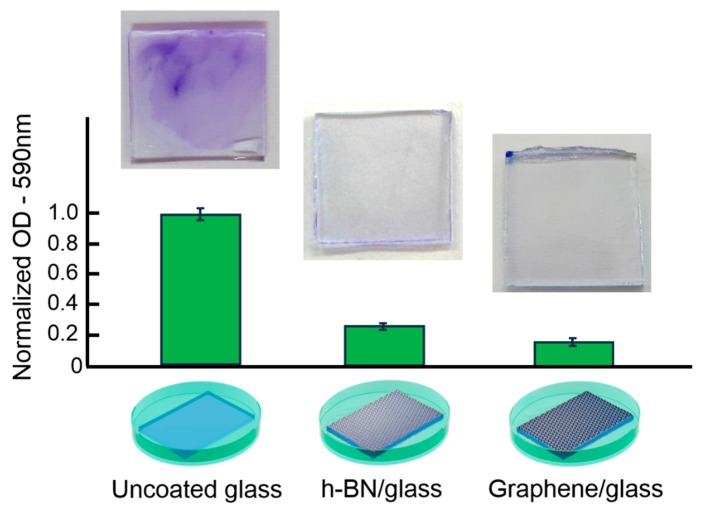
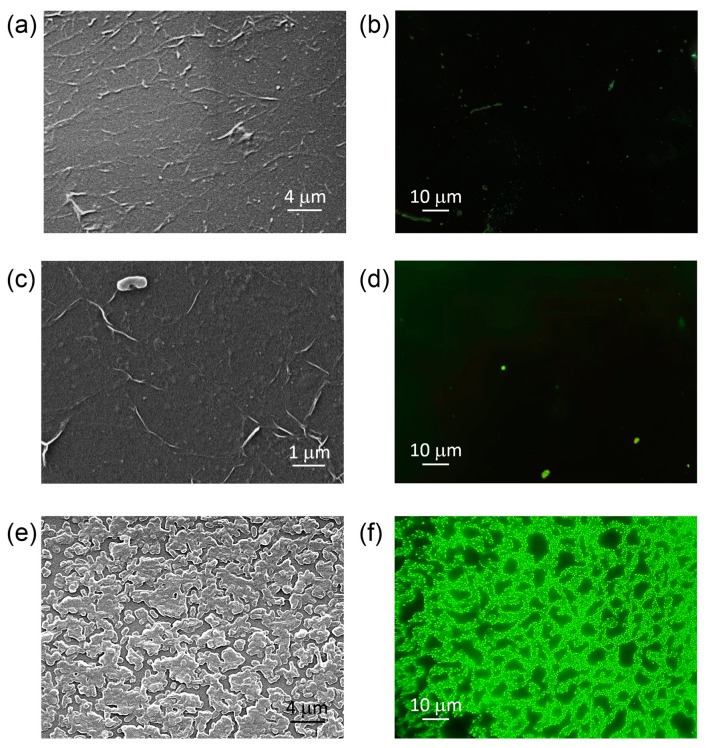
Although biofilm formation is a very effective mechanism to sustain bacterial life, it is detrimental in medical and industrial sectors. Current strategies to control biofilm proliferation are typically based on biocides, which exhibit a negative environmental impact. In the search for environmentally friendly solutions, nanotechnology opens the possibility to control the interaction between biological systems and colonized surfaces by introducing nanostructured coatings that have the potential to affect bacterial adhesion by modifying surface properties at the same scale. In this work, we present a study on the performance of graphene and hexagonal boron nitride coatings (h-BN) to reduce biofilm formation. In contraposition to planktonic state, we focused on evaluating the efficiency of graphene and h-BN at the irreversible stage of biofilm formation, where most of the biocide solutions have a poor performance. A wild strain was isolated, from fouling found in a natural environment, and used in these experiments. According to our results, graphene and h-BN coatings modify surface energy and electrostatic interactions with biological systems. This nanoscale modification determines a significant reduction in biofilm formation at its irreversible stage. No bactericidal effects were found, suggesting both coatings offer a biocompatible solution for biofilm and fouling control in a wide range of applications.
尽管生物膜形成是维持细菌生命的一种非常有效的机制,但在医疗和工业领域却是有害的。当前控制生物膜增殖的策略通常基于杀菌剂,而杀菌剂会对环境产生负面影响。在寻找环境友好型解决方案的过程中,纳米技术通过引入纳米结构涂层,为控制生物系统与被殖民表面之间的相互作用开辟了可能性,这些涂层有可能通过在相同尺度上改变表面性质来影响细菌粘附。在这项工作中,我们展示了一项关于石墨烯和六方氮化硼涂层(h-BN)减少生物膜形成性能的研究。与浮游状态相反,我们专注于评估石墨烯和h-BN在生物膜形成不可逆阶段的效率,在这个阶段大多数杀菌剂溶液的性能较差。从自然环境中发现的污垢中分离出一种野生菌株,并用于这些实验。根据我们的结果,石墨烯和h-BN涂层改变了与生物系统的表面能和静电相互作用。这种纳米尺度的改变决定了在生物膜形成的不可逆阶段生物膜形成的显著减少。未发现杀菌作用,这表明这两种涂层为广泛应用中的生物膜和污垢控制提供了一种生物相容性解决方案。