Silva Saura R, Michael Todd P, Meer Elliott J, Pinheiro Daniel G, Varani Alessandro M, Miranda Vitor F O
Universidade Estadual Paulista (Unesp), Botucatu, Instituto de Biociências, São Paulo, Brazil.
J. Craig Venter Institute, La Jolla, CA, United States of America.
PLoS One. 2018 Jan 2;13(1):e0190321. doi: 10.1371/journal.pone.0190321. eCollection 2018.
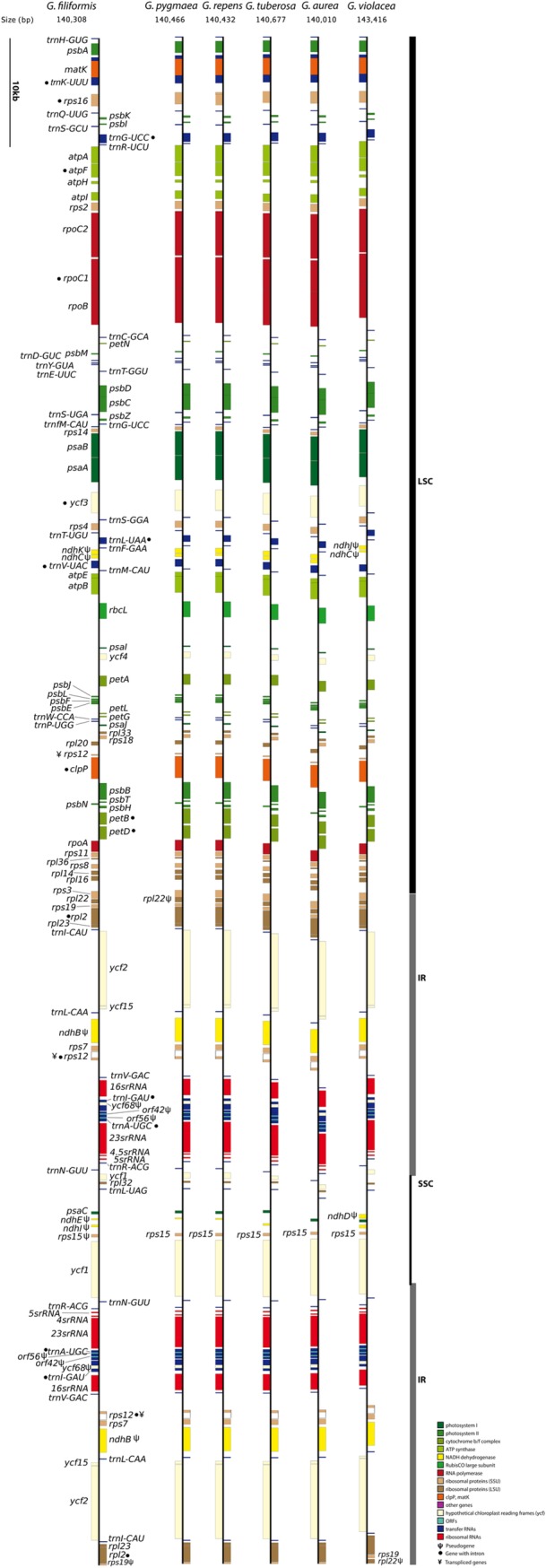
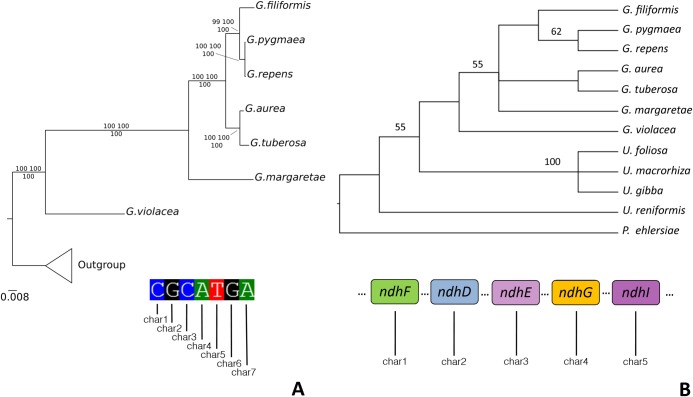
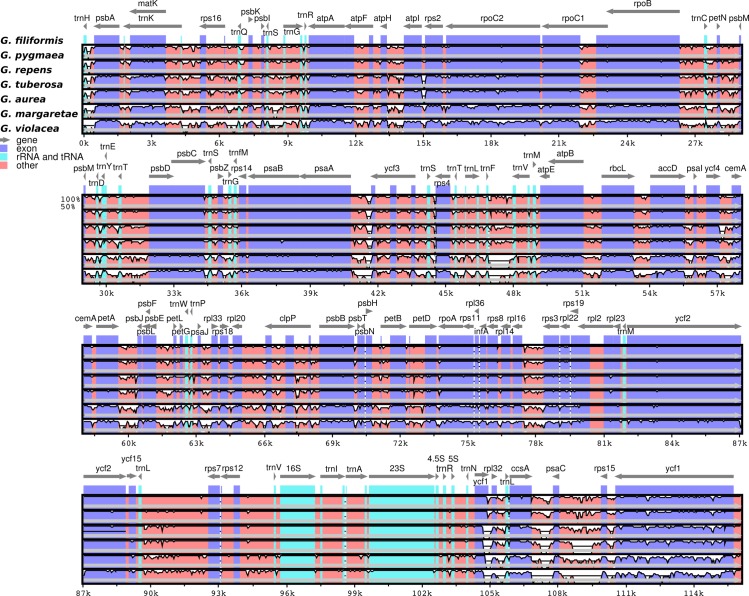
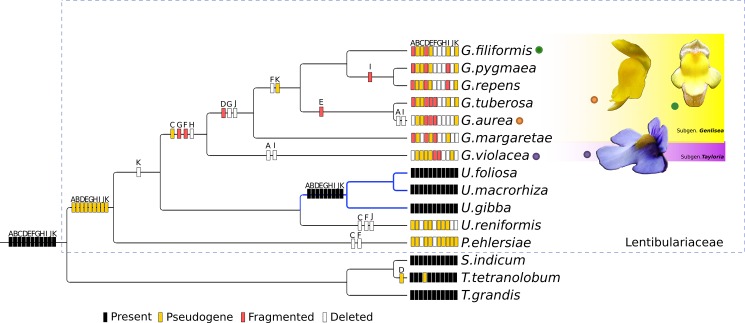
In the carnivorous plant family Lentibulariaceae, all three genome compartments (nuclear, chloroplast, and mitochondria) have some of the highest rates of nucleotide substitutions across angiosperms. While the genera Genlisea and Utricularia have the smallest known flowering plant nuclear genomes, the chloroplast genomes (cpDNA) are mostly structurally conserved except for deletion and/or pseudogenization of the NAD(P)H-dehydrogenase complex (ndh) genes known to be involved in stress conditions of low light or CO2 concentrations. In order to determine how the cpDNA are changing, and to better understand the evolutionary history within the Genlisea genus, we sequenced, assembled and analyzed complete cpDNA from six species (G. aurea, G. filiformis, G. pygmaea, G. repens, G. tuberosa and G. violacea) together with the publicly available G. margaretae cpDNA. In general, the cpDNA structure among the analyzed Genlisea species is highly similar. However, we found that the plastidial ndh genes underwent a progressive process of degradation similar to the other terrestrial Lentibulariaceae cpDNA analyzed to date, but in contrast to the aquatic species. Contrary to current thinking that the terrestrial environment is a more stressful environment and thus requiring the ndh genes, we provide evidence that in the Lentibulariaceae the terrestrial forms have progressive loss while the aquatic forms have the eleven plastidial ndh genes intact. Therefore, the Lentibulariaceae system provides an important opportunity to understand the evolutionary forces that govern the transition to an aquatic environment and may provide insight into how plants manage water stress at a genome scale.
在食虫植物狸藻科中,所有三个基因组区域(核基因组、叶绿体基因组和线粒体基因组)在被子植物中都具有一些最高的核苷酸替换率。虽然螺旋狸藻属和狸藻属拥有已知开花植物中最小的核基因组,但叶绿体基因组(cpDNA)在结构上大多是保守的,只是参与低光照或低二氧化碳浓度胁迫条件的NAD(P)H脱氢酶复合体(ndh)基因存在缺失和/或假基因化现象。为了确定cpDNA是如何变化的,并更好地了解螺旋狸藻属内的进化历史,我们对六个物种(金色螺旋狸藻、丝状螺旋狸藻、矮小螺旋狸藻、匍匐螺旋狸藻、块茎螺旋狸藻和堇色螺旋狸藻)的完整cpDNA进行了测序、组装和分析,并结合了公开可用的玛格丽特螺旋狸藻cpDNA。总体而言,所分析的螺旋狸藻属物种的cpDNA结构高度相似。然而,我们发现质体ndh基因经历了一个渐进的降解过程,这与迄今为止分析的其他陆生狸藻科cpDNA相似,但与水生物种不同。与目前认为陆地环境压力更大因而需要ndh基因的观点相反,我们提供的证据表明,在狸藻科中,陆生类型的ndh基因逐渐丢失,而水生类型的11个质体ndh基因是完整的。因此,狸藻科系统为理解控制向水生环境过渡的进化力量提供了一个重要机会,并可能为植物在基因组尺度上应对水分胁迫的方式提供见解。