Jepsen Mette D E, Sparvath Steffen M, Nielsen Thorbjørn B, Langvad Ane H, Grossi Guido, Gothelf Kurt V, Andersen Ebbe S
Interdisciplinary Nanoscience Center, Aarhus University, 8000, Aarhus C, Denmark.
Department of Chemistry, Aarhus University, 8000, Aarhus C, Denmark.
Nat Commun. 2018 Jan 2;9(1):18. doi: 10.1038/s41467-017-02435-x.
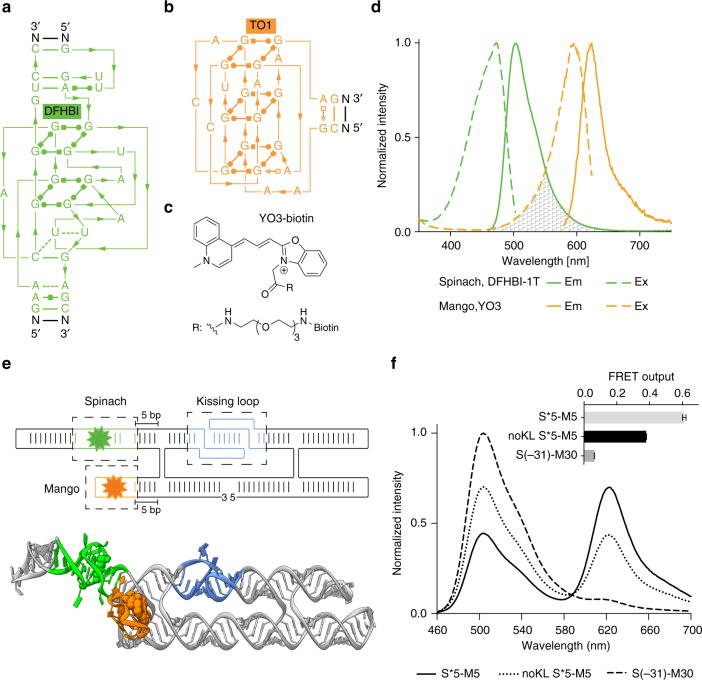
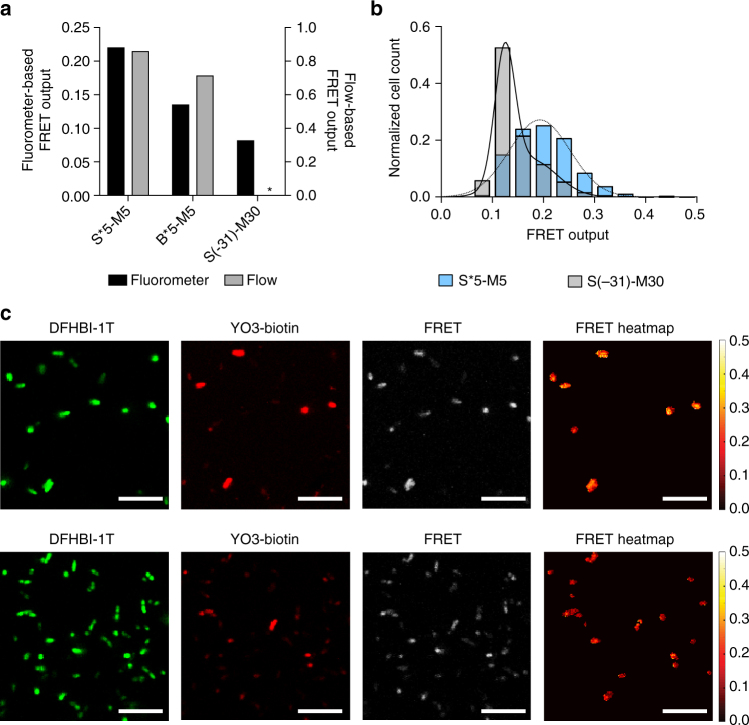
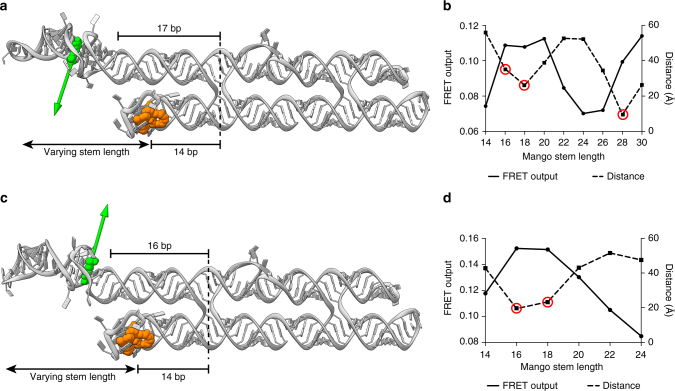
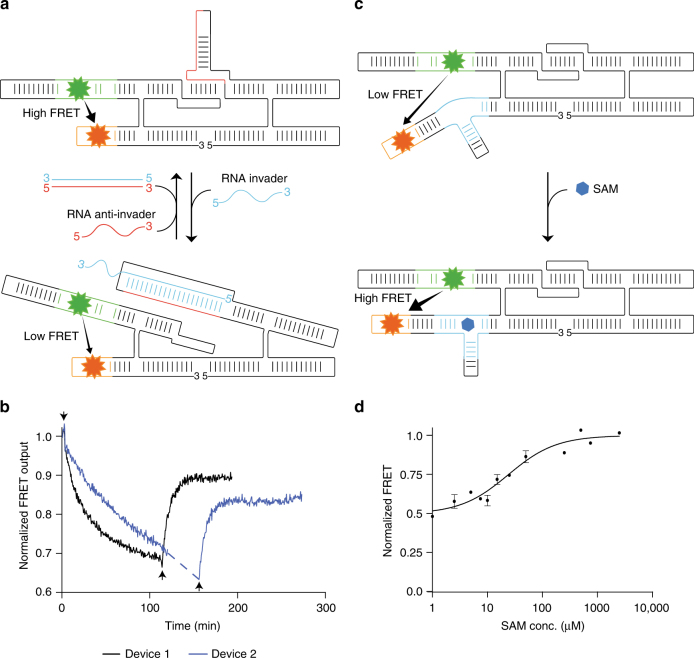
Fluorescent RNA aptamers are useful as markers for tracking RNA molecules inside cells and for creating biosensor devices. Förster resonance energy transfer (FRET) based on fluorescent proteins has been used to detect conformational changes, however, such FRET devices have not yet been produced using fluorescent RNA aptamers. Here we develop an RNA aptamer-based FRET (apta-FRET) system using single-stranded RNA origami scaffolds. To obtain FRET, the fluorescent aptamers Spinach and Mango are placed in close proximity on the RNA scaffolds and a new fluorophore is synthesized to increase spectral overlap. RNA devices that respond to conformational changes are developed, and finally, apta-FRET constructs are expressed in E. coli where FRET is observed, demonstrating that the apta-FRET system is genetically encodable and that the RNA nanostructures fold correctly in bacteria. We anticipate that the RNA apta-FRET system could have applications as ratiometric sensors for real-time studies in cell and synthetic biology.
荧光RNA适体可用作追踪细胞内RNA分子以及制造生物传感器设备的标记物。基于荧光蛋白的荧光共振能量转移(FRET)已被用于检测构象变化,然而,尚未使用荧光RNA适体制造出此类FRET设备。在此,我们利用单链RNA折纸支架开发了一种基于RNA适体的FRET(适体-FRET)系统。为了实现FRET,将荧光适体菠菜素(Spinach)和芒果素(Mango)紧密放置在RNA支架上,并合成了一种新的荧光团以增加光谱重叠。开发了对构象变化有响应的RNA设备,最后,适体-FRET构建体在大肠杆菌中表达并观察到FRET,这表明适体-FRET系统是可遗传编码的,并且RNA纳米结构在细菌中能正确折叠。我们预计RNA适体-FRET系统可作为比率传感器应用于细胞生物学和合成生物学的实时研究。