Department of Emerging Infectious Diseases, Institute of Tropical Medicine (NEKKEN), Nagasaki University, 1-12-4 Sakamoto, Nagasaki 852-8523, Japan.
Micro/Nano Technology Center, Tokai University, 411 Kitakaname, Hiratsuka, Kanagawa 259-1292, Japan.
J Gen Virol. 2018 Feb;99(2):181-186. doi: 10.1099/jgv.0.000999. Epub 2018 Jan 4.
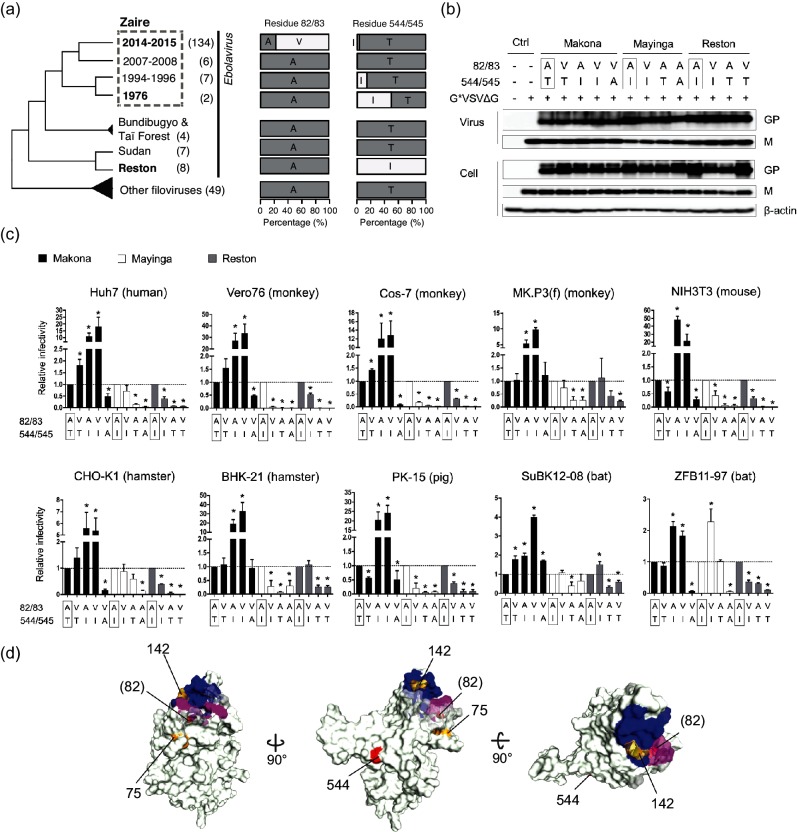
Ebola virus (EBOV), which belongs to the genus Ebolavirus, causes a severe and often fatal infection in primates, including humans, whereas Reston virus (RESTV) only causes lethal disease in non-human primates. Two amino acids (aa) at positions 82 and 544 of the EBOV glycoprotein (GP) are involved in determining viral infectivity. However, it remains unclear how these two aa residues affect the infectivity of Ebolavirus species in various hosts. Here we performed viral pseudotyping experiments with EBOV and RESTV GP derivatives in 10 cell lines from 9 mammalian species. We demonstrated that isoleucine at position 544/545 increases viral infectivity in all host species, whereas valine at position 82/83 modulates viral infectivity, depending on the viral and host species. Structural modelling suggested that the former residue affects viral fusion, whereas the latter residue influences the interaction with the viral entry receptor, Niemann-Pick C1.
埃博拉病毒(EBOV)属于埃博拉病毒属,可引起灵长类动物(包括人类)的严重且常致命感染,而雷斯顿病毒(RESTV)仅在非人类灵长类动物中引起致命疾病。EBOV 糖蛋白(GP)的 82 位和 544 位的两个氨基酸(aa)参与决定病毒的感染力。然而,目前尚不清楚这两个 aa 残基如何影响各种宿主中埃博拉病毒属的感染性。在这里,我们使用来自 9 种哺乳动物的 10 种细胞系进行了 EBOV 和 RESTV GP 衍生物的病毒假型实验。我们证明第 544/545 位的异亮氨酸增加了所有宿主物种中的病毒感染力,而第 82/83 位的缬氨酸则根据病毒和宿主物种的不同调节病毒感染力。结构建模表明,前一个残基影响病毒融合,而后一个残基影响与病毒进入受体尼曼-匹克 C1 的相互作用。