Division of Food Biotechnology, Food Research Institute, NARO, 2-1-12 Kannon-dai, Tsukuba, Ibaraki 305-8642, Japan.
Toxins (Basel). 2018 Jan 5;10(1):31. doi: 10.3390/toxins10010031.
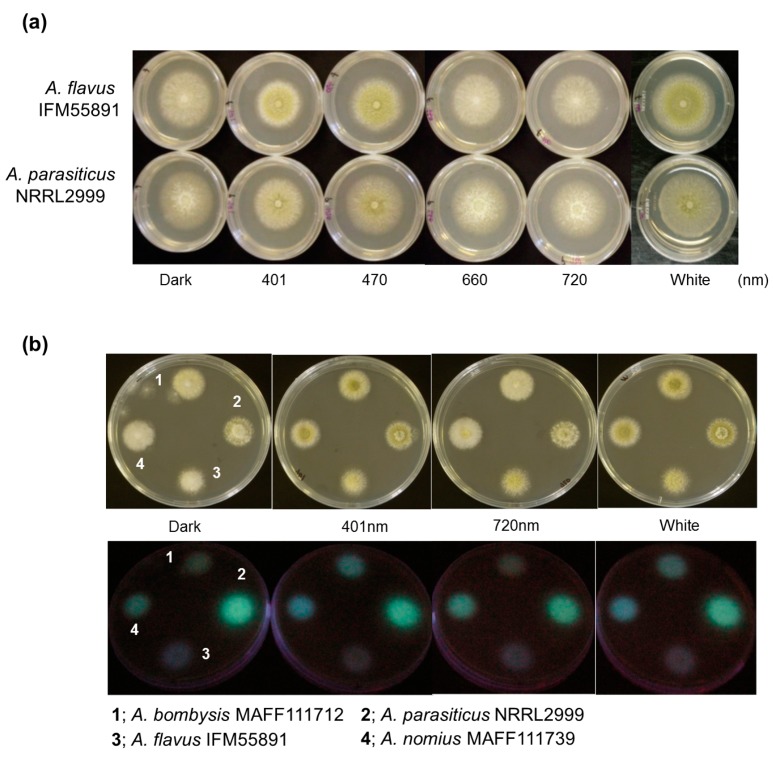
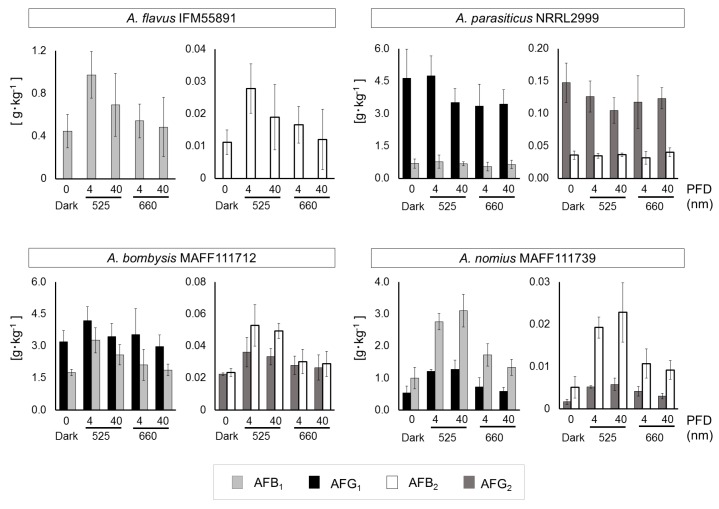
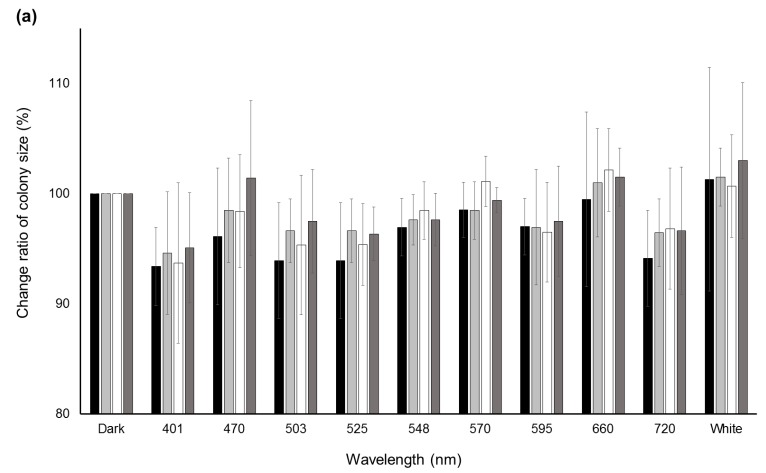
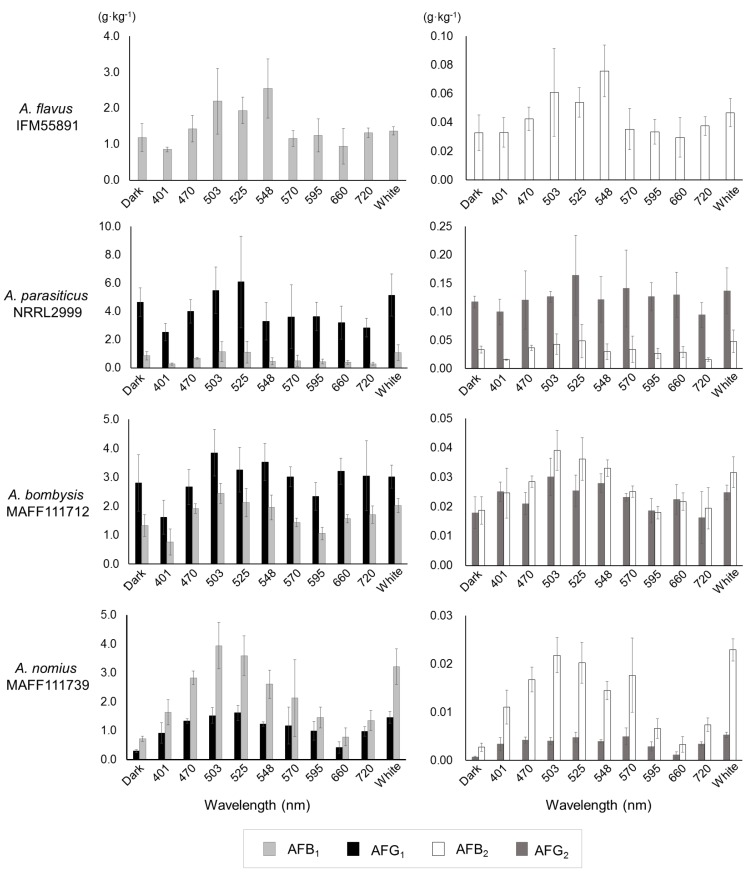
Fungi respond to light irradiation by forming conidia and occasionally synthesizing mycotoxins. Several light wavelengths, such as blue and red, affect the latter. However, the relationship between light irradiation and mycotoxin synthesis varies depending on the fungal species or strain. This study focused on aflatoxin (AF), which is a mycotoxin, and the types of light irradiation that increase AF synthesis. Light-irradiation tests using the visible region indicated that blue wavelengths in the lower 500 nm region promoted AF synthesis. In contrast, red wavelengths of 660 nm resulted in limited significant changes compared with dark conditions. Irradiation tests with different intensity levels indicated that a low light intensity increased AF synthesis. For one fungal strain, light irradiation decreased the AF synthesis under all wavelength conditions. However, the decrease was mitigated by 525 nm low intensity irradiation. Thus, blue-green low intensity irradiation may increase AF synthesis in fungi.
真菌通过形成分生孢子和偶尔合成真菌毒素来响应光照。几种光波长,如蓝色和红色,会影响后者。然而,光照和真菌毒素合成之间的关系因真菌种类或菌株而异。本研究集中于黄曲霉毒素(AF),这是一种真菌毒素,以及增加 AF 合成的光照类型。使用可见区域进行的光照试验表明,500nm 以下的蓝光区域促进了 AF 的合成。相比之下,660nm 的红光与黑暗条件相比,仅有有限的显著变化。不同强度水平的照射试验表明,低光强度会增加 AF 的合成。对于一种真菌菌株,在所有波长条件下,光照都会降低 AF 的合成。然而,525nm 的低强度照射减轻了这种降低。因此,蓝绿光低强度照射可能会增加真菌中的 AF 合成。