Dwyer Dominic E, Lynfield Ruth, Losso Marcelo H, Davey Richard T, Cozzi-Lepri Alessandro, Wentworth Deborah, Uyeki Timothy M, Gordin Fred, Angus Brian, Qvist Tavs, Emery Sean, Lundgren Jens, Neaton James D
Institute of Clinical Pathology and Medical Research, NSW Health Pathology, Westmead Hospital, Westmead, Sydney, Australia.
Minnesota Department of Health, St. Paul, Minnesota.
Open Forum Infect Dis. 2017 Oct 7;4(4):ofx212. doi: 10.1093/ofid/ofx212. eCollection 2017 Fall.
Outcome data from prospective follow-up studies comparing infections with different influenza virus types/subtypes are limited.
Demographic, clinical characteristics and follow-up outcomes for adults with laboratory-confirmed influenza A(H1N1)pdm09, A(H3N2), or B virus infections were compared in 2 prospective cohorts enrolled globally from 2009 through 2015. Logistic regression was used to compare outcomes among influenza virus type/subtypes.
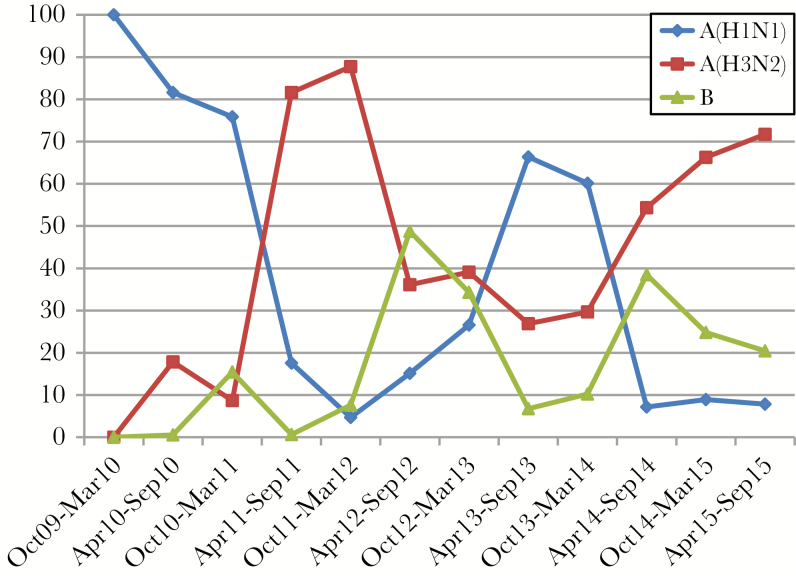
Of 3952 outpatients, 1290 (32.6%) had A(H1N1)pdm09 virus infection, 1857 (47.0%) had A(H3N2), and 805 (20.4%) had influenza B. Of 1398 inpatients, 641 (45.8%) had A(H1N1)pdm09, 532 (38.1%) had A(H3N2), and 225 (16.1%) had influenza B. Outpatients with A(H1N1)pdm09 were younger with fewer comorbidities and were more likely to be hospitalized during the 14-day follow-up (3.3%) than influenza B (2.2%) or A(H3N2) (0.7%; < .0001). Hospitalized patients with A(H1N1)pdm09 (20.3%) were more likely to be enrolled from intensive care units (ICUs) than those with A(H3N2) (11.3%) or B (9.8%; < .0001). However, 60-day follow-up of discharged inpatients showed no difference in disease progression ( = .32) or all-cause mortality ( = .30) among influenza types/subtypes. These findings were consistent after covariate adjustment, in sensitivity analyses, and for subgroups defined by age, enrollment location, and comorbidities.
Outpatients infected with influenza A(H1N1)pdm09 or influenza B were more likely to be hospitalized than those with A(H3N2). Hospitalized patients infected with A(H1N1)pdm09 were younger and more likely to have severe disease at study entry (measured by ICU enrollment), but did not have worse 60-day outcomes.
比较不同甲型/乙型流感病毒感染的前瞻性随访研究的结果数据有限。
在2009年至2015年全球招募的2个前瞻性队列中,比较了实验室确诊的甲型H1N1pdm09、甲型H3N2或乙型流感病毒感染成人的人口统计学、临床特征和随访结果。采用逻辑回归比较不同甲型/乙型流感病毒的结局。
在3952名门诊患者中,1290例(32.6%)感染甲型H1N1pdm09病毒,1857例(47.0%)感染甲型H3N2,805例(20.4%)感染乙型流感。在1398名住院患者中,641例(45.8%)感染甲型H1N1pdm09,532例(38.1%)感染甲型H3N2,225例(16.1%)感染乙型流感。感染甲型H1N1pdm09的门诊患者年龄较轻,合并症较少,在14天随访期间住院的可能性(3.3%)高于感染乙型流感(2.2%)或甲型H3N2(0.7%;P<0.0001)的患者。感染甲型H1N1pdm09的住院患者(20.3%)比感染甲型H3N2(11.3%)或乙型流感(9.8%;P<0.0001)的患者更有可能从重症监护病房(ICU)入组。然而,出院住院患者的60天随访显示,不同甲型/乙型流感病毒感染在疾病进展(P=0.32)或全因死亡率(P=0.30)方面无差异。在协变量调整、敏感性分析以及按年龄、入组地点和合并症定义的亚组分析中,这些结果是一致的。
感染甲型H1N1pdm09或乙型流感的门诊患者比感染甲型H3N2的患者更有可能住院。感染甲型H1N1pdm09的住院患者年龄较轻,在研究入组时病情更严重(以入住ICU衡量),但60天结局并不更差。