Department of Psychology, Stanford University, Stanford, CA.
Department of Pediatrics, Division of Neonatal and Developmental Medicine, Stanford University, Stanford, CA.
J Dev Behav Pediatr. 2018 Apr;39(3):246-253. doi: 10.1097/DBP.0000000000000541.
Identifying which preterm (PT) children are at increased risk of language and learning differences increases opportunities for participation in interventions that improve outcomes. Speed in spoken language comprehension at early stages of language development requires information processing skills that may form the foundation for later language and school-relevant skills. In children born full-term, speed of comprehending words in an eye-tracking task at 2 years old predicted language and nonverbal cognition at 8 years old. Here, we explore the extent to which speed of language comprehension at 1.5 years old predicts both verbal and nonverbal outcomes at 4.5 years old in children born PT.
Participants were children born PT (n = 47; ≤32 weeks gestation). Children were tested in the "looking-while-listening" task at 18 months old, adjusted for prematurity, to generate a measure of speed of language comprehension. Parent report and direct assessments of language were also administered. Children were later retested on a test battery of school-relevant skills at 4.5 years old.
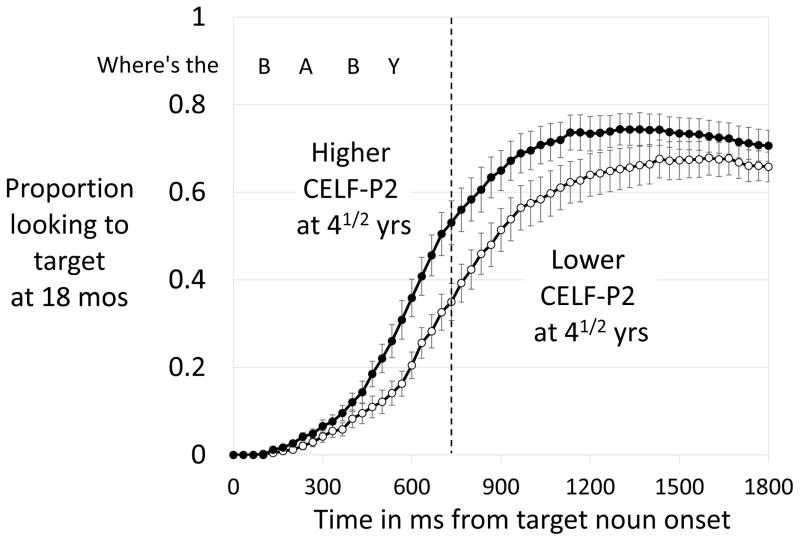
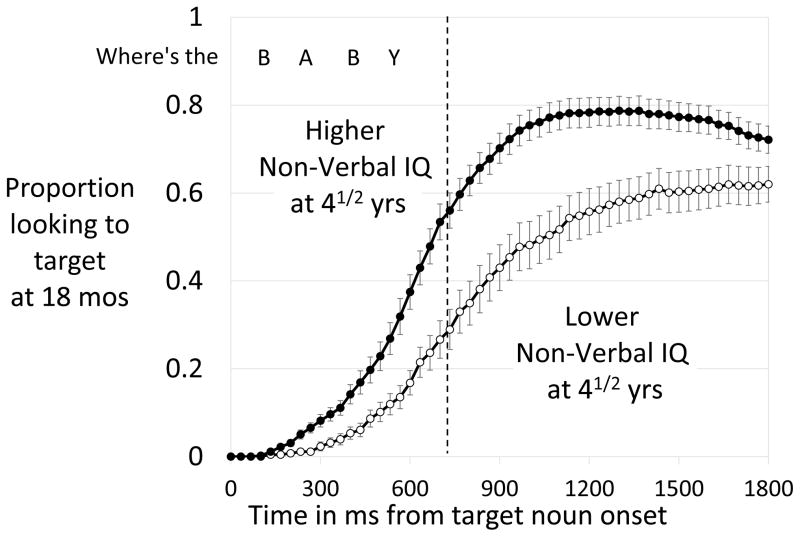
Speed of language comprehension at 18 months old predicted significant unique variance (12%-31%) in receptive vocabulary, global language abilities, and nonverbal intelligence quotient (IQ) at 4.5 years, controlling for socioeconomic status, gestational age, and medical complications of PT birth. Speed of language comprehension remained uniquely predictive (5%-12%) when also controlling for children's language skills at 18 months old.
Individual differences in speed of spoken language comprehension may serve as a marker for neuropsychological processes that are critical for the development of school-relevant linguistic skills and nonverbal IQ in children born PT.
确定哪些早产儿(PT)儿童存在语言和学习差异的风险增加,这增加了参与改善结果的干预措施的机会。语言发展早期口语理解的速度需要信息处理技能,这些技能可能是以后语言和与学校相关的技能的基础。在足月出生的儿童中,2 岁时在眼动追踪任务中理解单词的速度可预测 8 岁时的语言和非语言认知。在这里,我们探讨了 1.5 岁时语言理解速度在多大程度上预测了 PT 出生的儿童 4.5 岁时的言语和非言语结果。
参与者为 PT 出生的儿童(n=47;≤32 周妊娠)。在 18 个月时,对儿童进行“听时看”测试,以早产儿矫正后的速度生成语言理解速度的度量。还进行了父母报告和语言的直接评估。然后,在 4.5 岁时,对儿童进行学校相关技能测试的电池测试。
18 个月时的语言理解速度预测了 4.5 岁时接受性词汇、整体语言能力和非言语智商(IQ)的显著独特差异(12%-31%),控制了社会经济地位、胎龄和 PT 出生的医疗并发症。当也控制了 18 个月时儿童的语言技能时,语言理解速度仍然具有独特的预测性(5%-12%)。
口语理解速度的个体差异可能是对神经心理过程的标志,这些过程对于 PT 出生的儿童发展与学校相关的语言技能和非言语 IQ 至关重要。