Child and Adolescent Studies, Utrecht University, Utrecht, Netherlands.
PLoS One. 2019 Nov 6;14(11):e0223690. doi: 10.1371/journal.pone.0223690. eCollection 2019.
To compare moderate-to-late preterm born (32-36 weeks' gestation) to full term born (≥37 weeks' gestation) children in cognitive and behavioural functioning at the age of 6 years and assess which toddler skills predict later cognitive and behavioural functioning.
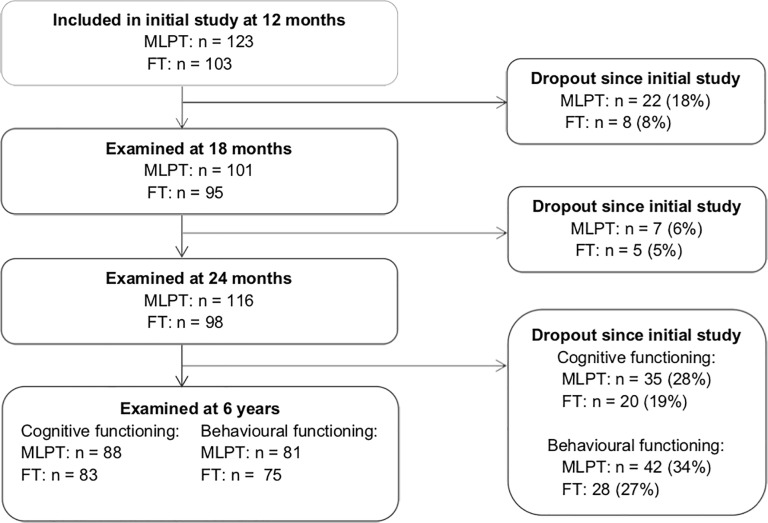
A prospective longitudinal study with a cohort of 88 moderate-to-late preterm and 83 full term born Dutch children, followed from 18 months to 6 years of age. Orienting, alerting and executive attention skills were assessed at 18 months (corrected for prematurity), and cognitive, motor and language skills (Bayley-III-NL) at 24 months (corrected for prematurity). At 6 years (corrected for prematurity), cognitive (indices of IQ; WPPSI-III-NL) and behavioural functioning (CBCL/6-18) were assessed. Group differences and potential predictors were examined with MANCOVAs and hierarchical regression analyses.
At 6 years, moderate-to-late preterm born children performed poorer than full term born children on cognitive processing speed, and they showed more behavioural attention problems. Attention problems at 6 years were predicted by poorer orienting attention skills at 18 months, while lower performance IQ was predicted by poorer alerting attention skills at 18 months. Full Scale IQ and Verbal IQ at 6 years were predicted by language skills at 24 months. Moderate-to-late preterm and full term born children showed some differing correlational patterns in the associations between early skills and later functioning, although in further analyses predictors appeared the same for both groups.
Moderate-to-late preterm born children show specific vulnerabilities at primary school-age, particularly in cognitive processing speed and behavioural attention problems. Cognitive and behavioural functioning at 6 years can be predicted by differentiated attention skills at 18 months and language skills at 24 months.
比较中度至晚期早产儿(32-36 孕周)和足月产儿(≥37 孕周)在 6 岁时的认知和行为功能,并评估哪些幼儿技能可以预测后期的认知和行为功能。
一项前瞻性纵向研究,对 88 名中度至晚期早产儿和 83 名足月产儿进行了队列研究,随访时间从 18 个月到 6 岁。在 18 个月(早产校正后)评估定向、警觉和执行注意技能,在 24 个月(早产校正后)评估认知、运动和语言技能(Bayley-III-NL)。在 6 岁(早产校正后),评估认知(智商指数;WPPSI-III-NL)和行为功能(CBCL/6-18)。采用 MANCOVA 和分层回归分析检查组间差异和潜在预测因素。
在 6 岁时,中度至晚期早产儿在认知处理速度方面的表现不如足月产儿,他们表现出更多的行为注意力问题。6 岁时的注意力问题由 18 个月时较差的定向注意力技能预测,而较低的表现智商由 18 个月时较差的警觉注意力技能预测。6 岁时的全量表智商和言语智商由 24 个月时的语言技能预测。中度至晚期早产儿和足月产儿在早期技能与后期功能之间的关联中表现出一些不同的相关模式,尽管在进一步的分析中,两组的预测因素似乎相同。
中度至晚期早产儿在小学年龄时表现出特定的脆弱性,特别是在认知处理速度和行为注意力问题方面。6 岁时的认知和行为功能可以由 18 个月时的不同注意力技能和 24 个月时的语言技能预测。