University of Washington, 6200 NE 74th Street, Suite 100, Seattle, WA, 98115, USA.
University of Minnesota, 250 Education Sciences Bldg, 56 East River Road, Minneapolis, MN, 55455, USA.
Implement Sci. 2018 Jan 8;13(1):5. doi: 10.1186/s13012-017-0705-6.
A substantial literature has established the role of the inner organizational setting on the implementation of evidence-based practices in community contexts, but very little of this research has been extended to the education sector, one of the most common settings for the delivery of mental and behavioral health services to children and adolescents. The current study examined the factor structure, psychometric properties, and interrelations of an adapted set of pragmatic organizational instruments measuring key aspects of the organizational implementation context in schools: (1) strategic implementation leadership, (2) strategic implementation climate, and (3) implementation citizenship behavior.
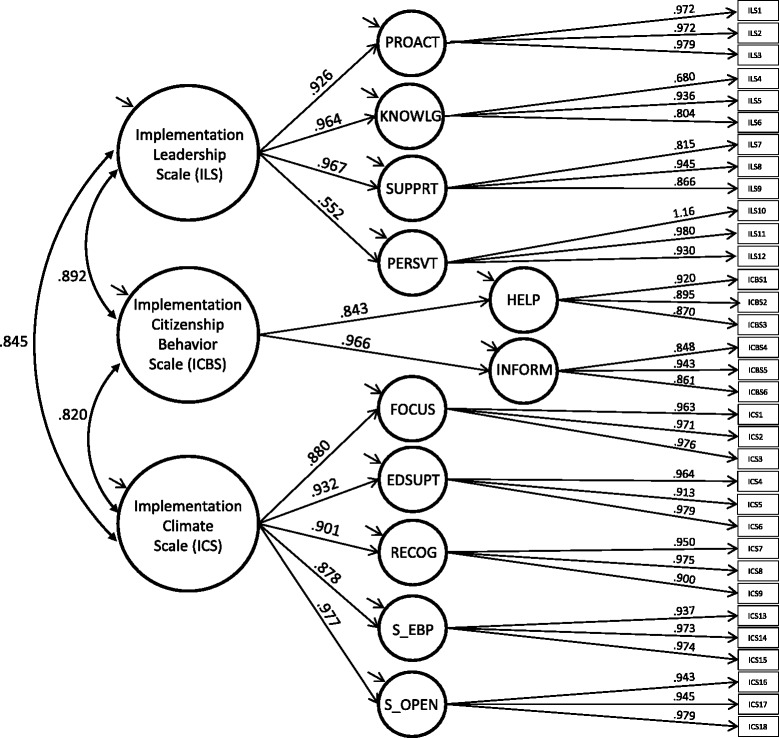
The Implementation Leadership Scale (ILS), Implementation Climate Scale (ICS), and Implementation Citizenship Behavior Scale (ICBS) were adapted by a research team that included the original scale authors and experts in the implementation of evidence-based practices in schools. These instruments were then administered to a geographically representative sample (n = 196) of school-based mental/behavioral health consultants to assess the reliability and structural validity via a series of confirmatory factor analyses.
Overall, the original factor structures for the ILS, ICS, and ICBS were confirmed in the current sample. The one exception was poor functioning of the Rewards subscale of the ICS, which was removed in the final ICS model. Correlations among the revised measures, evaluated as part of an overarching model of the organizational implementation context, indicated both unique and shared variance.
The current analyses suggest strong applicability of the revised instruments to implementation of evidence-based mental and behavioral practices in the education sector. The one poorly functioning subscale (Rewards on the ICS) was attributed to typical educational policies that do not allow for individual financial incentives to personnel. Potential directions for future expansion, revision, and application of the instruments in schools are discussed.
大量文献已经确定了内部组织环境对社区环境中实施循证实践的作用,但这项研究很少扩展到教育领域,而教育领域是向儿童和青少年提供心理和行为健康服务的最常见环境之一。本研究考察了一套经过修正的实用组织工具的结构因素、心理测量特性及其在学校组织实施环境中的关键方面的相互关系:(1)战略实施领导力;(2)战略实施氛围;(3)实施公民行为。
实施领导力量表(ILS)、实施氛围量表(ICS)和实施公民行为量表(ICBS)由一个研究团队进行了改编,该团队包括原始量表的作者和学校实施循证实践方面的专家。然后,这些工具被用于一个具有地理代表性的学校为基础的精神/行为健康顾问样本(n=196),通过一系列验证性因素分析来评估可靠性和结构有效性。
总体而言,ILS、ICS 和 ICBS 的原始因素结构在当前样本中得到了确认。唯一的例外是 ICS 的奖励子量表功能不佳,该子量表在最终的 ICS 模型中被删除。作为组织实施环境总体模型的一部分进行评估的修订措施之间的相关性表明存在独特和共享的差异。
目前的分析表明,修订后的工具在教育部门实施循证心理和行为实践方面具有很强的适用性。一个功能不佳的子量表(ICS 上的奖励)归因于典型的教育政策,这些政策不允许对人员进行个人财务激励。讨论了未来在学校中扩展、修订和应用这些工具的潜在方向。