SNL-R, Systems Neurobiology Laboratory, Salk Institute for Biological Studies, La Jolla, CA, United States.
Department of Cognitive Sciences, University of California, Irvine, Irvine, CA, United States.
Front Neural Circuits. 2017 Dec 22;11:108. doi: 10.3389/fncir.2017.00108. eCollection 2017.
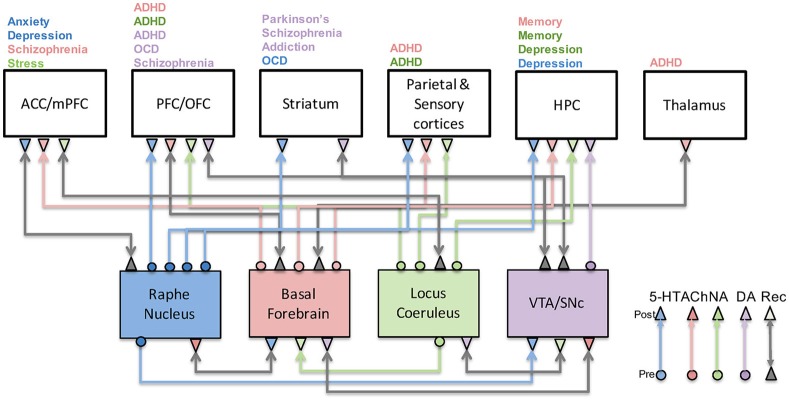
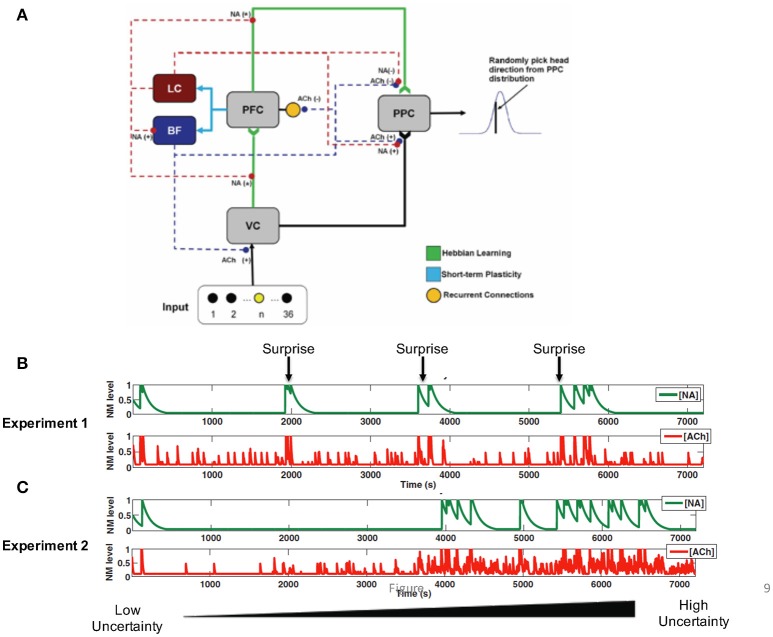
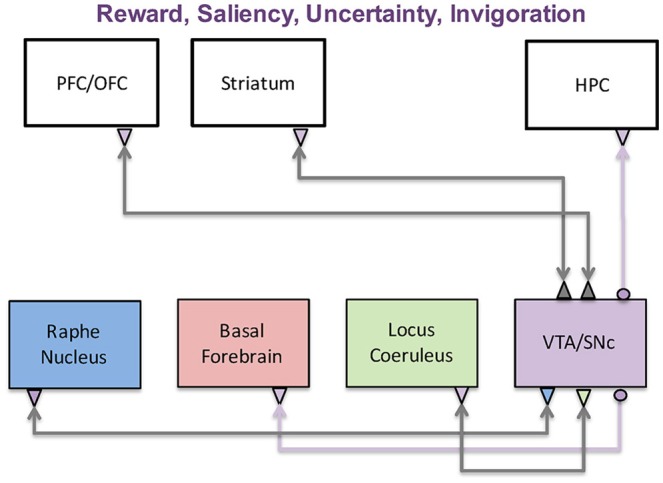
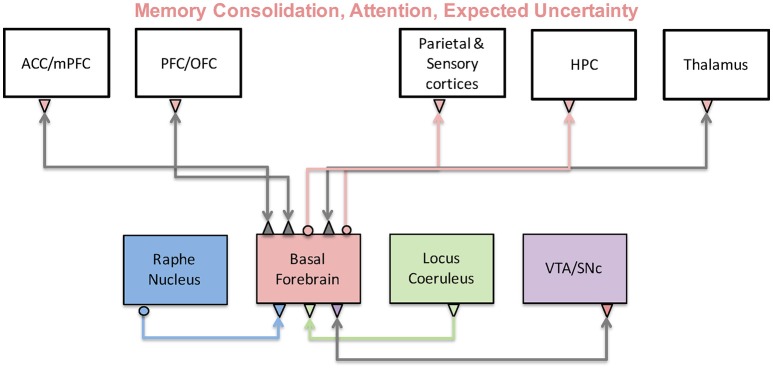
Neuromodulatory systems, including the noradrenergic, serotonergic, dopaminergic, and cholinergic systems, track environmental signals, such as risks, rewards, novelty, effort, and social cooperation. These systems provide a foundation for cognitive function in higher organisms; attention, emotion, goal-directed behavior, and decision-making derive from the interaction between the neuromodulatory systems and brain areas, such as the amygdala, frontal cortex, hippocampus, and sensory cortices. Given their strong influence on behavior and cognition, these systems also play a key role in disease states and are the primary target of many current treatment strategies. The fact that these systems interact with each other either directly or indirectly, however, makes it difficult to understand how a failure in one or more systems can lead to a particular symptom or pathology. In this review, we explore experimental evidence, as well as focus on computational and theoretical models of neuromodulation. Better understanding of neuromodulatory systems may lead to the development of novel treatment strategies for a number of brain disorders.
神经调节系统,包括去甲肾上腺素能、血清素能、多巴胺能和胆碱能系统,跟踪环境信号,如风险、奖励、新奇、努力和社会合作。这些系统为高等生物的认知功能提供了基础;注意力、情绪、目标导向行为和决策源自于神经调节系统与大脑区域(如杏仁核、前额叶皮层、海马体和感觉皮层)之间的相互作用。鉴于它们对行为和认知的强烈影响,这些系统在疾病状态中也起着关键作用,是许多当前治疗策略的主要目标。然而,这些系统要么直接要么间接相互作用,这使得很难理解一个或多个系统的故障如何导致特定的症状或病理学。在这篇综述中,我们探讨了实验证据,并重点关注神经调节的计算和理论模型。更好地理解神经调节系统可能会为许多脑部疾病的新治疗策略的发展提供依据。