1 Faculty of Education, Department of Psychology, Charles University , Prague, Czech Republic.
2 First Faculty of Medicine, Department of Addictology, Charles University , Prague, Czech Republic.
J Behav Addict. 2018 Mar 1;7(1):44-51. doi: 10.1556/2006.6.2017.089. Epub 2018 Jan 9.
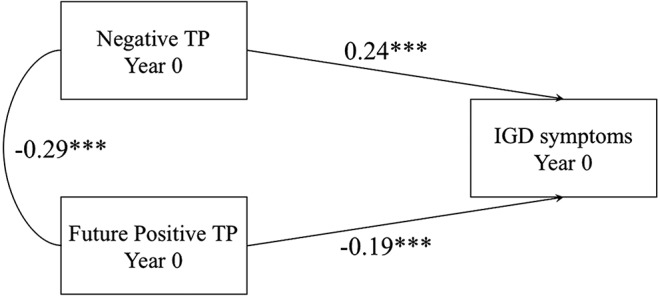
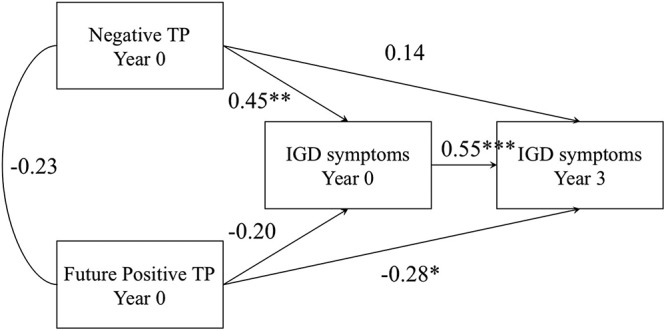
Backgrounds and aims This study focuses on the role of time perspective (TP) in Internet gaming disorder (IGD). An inventory-based study on 377 massive multiplayer online role playing game players was conducted, followed by a 3-year-follow-up in which 48 active players from the original sample participated. We proposed that TP factors (negative TP and future positive TP) will influence either the current presence of IGD symptoms or the further development of IGD over time. In other words, the effect of TP is stable. Finally, game usage patterns were analyzed in the sense of changes in playing time and IGD symptoms in gamers after 3 years. Methods To access the variables, two scales were administered through online inventory, the Zimbardo Time Perspective Inventory-short, and Charlton and Danforths' Core Addiction Scale, both in 2012 (N = 377) and 2015 (N = 48). The amount of time that gamers usually spent playing were obtained through self-reports. Results The study's primary presumptions were confirmed. Both negative TP and future positive TP were confirmed as significant predictors of the presence of IGD symptoms, either immediately or in the following 3 years. Data on game usage showed a significant decrease in playing time and IGD symptoms between year 0 and year 3 of the study.
本研究聚焦于时间观念(TP)在网络游戏障碍(IGD)中的作用。通过对 377 名大型多人在线角色扮演游戏玩家进行基于问卷的研究,并对原始样本中的 48 名活跃玩家进行了为期 3 年的随访,我们提出 TP 因素(消极 TP 和未来积极 TP)将影响当前 IGD 症状的存在或随时间的推移进一步发展 IGD。换句话说,TP 的影响是稳定的。最后,分析了游戏使用模式,即在 3 年后游戏者的游戏时间和 IGD 症状的变化。方法:为了评估变量,在 2012 年(N=377)和 2015 年(N=48),通过在线问卷的方式,分别使用了两个量表:津巴多时间观念量表和查尔顿与丹福思核心成瘾量表。通过自我报告,获得游戏者通常玩游戏的时间量。结果:研究的主要假设得到了证实。无论是现在还是未来 3 年,消极 TP 和未来积极 TP 都被证实是 IGD 症状存在的显著预测因素。游戏使用数据显示,在研究的第 0 年到第 3 年之间,游戏时间和 IGD 症状都显著减少。