Kershaw Colleen, Taylor Jessica L, Horowitz Gary, Brockmeyer Diane, Libman Howard, Kriegel Gila, Ngo Long
Department of Medicine, Beth Israel Deaconess Medical Center, 110 Francis Street, Suite GB, Boston, MA, 02215, USA.
Department of Medicine, Boston University School of Medicine, 801 Massachusetts Avenue, Crosstown 2, Boston, MA, 02118, USA.
BMC Health Serv Res. 2018 Jan 10;18(1):14. doi: 10.1186/s12913-017-2824-9.
More than 1 in 7 patients with human immunodeficiency virus (HIV) infection in the United States are unaware of their serostatus despite recommendations of US agencies that all adults through age 65 be screened for HIV at least once. To facilitate universal screening, an electronic medical record (EMR) reminder was created for our primary care practice. Screening rates before and after implementation were assessed to determine the impact of the reminder on screening rates.
A retrospective cohort analysis was performed for patients age 18-65 with visits between January 1, 2012-October 30, 2014. EMR databases were examined for HIV testing and selected patient characteristics. We evaluated the probability of HIV screening in unscreened patients before and after the reminder and used a multivariable generalized linear model to test the association between likelihood of HIV testing and specific patient characteristics.
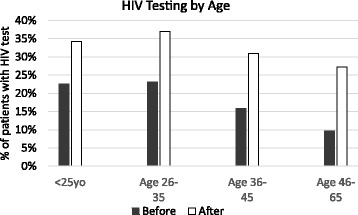
Prior to the reminder, the probability of receiving an HIV test for previously unscreened patients was 15.3%. This increased to 30.7% after the reminder (RR 2.02, CI 1.95-2.09, p < 0.0001). The impact was most significant in patients age 45-65. White race, English as primary language, and higher median household income were associated with lower likelihoods of screening both before and after implementation (RR 0.68, CI 0.65-0.72; RR 0.74, CI 0.67-0.82; RR 0.84, CI 0.80-0.88, respectively).
The EMR reminder increased rates of HIV screening twofold in our practice. It was most effective in increasing screening rates in older patients. Patients who were white, English-speaking, and had higher incomes were less likely to be screened for HIV both before and after the reminder.
在美国,超过七分之一的人类免疫缺陷病毒(HIV)感染者不知道自己的血清学状态,尽管美国机构建议对65岁及以下的所有成年人至少进行一次HIV筛查。为便于进行普遍筛查,我们为基层医疗实践创建了一份电子病历(EMR)提醒。评估实施前后的筛查率,以确定该提醒对筛查率的影响。
对2012年1月1日至2014年10月30日期间就诊的18 - 65岁患者进行回顾性队列分析。检查EMR数据库中的HIV检测情况和选定的患者特征。我们评估了提醒前后未筛查患者进行HIV筛查的概率,并使用多变量广义线性模型来检验HIV检测可能性与特定患者特征之间的关联。
在提醒之前,之前未筛查患者接受HIV检测的概率为15.3%。提醒之后,这一概率增加到了30.7%(相对风险2.02,置信区间1.95 - 2.09,p < 0.0001)。这种影响在45 - 65岁的患者中最为显著。白种人、以英语为主要语言以及家庭收入中位数较高在实施前后都与较低的筛查可能性相关(相对风险分别为0.68,置信区间0.65 - 0.72;0.74,置信区间0.67 - 0.82;0.84,置信区间0.80 - 0.88)。
在我们的实践中,EMR提醒使HIV筛查率提高了两倍。它在提高老年患者的筛查率方面最为有效。在提醒前后,白种人、说英语且收入较高的患者接受HIV筛查的可能性较小。