Riboulot Vincent, Ker Stephan, Sultan Nabil, Thomas Yannick, Marsset Bruno, Scalabrin Carla, Ruffine Livio, Boulart Cédric, Ion Gabriel
IFREMER, REM-GM, BP70, 29280, Plouzané, France.
National Institute of Marine Geology and Geo-ecology, RO-024053, Bucharest, Romania.
Nat Commun. 2018 Jan 9;9(1):117. doi: 10.1038/s41467-017-02271-z.
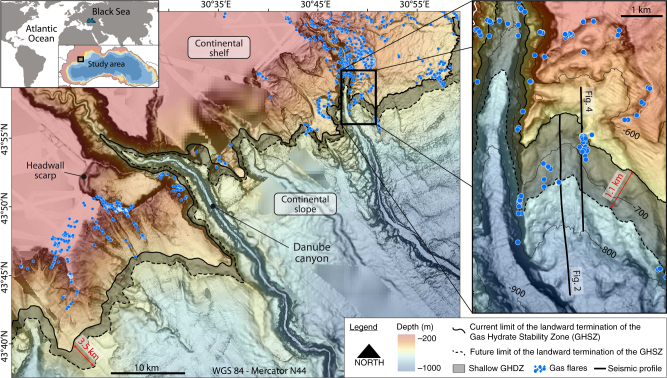
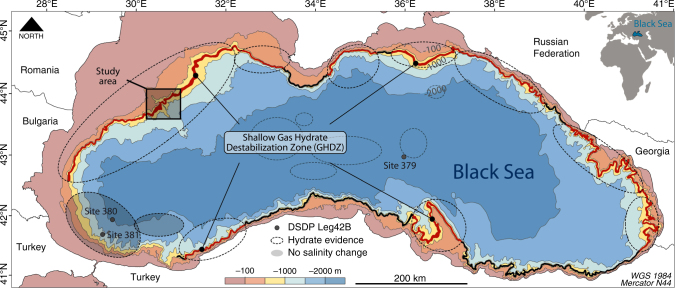
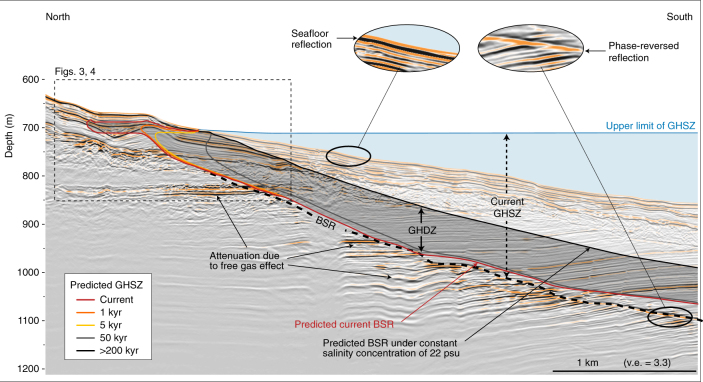
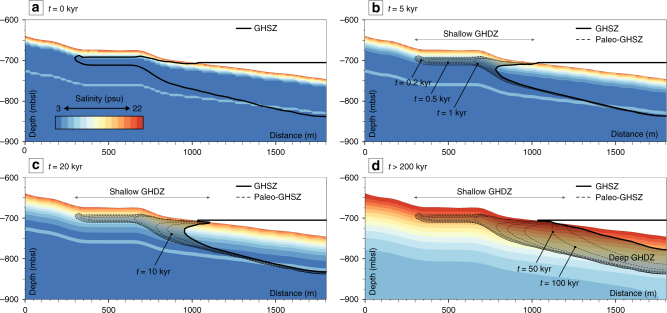
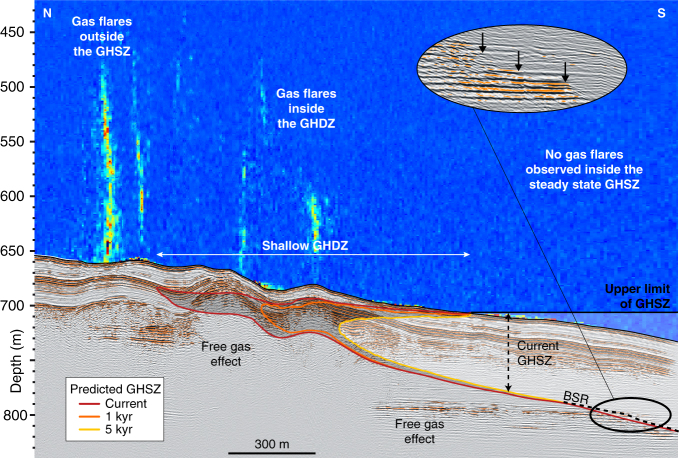
Gas hydrates, a solid established by water and gas molecules, are widespread along the continental margins of the world. Their dynamics have mainly been regarded through the lens of temperature-pressure conditions. A fluctuation in one of these parameters may cause destabilization of gas hydrate-bearing sediments below the seafloor with implications in ocean acidification and eventually in global warming. Here we show throughout an example of the Black Sea, the world's most isolated sea, evidence that extensive gas hydrate dissociation may occur in the future due to recent salinity changes of the sea water. Recent and forthcoming salt diffusion within the sediment will destabilize gas hydrates by reducing the extension and thickness of their thermodynamic stability zone in a region covering at least 2800 square kilometers which focus seepages at the observed sites. We suspect this process to occur in other world regions (e.g., Caspian Sea, Sea of Marmara).
天然气水合物是由水分子和气体分子形成的固体,广泛分布于全球大陆边缘。其动态变化主要是从温度 - 压力条件的角度来考虑的。这些参数中的任何一个发生波动,都可能导致海底以下含天然气水合物沉积物的失稳,进而引发海洋酸化,并最终导致全球变暖。在此,我们通过世界上最孤立的海域——黑海的一个例子表明,由于近期海水盐度的变化,未来可能会发生广泛的天然气水合物分解。沉积物中近期和即将发生的盐分扩散,将通过减少至少2800平方公里区域内天然气水合物热力学稳定带的范围和厚度,使天然气水合物失稳,该区域是观测点的集中渗漏区。我们怀疑这个过程也会在世界其他地区(如里海、马尔马拉海)发生。