Woo Mei Teng, Davids Keith, Liukkonen Jarmo, Chow Jia Yi, Jaakkola Timo
Faculty of Sport and Health Sciences, University of Jyväskylä, Jyväskylä, Finland.
School of Sports, Health, and Leisure, Republic Polytechnic, Singapore.
Geriatr Orthop Surg Rehabil. 2017 Dec;8(4):256-262. doi: 10.1177/2151458517745989. Epub 2017 Dec 14.
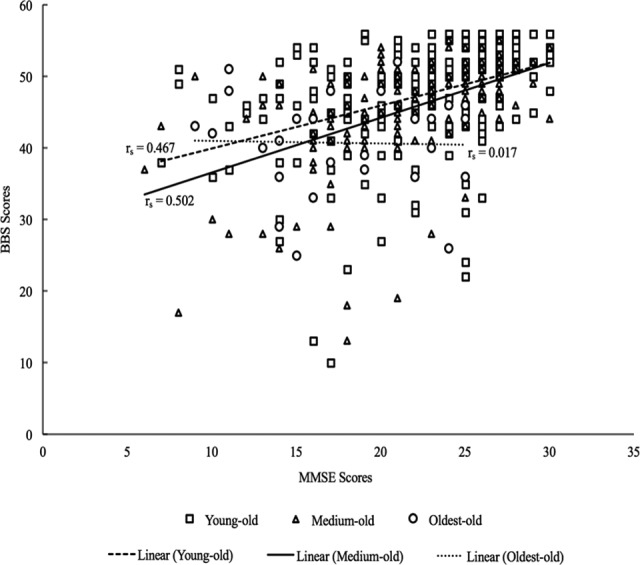
This study compared occurrence of falls, cognitive function, and balance profiles across participants in elderly age categories, investigating associations between the 3 aspects in a sample of Singapore's elderly population.
Community-dwelling elderly individuals (N = 385) were randomly recruited and grouped into "young-old (65-74 years)," "medium-old (75-84 years)," and "oldest-old (above 85 years)" groups. The Fallproof Health and Activity questionnaire, adapted Mini-Mental State Examination (MMSE), and Berg Balance Scale (BBS) tests were used to survey information related to falls, cognition, and balance profiles.
Findings revealed significant differences in MMSE and BBS scores across the age groups. Participants with mild cognitive impairment (odds ratio [OR] = 1.87, 95% confidence interval [CI] = 1.08-3.25) and BBS score ≤40 (OR = 0.25, 95% CI = 0.14-0.46) were at the highest risk of falling.
Community-dwelling elderly individuals with subtle cognitive impairment and BBS scores ≤40 displayed an increased risk of falling.
本研究比较了不同老年年龄组参与者的跌倒发生率、认知功能和平衡状况,调查新加坡老年人群样本中这三个方面之间的关联。
随机招募社区居住的老年人(N = 385),并将其分为“年轻老年人(65 - 74岁)”、“中年老年人(75 - 84岁)”和“高龄老年人(85岁以上)”组。使用防跌倒健康与活动问卷、简易精神状态检查表(MMSE)改编版和伯格平衡量表(BBS)测试来调查与跌倒、认知和平衡状况相关的信息。
研究结果显示,各年龄组的MMSE和BBS评分存在显著差异。轻度认知障碍参与者(优势比[OR] = 1.87,95%置信区间[CI] = 1.08 - 3.25)和BBS评分≤40的参与者(OR = 0.25,95% CI = 0.14 - 0.46)跌倒风险最高。
存在轻微认知障碍且BBS评分≤40的社区居住老年人跌倒风险增加。