Jhaveri Kenar D, Wanchoo Rimda, Sakhiya Vipulbhai, Ross Daniel W, Fishbane Steven
Department of Internal Medicine, Division of Kidney Diseases and Hypertension, Hofstra Northwell School of Medicine, Northwell Health, Great Neck, New York, USA.
Kidney Int Rep. 2016 Sep 21;2(1):108-123. doi: 10.1016/j.ekir.2016.09.055. eCollection 2017 Jan.
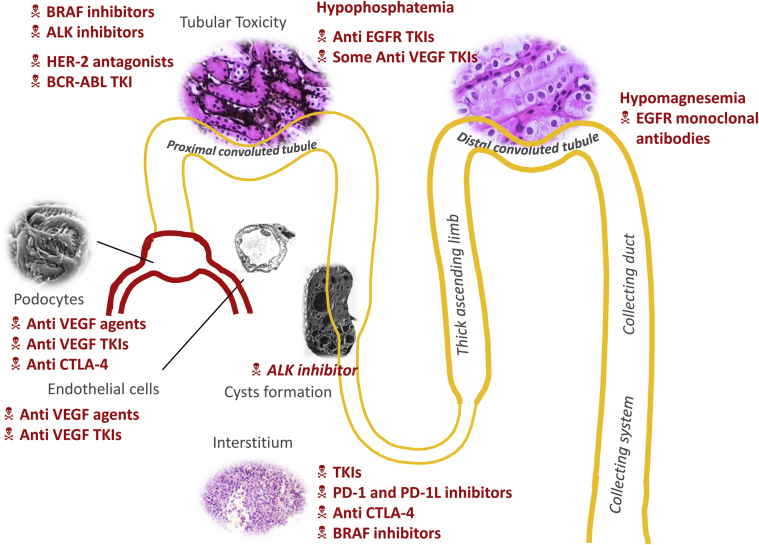
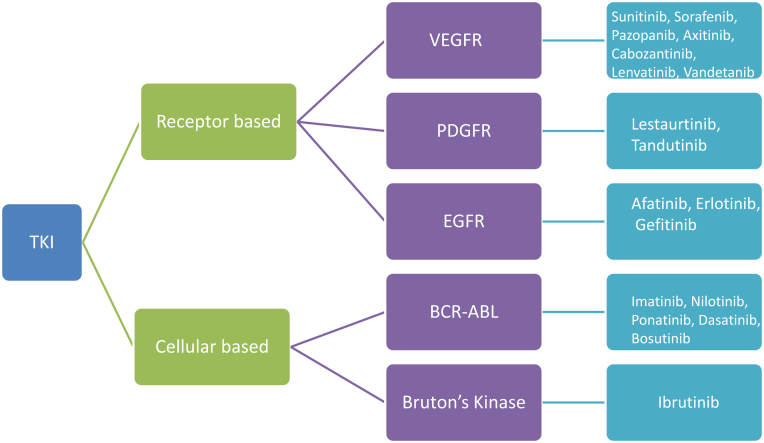
Novel targeted anti-cancer therapies have resulted in improvement in patient survival compared to standard chemotherapy. Renal toxicities of targeted agents are increasingly being recognized. The incidence, severity, and pattern of renal toxicities may vary according to the respective target of the drug. Here we review the adverse renal effects associated with a selection of currently approved targeted cancer therapies, directed to EGFR, HER2, BRAF, MEK, ALK, PD1/PDL1, CTLA-4, and novel agents targeted to VEGF/R and TKIs. In summary, electrolyte disorders, renal impairment and hypertension are the most commonly reported events. Of the novel targeted agents, ipilumumab and cetuximab have the most nephrotoxic events reported. The early diagnosis and prompt recognition of these renal adverse events are essential for the general nephrologist taking care of these patients.
与标准化疗相比,新型靶向抗癌疗法已使患者生存率得到提高。靶向药物的肾毒性越来越受到关注。肾毒性的发生率、严重程度和模式可能因药物各自的靶点而异。在此,我们回顾与目前批准的一系列靶向癌症疗法相关的肾脏不良反应,这些疗法针对表皮生长因子受体(EGFR)、人表皮生长因子受体2(HER2)、B-Raf原癌基因丝氨酸/苏氨酸蛋白激酶(BRAF)、丝裂原活化蛋白激酶激酶(MEK)、间变性淋巴瘤激酶(ALK)、程序性死亡受体1/程序性死亡配体1(PD1/PDL1)、细胞毒性T淋巴细胞相关蛋白4(CTLA-4)以及靶向血管内皮生长因子/受体(VEGF/R)和酪氨酸激酶抑制剂(TKIs)的新型药物。总之,电解质紊乱、肾功能损害和高血压是最常报告的事件。在新型靶向药物中,伊匹单抗和西妥昔单抗报告的肾毒性事件最多。对于负责治疗这些患者的普通肾科医生而言,早期诊断和及时识别这些肾脏不良事件至关重要。