Children's Hospital, Landspitali University Hospital, Reykjavik, Iceland.
School of Engineering and Natural Sciences, University of Iceland, Reykjavík, Iceland.
Allergy. 2018 Jun;73(6):1305-1312. doi: 10.1111/all.13385. Epub 2018 Jan 31.
Consumption of oily fish or fish oil during pregnancy, lactation and infancy has been linked to a reduction in the development of allergic diseases in childhood.
In an observational study, Icelandic children (n = 1304) were prospectively followed from birth to 2.5 years with detailed questionnaires administered at birth and at 1 and 2 years of age, including questions about fish oil supplementation. Children with suspected food allergy were invited for physical examinations, allergic sensitization tests, and a double-blind, placebo-controlled food challenge if the allergy testing or clinical history indicated food allergy. The study investigated the development of sensitization to food and confirmed food allergy according to age and frequency of postnatal fish oil supplementation using proportional hazards modelling.
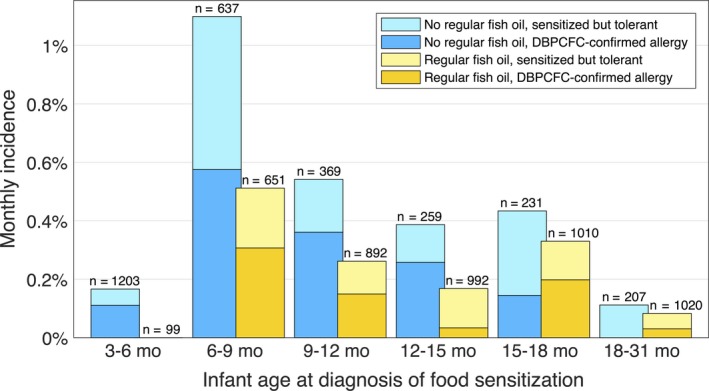
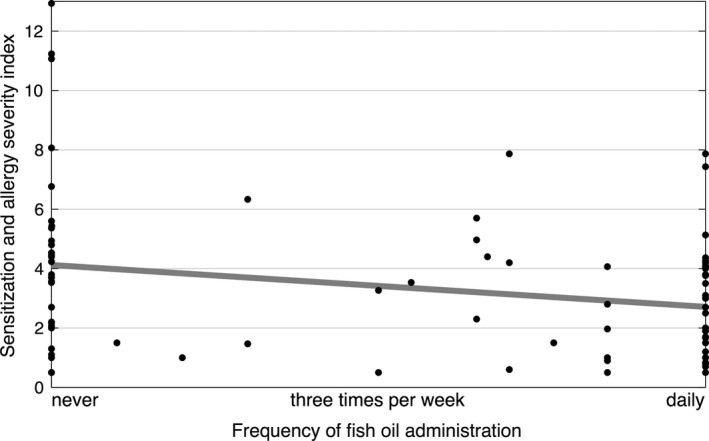
The incidence of diagnosed food sensitization was significantly lower in children who received regular fish oil supplementation (relative risk: 0.51, 95% confidence interval: 0.32-0.82). The incidence of challenge-confirmed food allergy was also reduced, although not statistically significant (0.57, 0.30-1.12). Children who began to receive fish oil in their first half year of life were significantly more protected than those who began later (P = .045 for sensitization, P = .018 for allergy). Indicators of allergy severity decreased with increased fish oil consumption (P = .013). Adjusting for parent education and allergic family history did not change the results.
Postnatal fish oil consumption is associated with decreased food sensitization and food allergies in infants and may provide an intervention strategy for allergy prevention.
孕期、哺乳期和婴儿期食用油性鱼类或鱼油与儿童期过敏性疾病的减少有关。
在一项观察性研究中,冰岛儿童(n=1304)从出生开始前瞻性随访至 2.5 岁,在出生时和 1 岁和 2 岁时进行详细的问卷调查,包括鱼油补充的问题。如果过敏测试或临床病史表明存在食物过敏,有疑似食物过敏的儿童将被邀请进行体格检查、过敏敏感测试和双盲、安慰剂对照的食物挑战。该研究根据年龄和产后鱼油补充的频率,使用比例风险建模来调查食物过敏致敏和确诊食物过敏的发展。
定期补充鱼油的儿童食物过敏发生率显著降低(相对风险:0.51,95%置信区间:0.32-0.82)。虽然没有统计学意义,但挑战确诊的食物过敏发生率也降低(0.57,0.30-1.12)。在生命的前半年开始接受鱼油的儿童比后期开始接受鱼油的儿童受到的保护更显著(致敏的 P=0.045,过敏的 P=0.018)。随着鱼油摄入量的增加,过敏严重程度的指标也有所降低(P=0.013)。调整父母教育和过敏家族史后,结果并未改变。
产后鱼油的摄入与婴儿食物过敏致敏和食物过敏的减少有关,可能为预防过敏提供一种干预策略。