Venter Carina, Smith Peter K, Fleischer David M
Section of Allergy and Immunology, Department of Pediatrics, Children's Hospital Colorado, University of Colorado School of Medicine, Aurora, CO, USA.
Qld Allergy Services, Southport, QLD, Australia.
Asia Pac Allergy. 2023 Mar;13(1):15-27. doi: 10.5415/apallergy.0000000000000001. Epub 2023 Apr 28.
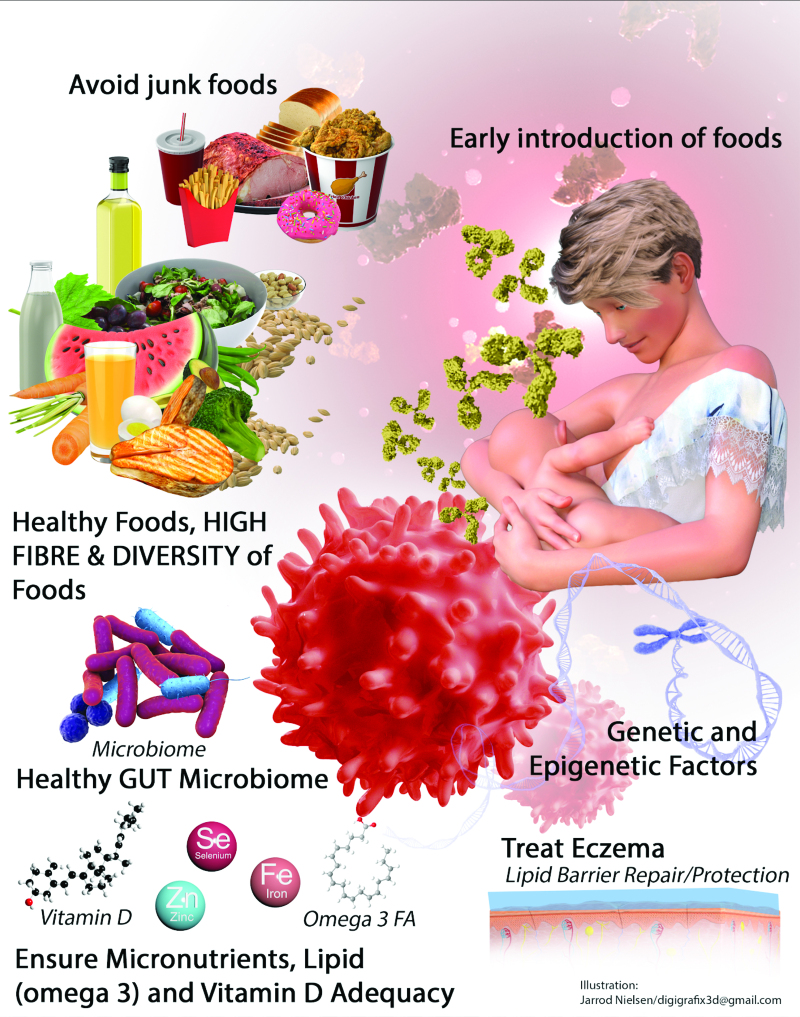
Food allergy prevention involves recommendations to the maternal diet during pregnancy and breast feeding, early life feeding and introduction of solid foods. Pregnant and breastfeeding women are not recommended to exclude any food allergens from their diet, but data are lacking to support active consumption of food allergens for prevention of food allergy. Breastfeeding is recommended for the many health benefits to the mother and child but has not shown any association with reduction in childhood food allergies. There is currently no recommendation regarding the use of any infant formula for allergy prevention, including the use of partially or extensively hydrolyzed formulas. Once the introduction of solid food commences, based on randomized controlled trials, it is advised to actively introduce peanuts and egg early into the infant diet and continue with consumption of these. Although there are limited data with respect to other major food allergens and whether early introduction may prevent allergy development, there is no need to delay the introduction of these allergens into the infant diet. Interpreting food allergen consumption in the context of cultural food practices has not been studied, but it makes sense to introduce the infant to family foods by 1 year of age. Consumption of foods typical of the Western diet and foods high in advanced glycation end products may be associated with an increase in food allergies. Similarly, intake of micronutrients, such as vitamin D and omega-3 fatty acids in both the maternal and infant diet, needs further clarification in the context of food allergy prevention.
食物过敏的预防涉及孕期和哺乳期的孕产妇饮食建议、早期喂养以及固体食物的引入。不建议孕妇和哺乳期妇女在饮食中排除任何食物过敏原,但缺乏数据支持为预防食物过敏而主动摄入食物过敏原。推荐母乳喂养,因为这对母婴有诸多健康益处,但尚未显示出与降低儿童食物过敏有任何关联。目前对于使用任何婴儿配方奶粉预防过敏,包括部分或深度水解配方奶粉,均无相关建议。一旦开始引入固体食物,基于随机对照试验,建议在婴儿饮食中尽早主动引入花生和鸡蛋,并持续食用。尽管关于其他主要食物过敏原以及早期引入是否可预防过敏发生的数据有限,但无需延迟在婴儿饮食中引入这些过敏原。尚未研究在文化饮食习俗背景下对食物过敏原摄入的解读,但在1岁前让婴儿接触家庭食物是合理的。西方饮食典型食物以及晚期糖基化终产物含量高的食物的摄入可能与食物过敏增加有关。同样,在预防食物过敏的背景下,母婴饮食中维生素D和ω-3脂肪酸等微量营养素的摄入需要进一步阐明。