Department of Epidemiology, Harvard T. H. School Chan School of Public Health, Boston, Massachusetts, USA.
Department of Nutrition, Harvard T. H. Chan School of Public Health, Boston, Massachusetts, USA.
Mov Disord. 2018 Mar;33(3):414-420. doi: 10.1002/mds.27279. Epub 2018 Jan 10.
Caffeine intake has been inversely associated with Parkinson's disease (PD) risk. This relationship may be modified by polymorphisms of glutamate ionotropic receptor NMDA type subunit 2A (GRIN2A) and cytochrome P450 1A2 (CYP1A2), but the results of previous studies have been inconsistent.
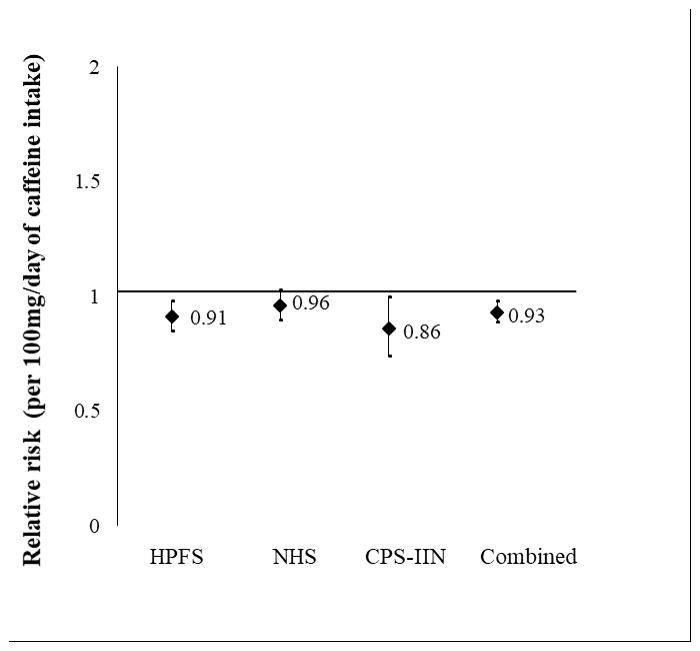
We examined the interaction of caffeine intake with GRIN2A-rs4998386 and CYP1A2-rs762551 polymorphisms in influencing PD risk among 829 incident cases of PD and 2,754 matched controls selected among participants in the following 3 large prospective ongoing cohorts: the Nurses' Health Study, the Health Professionals' Follow-up Study, and the Cancer Prevention Study II Nutrition Cohort. Matching factors included cohort, birth year, source of DNA, date of DNA collection, and race. Relative risks and 95% confidence intervals were estimated using conditional logistic models. Interactions were tested both on the multiplicative scale and on the additive scale.
Overall, caffeine intake was associated with a lower PD risk (adjusted relative risk for highest versus lowest tertile = 0.70; 95% confidence interval, 0.57-0.86; p < .001). In analyses stratified by the GRIN2A-rs4998386 genotype, the multivariable-adjusted relative risk of PD comparing the highest to the lowest tertile of caffeine was 0.69 (95% confidence interval, 0.55-0.88; p < .01) among individuals homozygous for the C allele, and 0.85 (95% confidence interval, 0.55-1.32; p = .47; p = .43) among carriers for the T allele. Interactions between caffeine and GRIN2A were not significant in either the multiplicative or additive scales. We also did not observe significant interactions for CYP1A2-rs762551 and incident PD risk.
Our findings do not support the hypothesis of an interaction between the GRIN2A-rs4998386 or CYP1A2-rs762551 polymorphism and caffeine intake in determining PD risk. © 2018 International Parkinson and Movement Disorder Society.
咖啡因的摄入与帕金森病(PD)风险呈负相关。这种关系可能受到谷氨酸离子型受体 NMDA 型亚单位 2A(GRIN2A)和细胞色素 P450 1A2(CYP1A2)多态性的影响,但是之前的研究结果并不一致。
我们在以下 3 个大型前瞻性队列研究的参与者中,对 829 例新发 PD 病例和 2754 例匹配对照进行了研究,以检查咖啡因摄入量与 GRIN2A-rs4998386 和 CYP1A2-rs762551 多态性之间的相互作用对 PD 风险的影响。匹配因素包括队列、出生年份、DNA 来源、DNA 采集日期和种族。使用条件逻辑模型估计相对风险和 95%置信区间。在乘法和加法尺度上都测试了相互作用。
总的来说,咖啡因的摄入与 PD 风险较低相关(最高与最低三分位相比的调整相对风险=0.70;95%置信区间,0.57-0.86;p<0.001)。在按 GRIN2A-rs4998386 基因型分层的分析中,比较最高与最低三分位的咖啡因,与 CC 基因型个体相比,PD 的多变量调整相对风险为 0.69(95%置信区间,0.55-0.88;p<0.01),而 TT 基因型个体的相对风险为 0.85(95%置信区间,0.55-1.32;p=0.47;p=0.43)。在乘法和加法尺度上,咖啡因与 GRIN2A 之间的相互作用均不显著。我们也没有观察到 CYP1A2-rs762551 与 PD 发病风险之间的显著相互作用。
我们的研究结果不支持 GRIN2A-rs4998386 或 CYP1A2-rs762551 多态性与咖啡因摄入在决定 PD 风险方面相互作用的假设。