Emmett Bryan D, Youngblut Nicholas D, Buckley Daniel H, Drinkwater Laurie E
Horticulture Section, School of Integrative Plant Science, Cornell University, Ithaca, NY, United States.
Department of Microbiome Science, Max Planck Institute for Developmental Biology, Tübingen, Germany.
Front Microbiol. 2017 Dec 11;8:2414. doi: 10.3389/fmicb.2017.02414. eCollection 2017.
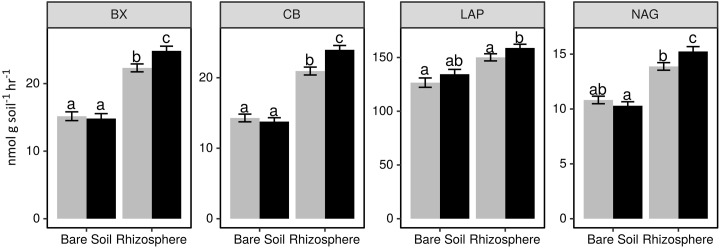
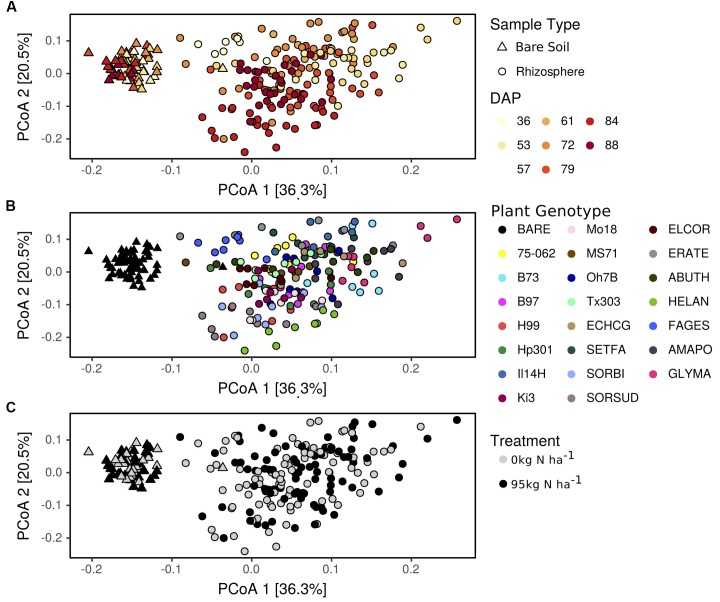
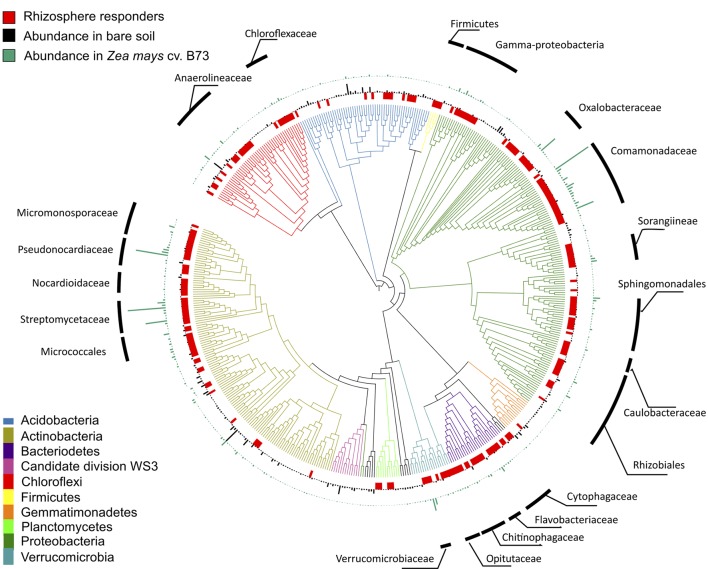
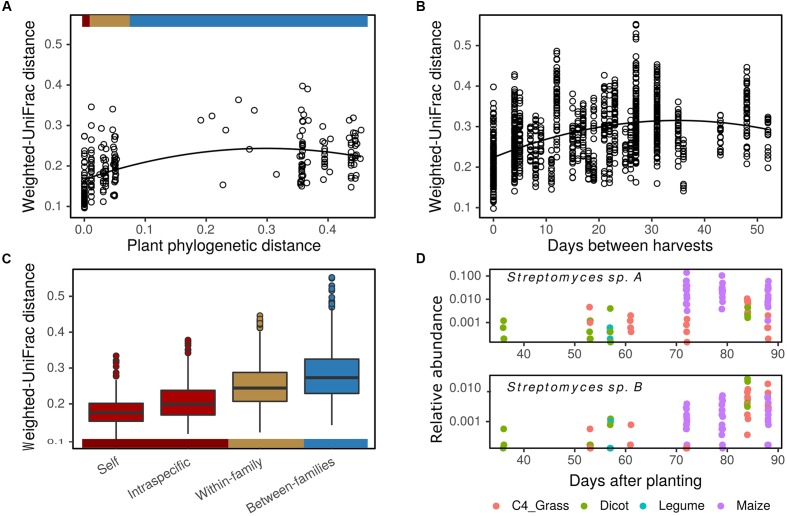
Rhizosphere microbial communities are critically important for soil nitrogen cycling and plant productivity. There is evidence that plant species and genotypes select distinct rhizosphere communities, however, knowledge of the drivers and extent of this variation remains limited. We grew 11 annual species and 11 maize ( subsp. ) inbred lines in a common garden experiment to assess the influence of host phylogeny, growth, and nitrogen metabolism on rhizosphere communities. Growth characteristics, bacterial community composition and potential activity of extracellular enzymes were assayed at time of flowering, when plant nitrogen demand is maximal. Bacterial community composition varied significantly between different plant species and genotypes. Rhizosphere beta-diversity was positively correlated with phylogenetic distance between plant species, but not genetic distance within a plant species. In particular, life history traits associated with plant resource acquisition (e.g., longer lifespan, high nitrogen use efficiency, and larger seed size) were correlated with variation in bacterial community composition and enzyme activity. These results indicate that plant evolutionary history and life history strategy influence rhizosphere bacterial community composition and activity. Thus, incorporating phylogenetic or functional diversity into crop rotations may be a tool to manipulate plant-microbe interactions in agricultural systems.
根际微生物群落对于土壤氮循环和植物生产力至关重要。有证据表明植物物种和基因型会选择不同的根际群落,然而,关于这种变异的驱动因素和程度的了解仍然有限。我们在一个共同园试验中种植了11种一年生植物物种和11个玉米(亚种)自交系,以评估宿主系统发育、生长和氮代谢对根际群落的影响。在开花期(此时植物对氮的需求最大)测定了生长特征、细菌群落组成和细胞外酶的潜在活性。不同植物物种和基因型之间的细菌群落组成差异显著。根际β多样性与植物物种之间的系统发育距离呈正相关,但与植物物种内的遗传距离无关。特别是,与植物资源获取相关的生活史特征(例如,更长的寿命、高氮利用效率和更大的种子大小)与细菌群落组成和酶活性的变化相关。这些结果表明,植物进化史和生活史策略会影响根际细菌群落组成和活性。因此,将系统发育或功能多样性纳入作物轮作可能是一种在农业系统中操纵植物-微生物相互作用的工具。