Dhungana Ishwora, Nguyen Nhu H
Department of Tropical Plant and Soil Sciences, University of Hawai'i at Mānoa, Honolulu, HI, USA.
Microb Ecol. 2025 Apr 16;88(1):30. doi: 10.1007/s00248-025-02530-3.
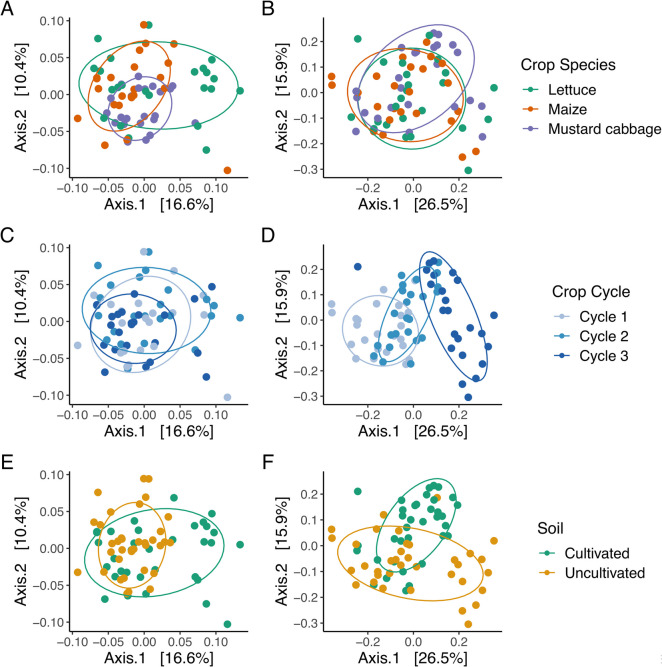
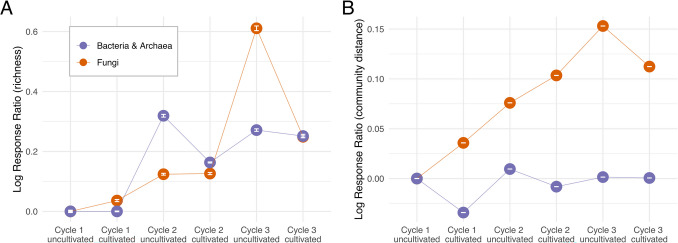
Agricultural practices and the crop being actively cultivated are some of the most important contributors to soil microbial community assembly processes in agroecosystems. However, it is not well-understood how the cultivation of diverse crop species can directionally shift complex soil microbial communities, especially under continuous monoculture systems. Here, we conducted a field experiment to assess how three crop species (Lactuca sativa, Brassica juncea, and Zea mays) may shift soil microbial (bacteria/archaea and fungi) communities when planted in a monoculture and repeatedly grown for three cycles in a tropical Oxisol soil. We found that while plant species made limited contributions to microbial community differentiation, repeated cultivation was a strong driver of community development over time. The bacterial/archaeal communities exhibited a cyclical community development pattern, initially with strong differentiation that attenuated to a steady state at the end of the three cycles. In contrast, fungal communities generally developed more linearly and may have only started to stabilize after three cropping cycles. These developments may speak to the stronger legacy effects on fungal communities. Together, these results highlight the differences between how bacteria/archaea and fungal communities develop, especially in tropical, underdeveloped, intensively degraded, or marginal soils.
农业实践活动以及正在种植的作物是农业生态系统中土壤微生物群落组装过程的一些最重要的影响因素。然而,人们对种植不同作物品种如何定向改变复杂的土壤微生物群落了解甚少,尤其是在连续单作系统下。在此,我们进行了一项田间试验,以评估三种作物品种(生菜、芥菜和玉米)在热带氧化土中进行单作种植并连续种植三个周期时,如何改变土壤微生物(细菌/古菌和真菌)群落。我们发现,虽然植物品种对微生物群落分化的贡献有限,但随着时间的推移,重复种植是群落发展的一个强大驱动因素。细菌/古菌群落呈现出一种周期性的群落发展模式,最初分化强烈,在三个周期结束时减弱至稳定状态。相比之下,真菌群落的发展通常更呈线性,可能在三个种植周期后才开始稳定。这些发展情况可能说明对真菌群落的遗留影响更强。总之,这些结果凸显了细菌/古菌群落和真菌群落发展方式的差异,尤其是在热带、欠发达、严重退化或边缘土壤中。