Department of Ophthalmology, Dongsan Medical Center, Keimyung University School of Medicine, Daegu, 41931, Korea.
Sci Rep. 2018 Jan 11;8(1):511. doi: 10.1038/s41598-017-18926-2.
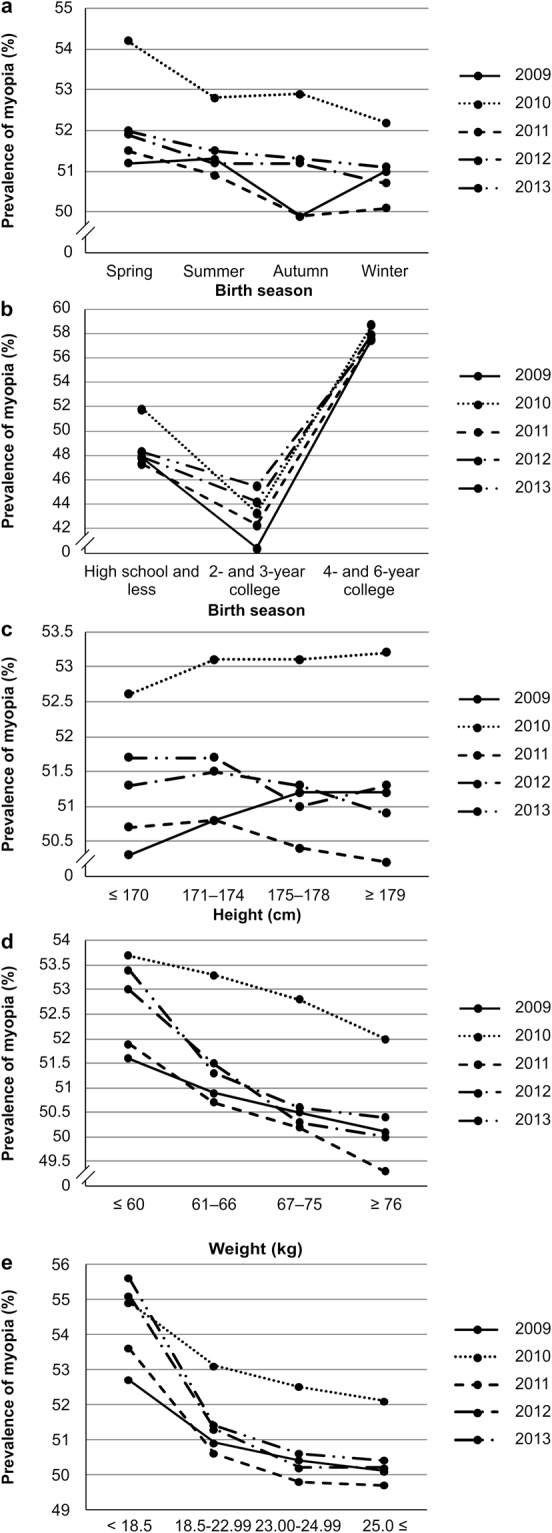
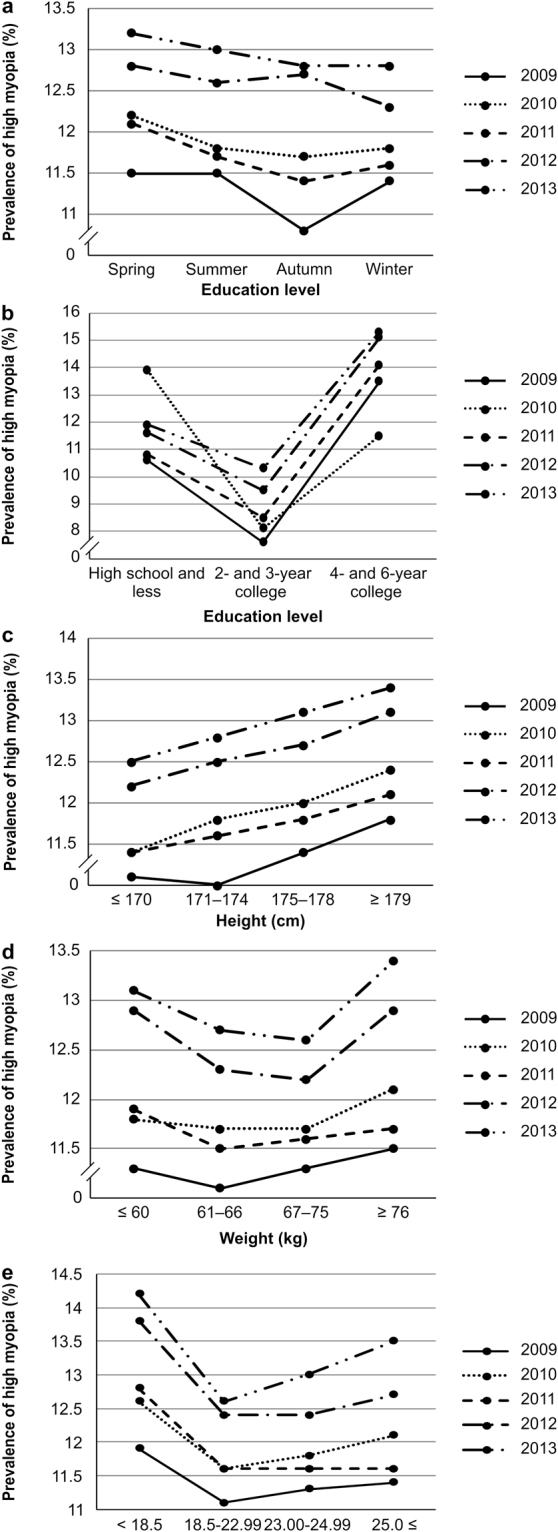
The prevalence of myopia has been increasing worldwide. Its causes are not completely clear, although genetic and environmental factors are thought to play a role. Data were collected by the Korean Military Manpower Administration. Frequency analysis was used for comparisons of general characteristics. Pearson's chi-square tests and logistic regression analysis were used to verify the correlations between possible risk factors and the prevalence of myopia or high myopia. The prevalence of myopia (50.6-53.0%) and high myopia (11.3-12.9%) increased each year. These tended to be the highest in patients born in spring, and decreased in the following order according to education level: 4- or 6-year university education or more, high school education or less, and 2- to 3-year college education. Moreover, the prevalence of myopia and high myopia was significantly higher in patients ≤ 60 kg and with a body mass index ≤ 18.5 kg/m. The prevalence of high myopia was significantly higher in taller patients (≥175 cm). The prevalence of myopia and high myopia increased each year in Korean young adult men and was associated with birth season, education level, height, weight, and body mass index. Tall, lean men were more likely to have high myopia.
近视的患病率在全球范围内不断上升。虽然遗传和环境因素被认为起作用,但近视的确切病因尚不完全清楚。数据由韩国军方人力管理局收集。采用频率分析比较一般特征。采用皮尔逊卡方检验和逻辑回归分析验证可能的危险因素与近视或高度近视患病率之间的相关性。近视(50.6-53.0%)和高度近视(11.3-12.9%)的患病率逐年上升。这些趋势在春季出生的患者中最高,按教育程度依次降低:4 或 6 年制大学教育或以上、高中教育或以下、2 至 3 年制大专教育。此外,体重指数(BMI)≤18.5kg/m2且体重≤60kg 的患者近视和高度近视的患病率显著更高。身高≥175cm 的患者高度近视的患病率显著更高。韩国年轻男性近视和高度近视的患病率逐年上升,与出生季节、教育程度、身高、体重和 BMI 有关。高瘦的男性更有可能患有高度近视。