Garcia Carla, Golay Philippe, Favrod Jérôme, Bonsack Charles
Community Psychiatry Unit, Department of Psychiatry, Centre Hospitalier Universitaire Vaudois, Lausanne, Switzerland.
School of Nursing Sciences La Source, University of Applied Sciences and Arts of Western Switzerland, Lausanne, Switzerland.
Front Psychiatry. 2017 Dec 18;8:290. doi: 10.3389/fpsyt.2017.00290. eCollection 2017.
The concept of stigma refers to problems of knowledge (ignorance), attitudes (prejudice), and behavior (discrimination). Stigma may hinder access to care, housing, and work. In the context of implementation of programs such as "housing first" or "individual placement and support" in French speaking regions, validated instruments measuring stigma are necessary. "Attitudes to Mental Illness 2011" is a questionnaire that includes three scales measuring stigma through these three dimensions. This study aimed to translate, adapt, and validate these three scales in French.
The "Attitudes to Mental Illness 2011" questionnaire was translated into French and back-translated into English by an expert. Two hundred and sixty-eight nursing students completed the questionnaire. Content validity, face validity, internal validity, and convergent validity were assessed. Long-term reliability was also estimated over a three-month period.
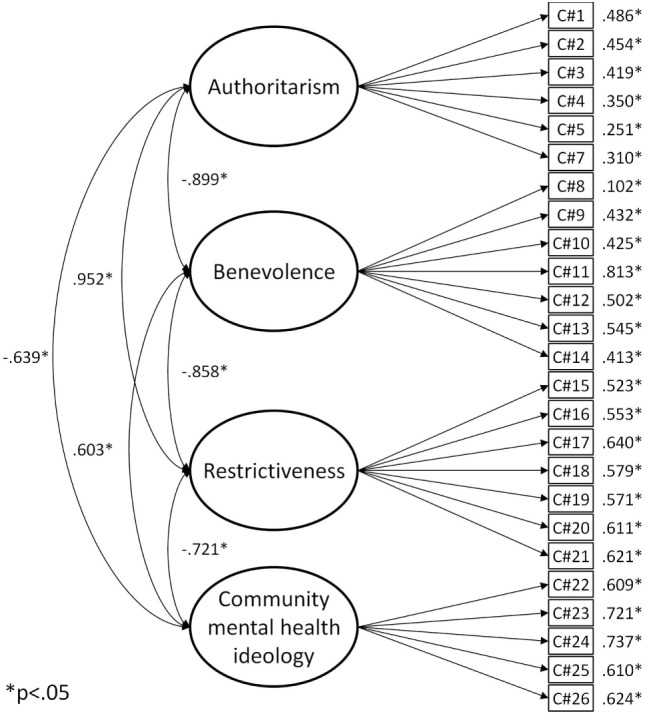
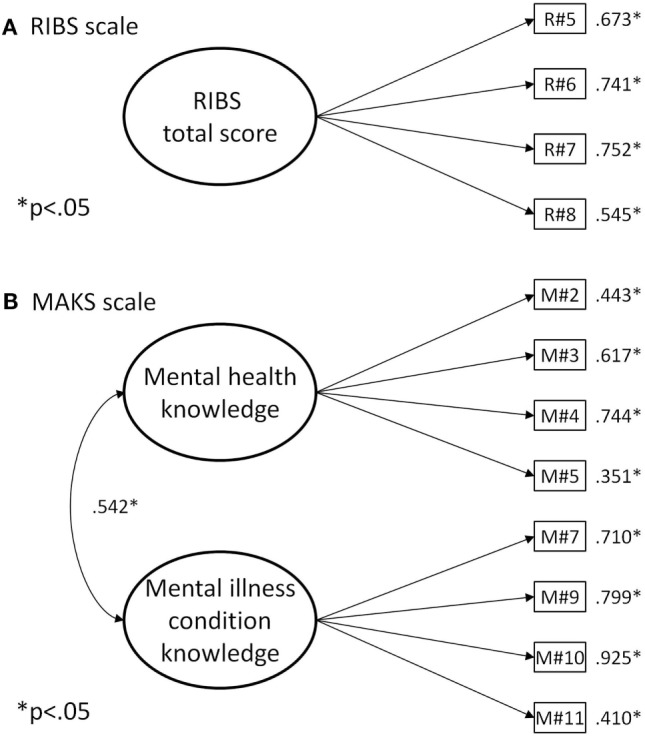
Experts and participants found that the questionnaire's content validity and face validity were appropriate. The internal validities of the three scales were also considered adequate. Convergent validity indicated that the scales did indeed measure what they were supposed to. Long-term stability estimates were moderate; this pattern of results suggested that the construct targeted by the three scales is adequately measured but does not necessarily represent stable and enduring traits.
Because of their good psychometric properties, these three scales can be used in French, either separately, to measure one specific dimension of stigma, or together, to assess stigma in its three dimensions. This would seem of paramount importance in evaluating campaigns against stigma since it allows measures to be adapted according to campaign goals and the target population.
污名化概念涉及知识(无知)、态度(偏见)和行为(歧视)等问题。污名化可能会阻碍获得医疗、住房和工作机会。在法语地区实施诸如“住房优先”或“个人安置与支持”等项目的背景下,需要经过验证的测量污名化的工具。《2011年对精神疾病的态度》是一份问卷,其中包括通过这三个维度测量污名化的三个量表。本研究旨在将这三个量表翻译成法语、进行改编并验证。
《2011年对精神疾病的态度》问卷由一位专家翻译成法语,然后再回译成英语。268名护理专业学生完成了该问卷。评估了内容效度、表面效度、内部效度和收敛效度。还估计了三个月期间的长期信度。
专家和参与者发现该问卷的内容效度和表面效度是合适的。这三个量表的内部效度也被认为是充分的。收敛效度表明这些量表确实测量了它们应该测量的内容。长期稳定性估计适中;这种结果模式表明,这三个量表所针对的结构得到了充分测量,但不一定代表稳定和持久的特征。
由于这三个量表具有良好的心理测量特性,它们可以用法语单独使用,以测量污名化的一个特定维度,也可以一起使用,以评估污名化的三个维度。这在评估反污名化运动中似乎至关重要,因为它允许根据运动目标和目标人群调整测量方法。