Analytical Sciences Unit, Institute of Food Research, Norwich Research Park, Norwich NR4 7UA, UK.
Oxford Instruments, Tubney Woods, Abingdon, Oxford OX13 5QX, UK.
Food Chem. 2018 May 15;248:52-60. doi: 10.1016/j.foodchem.2017.12.034. Epub 2017 Dec 11.
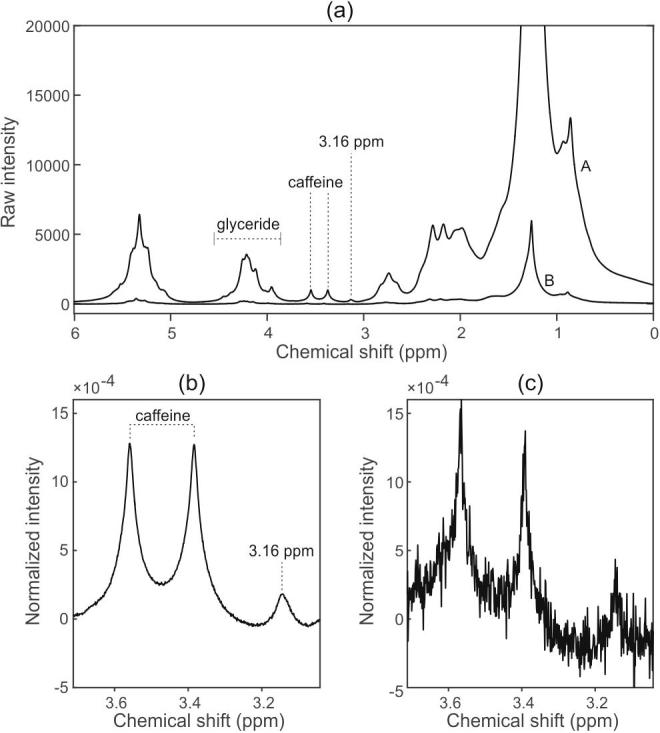
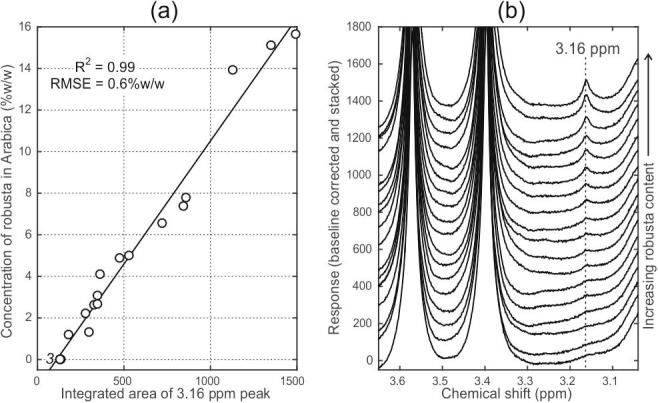
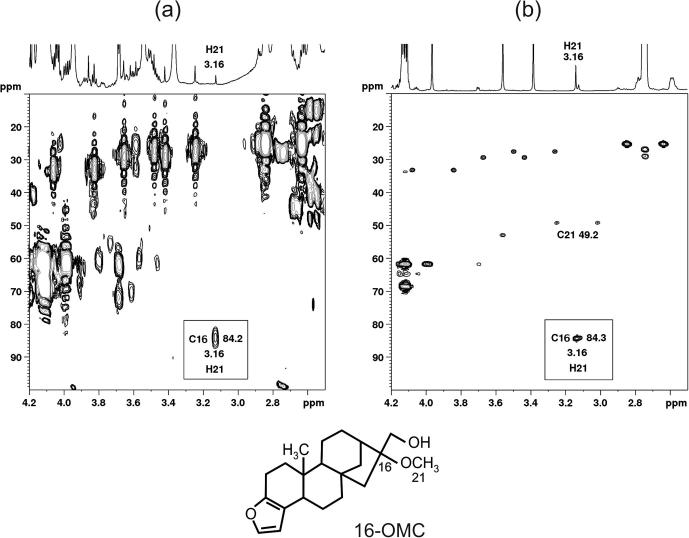
High-field and low-field proton NMR spectroscopy were used to analyse lipophilic extracts from ground roast coffees. Using a sample preparation method that produced concentrated extracts, a small marker peak at 3.16 ppm was observed in 30 Arabica coffees of assured origin. This signal has previously been believed absent from Arabicas, and has been used as a marker for detecting adulteration with robusta. Via 2D 600 MHz NMR and LC-MS, 16-O-methylcafestol and 16-O-methylkahweol were detected for the first time in Arabica roast coffee and shown to be responsible for the marker peak. Using low-field NMR, robusta in Arabica could be detected at levels of the order of 1-2% w/w. A surveillance study of retail purchased "100% Arabica" coffees found that 6 out of 60 samples displayed the 3.16 ppm marker signal to a degree commensurate with adulteration at levels of 3-30% w/w.
采用高场和低场质子 NMR 光谱法分析研磨烘焙咖啡的亲脂提取物。使用一种产生浓缩提取物的样品制备方法,在 30 种来源可靠的阿拉比卡咖啡中观察到 3.16 ppm 处的一个小标记峰。该信号以前被认为不存在于阿拉比卡咖啡中,并且一直被用作检测与罗布斯塔混合的标记物。通过二维 600 MHz NMR 和 LC-MS,首次在阿拉比卡烘焙咖啡中检测到 16-O-甲基咖啡醇和 16-O-甲基卡瓦醇,并证明它们是标记峰的原因。使用低场 NMR,可以检测到阿拉比卡中的罗布斯塔含量在 1-2% w/w 左右。对零售购买的“100%阿拉比卡”咖啡的监测研究发现,在 60 个样品中有 6 个样品显示出 3.16 ppm 的标记信号,与 3-30% w/w 的掺假水平相当。