Mohammed Mohammed A, Moles Rebekah J, Hilmer Sarah N, Kouladjian O'Donnel Lisa, Chen Timothy F
Faculty of Pharmacy, University of Sydney, Sydney, New South Wales, Australia.
Department of Clinical Pharmacology and Aged Care, Royal North Shore Hospital, Kolling Institute of Medical Research, Sydney, New South Wales, Australia.
BMJ Open. 2018 Jan 11;8(1):e018880. doi: 10.1136/bmjopen-2017-018880.
Medication-related burden (MRB) is a negative experience with medicine, which may impact on psychological, social, physical and financial well-being of an individual. This study describes the development and initial validation of an instrument specifically designed to measure MRB on functioning and well-being-the Medication-Related Burden Quality of Life (MRB-QoL) tool.
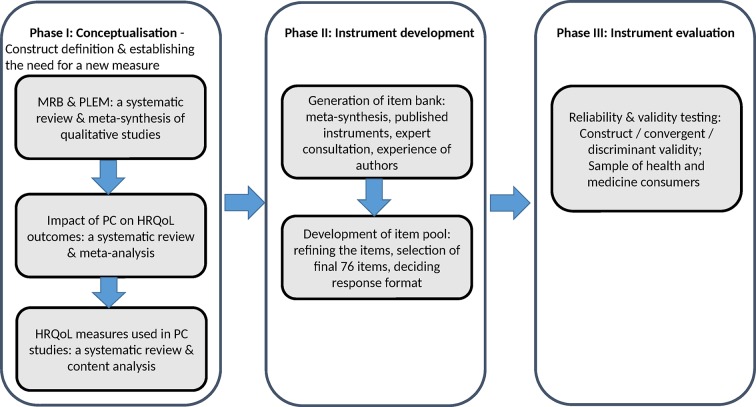
An initial pool of 76-items for MRB-QoL was generated. The link to MRB-QoL survey was sent to a sample of consumers living with at least one chronic medical condition and taking ≥3 prescription medicines on a regular basis. Exploratory factor analysis (EFA) was used to determine the underlining factor structure. Internal consistency (Cronbach's α) and construct validity were examined. The latter was examined through correlation with Medication Regimen Complexity Index (MRCI), Drug Burden Index (DBI) and Charlson's Comorbidity Index (CCI).
367 consumers completed the survey (51.2% male). EFA resulted in a 31-item, five-factor solution explaining 72% of the total variance. The five subscales were labelled as 'Routine and Regimen Complexity' (11 items), 'Psychological Burden' (six items), 'Functional and Role Limitation' (seven items), 'Therapeutic Relationship' (three items) and 'Social Burden' (four items). All subscales showed good internal consistency (Cronbach's α 0.87 to 0.95). Discriminant validity of MRB-QoL was demonstrated via its correlations with MRCI (Spearman's r -0.16 to 0.08), DBI (r 0.12 to 0.28) and CCI (r -0.23 to -0.15). Correlation between DBI and 'Functional and Role Limitation' subscale (r 0.36) indicated some evidence of convergent validity. Patients with polypharmacy, multiple morbidity and DBI >0 had higher median scores of MRB-QoL providing evidence for known group validity.
The MRB-QoL V.1 has good construct validity and internal consistency. The MRB-QoL may be a useful humanistic measure for evaluating the impact of pharmaceutical care interventions on patients' quality of life. Future research is warranted to further examine additional psychometric properties of MRB-QoL V.1 and its utility in patient care.
药物相关负担(MRB)是一种与药物有关的负面体验,可能会影响个人的心理、社会、身体和经济福祉。本研究描述了一种专门设计用于测量药物对功能和福祉影响的工具——药物相关负担生活质量(MRB-QoL)工具的开发和初步验证。
生成了一个包含76个条目的MRB-QoL初始条目池。将MRB-QoL调查问卷的链接发送给至少患有一种慢性疾病且定期服用≥3种处方药的消费者样本。采用探索性因素分析(EFA)来确定潜在的因素结构。检验了内部一致性(Cronbach's α)和结构效度。通过与药物治疗方案复杂性指数(MRCI)、药物负担指数(DBI)和查尔森合并症指数(CCI)的相关性来检验结构效度。
367名消费者完成了调查(男性占51.2%)。探索性因素分析得出了一个包含31个条目的五因素模型,解释了总方差的72%。这五个子量表分别被标记为“日常和治疗方案复杂性”(11个条目)、“心理负担”(6个条目)、“功能和角色限制”(7个条目)、“治疗关系”(3个条目)和“社会负担”(4个条目)。所有子量表都显示出良好的内部一致性(Cronbach's α为0.87至0.95)。MRB-QoL的区分效度通过其与MRCI(斯皮尔曼相关系数r为-0.16至0.08)、DBI(r为0.12至0.28)和CCI(r为-0.23至-0.15)的相关性得到证明。DBI与“功能和角色限制”子量表之间的相关性(r为0.36)表明存在一些收敛效度的证据。患有多种药物治疗、多种合并症且DBI>0的患者的MRB-QoL中位数得分较高,为已知组效度提供了证据。
MRB-QoL V.1具有良好的结构效度和内部一致性。MRB-QoL可能是评估药学服务干预对患者生活质量影响的一种有用的人文测量工具。有必要进行进一步的研究,以进一步检验MRB-QoL V.1的其他心理测量特性及其在患者护理中的效用。