Santos Maria Pia Costa, Gomes Catarina, Torres Joana
Gastroenterology Division, Surgical Department, Hospital Beatriz Ângelo, Loures, Portugal.
Ann Gastroenterol. 2018 Jan-Feb;31(1):14-23. doi: 10.20524/aog.2017.0208. Epub 2017 Oct 26.
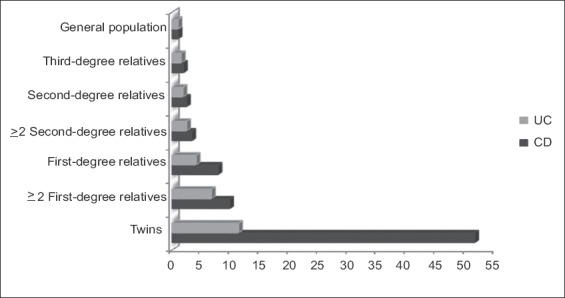
Familial aggregation in inflammatory bowel disease (IBD) has been established for several decades, reflecting shared genetic and environmental susceptibility. A positive family history remains the strongest recognizable risk factor for the development of IBD and is reported in around 8-12% of IBD patients. Crohn's disease shows a more frequent familial pattern than ulcerative colitis. The risk of developing IBD in first-degree relatives of an affected proband is increased 4- to 8-fold. The risk for twins and children born from couples who both have IBD is also substantially higher; a cumulative effect of the number of family members affected has been described, with the highest incidence being described for families with three or more affected members. Herein, we review the available evidence regarding familial IBD, and briefly discuss the variation of IBD across different races and ethnicities, hoping to provide a useful update and a practical guide that can serve clinicians as a guide for counseling.
炎症性肠病(IBD)的家族聚集现象已被证实数十年,这反映了共同的遗传和环境易感性。家族史阳性仍然是IBD发病最明显的风险因素,约8%-12%的IBD患者有家族史。克罗恩病比溃疡性结肠炎表现出更常见的家族模式。受累先证者的一级亲属患IBD的风险增加4至8倍。双胞胎以及父母双方均患有IBD的孩子患IBD的风险也显著更高;有描述称受影响家庭成员数量存在累积效应,受影响成员为三人或更多的家庭发病率最高。在此,我们综述了有关家族性IBD的现有证据,并简要讨论IBD在不同种族和民族中的差异,希望能提供有用的更新内容和实用指南,为临床医生提供咨询指导。