Dorostghoal Mehran, Ghaffari Hamid-O-Allah, Marmazi Farideh, Keikhah Narjes
Infectious Diseases Research Center, Birjand University of Medical Sciences, Birjand, Iran.
Hematology-Oncology and Stem Cell Transplantation Research Center, Tehran University of Medical Science, Tehran, Iran.
Int J Fertil Steril. 2018 Apr;12(1):37-42. doi: 10.22074/ijfs.2018.5118. Epub 2018 Jan 7.
Failure in the endometrial receptivity may account for a significant number of infertility cases including unexplained infertility in women. Reduction in the endometrial estrogen receptor-alpha (ER-α) expression during implantation may be a critical event that coincides with the expression of specific genes and the formation of a receptive endometrium. The aim of the present study was to assess the expression of ER-α in the mid-secretory phase in the endometrium of women with unexplained infertility.
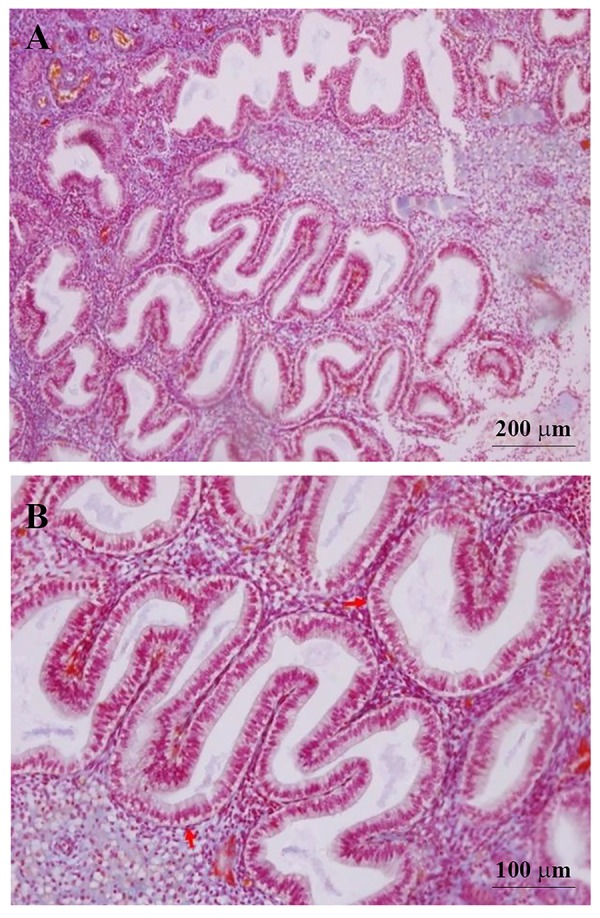
This case-control study was carried out on randomly selected fertile (n=10) and infertile (n=16) women whose source of infertility remained unexplained. We evaluated the expression of ER-α and glycodelin- A (GdA) through mRNA level measurement with real-time polymerase chain reaction (PCR) in the endometrium of fertile women and patients suffering from unexplained infertility and fertile women. Endometrial biopsies of each subject were collected during a single menstrual cycle 7 days after the peak of luteinizing hormone (LH+7).
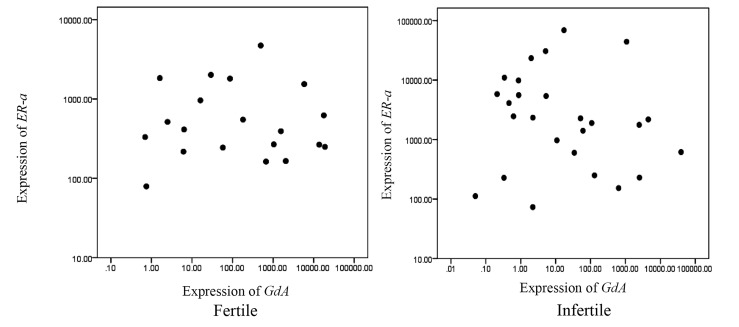
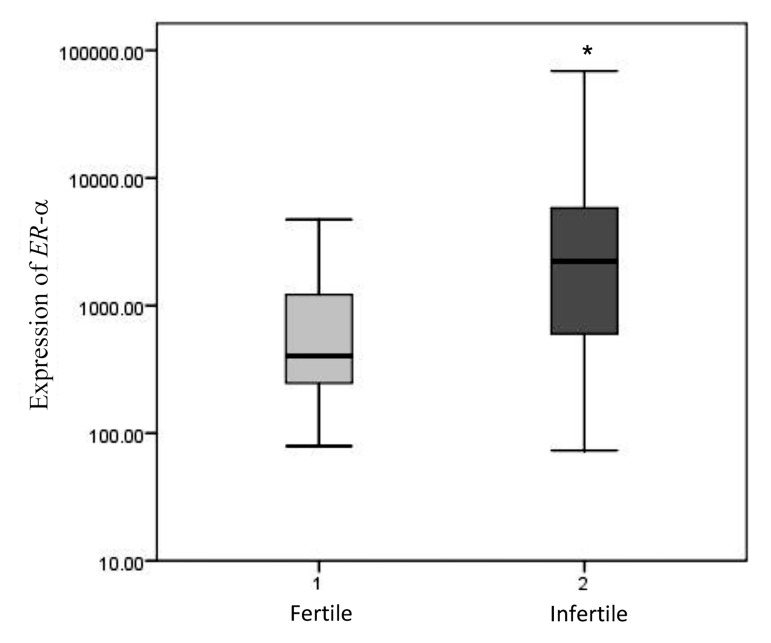
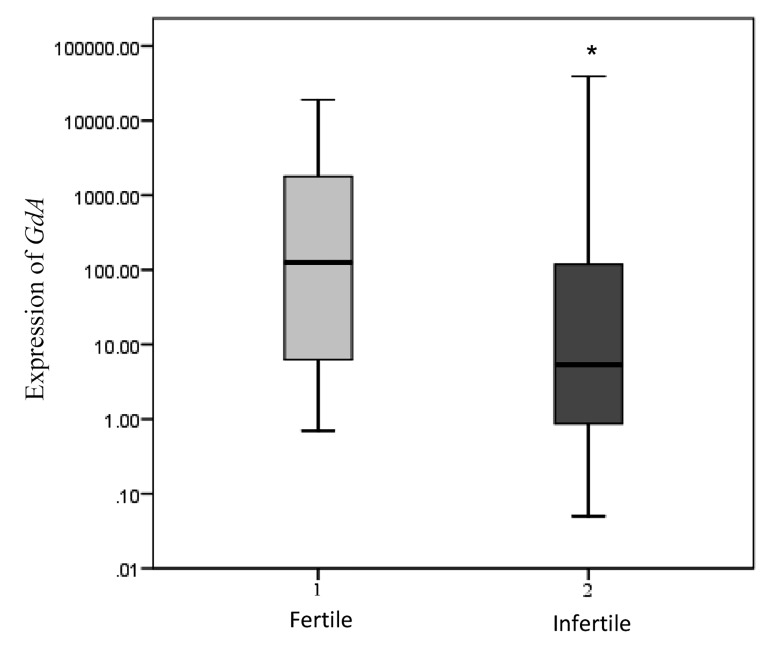
Endometrial expression level of ER-α was significantly (P<0.05) higher in the patients with unexplained infertility compared to the control. Significantly (P<0.05) lower levels of GdA expression were seen in women with unexplained infertility. A statistically non-significant negative correlation was observed between ER-α and GdA mRNA expression.
Our findings demonstrate that reduction in the endometrial GdA expression is associated with elevated expression of ER-α in mid-luteal phase. Disruption in the endometrial ER-α expression, which leads to defects in uterine receptivity, may contribute to unexplained infertility.
子宫内膜容受性失败可能是导致大量不孕病例的原因,包括女性不明原因不孕。着床期间子宫内膜雌激素受体-α(ER-α)表达的降低可能是一个关键事件,与特定基因的表达及容受性子宫内膜的形成同时发生。本研究的目的是评估不明原因不孕女性子宫内膜中分泌中期ER-α的表达情况。
本病例对照研究对随机选取的有生育能力的女性(n = 10)和不明原因不孕的女性(n = 16)进行。通过实时聚合酶链反应(PCR)测量mRNA水平,我们评估了有生育能力的女性、不明原因不孕患者及有生育能力女性子宫内膜中ER-α和糖蛋白A(GdA)的表达。在黄体生成素峰值后7天(LH + 7)的单个月经周期内收集每个受试者的子宫内膜活检样本。
与对照组相比,不明原因不孕患者子宫内膜中ER-α的表达水平显著更高(P < 0.05)。不明原因不孕女性中GdA表达水平显著更低(P < 0.05)。观察到ER-α与GdA mRNA表达之间存在统计学上无显著意义的负相关。
我们的研究结果表明,子宫内膜GdA表达的降低与黄体中期ER-α表达的升高有关。子宫内膜ER-α表达的破坏导致子宫容受性缺陷,可能是不明原因不孕的原因之一。