Jun Ji Eun, Choi Young Ju, Lee Yong-Ho, Kim Dae Jung, Park Seok Won, Huh Byung Wook, Lee Eun Jig, Jee Sun-Ha, Hur Kyu Yeon, Choi Sung Hee, Huh Kap Bum
Division of Endocrinology and Metabolism, Department of Medicine, Samsung Medical Center, Sungkyunkwan University School of Medicine, Seoul, Korea.
Huh's Diabetes Center and 21st Century Diabetes and Vascular Research Institute, Seoul, Korea.
Korean J Intern Med. 2018 Jan;33(1):138-147. doi: 10.3904/kjim.2017.396. Epub 2017 Dec 28.
BACKGROUND/AIMS: This study aimed to investigate whether the apolipoprotein (Apo) B/ApoA-I ratio is associated with carotid intima-media thickness (CIMT) in type 2 diabetes mellitus (T2DM) subjects with low density lipoprotein cholesterol (LDL-C) levels less than 100 mg/dL.
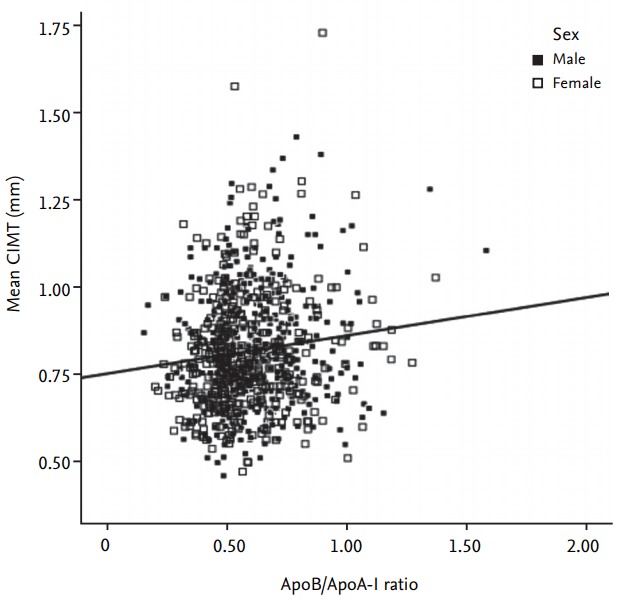
This cross-sectional study included 845 subjects aged with T2DM 40 to 75 years who had visited Huh's Diabetes Center in Seoul, Republic of Korea for CIMT measurement. Traditional fasting lipid profiles, ApoB and ApoA-I levels were examined. CIMT was measured at three points on the far wall of 1 cm long section of the common carotid artery in the proximity of the carotid bulb. The mean value of six measurements from right and left carotid arteries were used as the mean CIMT. In this study, carotid atherosclerosis was defined as having a focal plaque or diffuse thickening of the carotid wall (mean CIMT ≥ 1.0 mm).
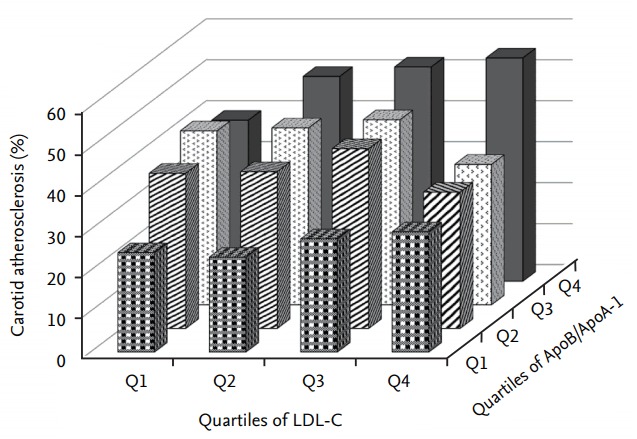
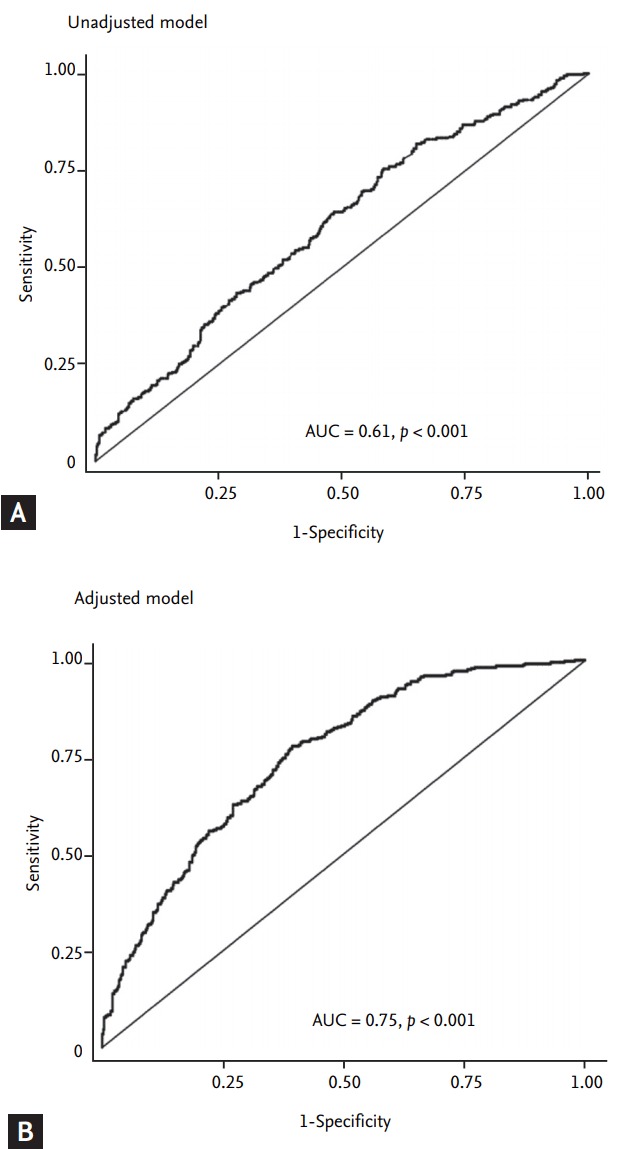
The prevalence of carotid atherosclerosis increased with ApoB/ApoA-I ratio. The ApoB/ApoA-I ratio, expressed as both quartiles (odds ratio [OR], 2.14; 95% confidence interval [CI], 1.21 to 3.79; for trend = 0.014) and continuous values (OR, 10.05; 95% CI, 3.26 to 30.97; < 0.001), was significantly associated with a higher risk for carotid atherosclerosis, regardless of conventional cardiovascular disease risk factors. The optimal ApoB/ApoA-I ratio cutoff value for detecting carotid atherosclerosis was 0.57, based on receiver operating characteristic curve analysis with a sensitivity of 58.0% and a specificity of 55.1%.
A high ApoB/ApoA-I ratio was significantly associated with carotid atherosclerosis in T2DM patients with LDL-C levels less than 100 mg/dL.
背景/目的:本研究旨在调查在低密度脂蛋白胆固醇(LDL-C)水平低于100mg/dL的2型糖尿病(T2DM)患者中,载脂蛋白(Apo)B/ApoA-I比值是否与颈动脉内膜中层厚度(CIMT)相关。
这项横断面研究纳入了845名年龄在40至75岁的T2DM患者,他们前往韩国首尔许氏糖尿病中心进行CIMT测量。检测了传统的空腹血脂谱、ApoB和ApoA-I水平。在颈总动脉球部附近1cm长节段的远壁上的三个点测量CIMT。将左右颈动脉六次测量的平均值用作平均CIMT。在本研究中,颈动脉粥样硬化定义为存在局灶性斑块或颈动脉壁弥漫性增厚(平均CIMT≥1.0mm)。
颈动脉粥样硬化的患病率随ApoB/ApoA-I比值升高而增加。ApoB/ApoA-I比值以四分位数(优势比[OR],2.14;95%置信区间[CI],1.21至3.79;趋势检验P=0.014)和连续值(OR,10.05;95%CI,3.26至30.97;P<0.001)表示,无论传统心血管疾病危险因素如何,均与颈动脉粥样硬化的较高风险显著相关。基于受试者工作特征曲线分析,检测颈动脉粥样硬化的最佳ApoB/ApoA-I比值临界值为0.57,敏感性为58.0%,特异性为55.1%。
在LDL-C水平低于100mg/dL的T2DM患者中,高ApoB/ApoA-I比值与颈动脉粥样硬化显著相关。