Richardson Julie, Tang Ada, Guyatt Gordon, Thabane Lehana, Xie Feng, Sahlas Demetrios, Hart Robert, Fleck Rebecca, Hladysh Genevieve, Macrae Louise
School of Rehabilitation Science, McMaster University, Hamilton, ON, Canada.
Department of Health Research Methods, Evidence, and Impact and Department of Medicine, McMaster University, Hamilton, ON, Canada.
Trials. 2018 Jan 15;19(1):39. doi: 10.1186/s13063-017-2416-3.
The current state of evidence suggests that community-based exercise programs are beneficial in improving impairment, function, and health status, and are greatly needed for persons with stroke. However, limitations of these studies include risk of bias, feasibility, and cost issues.
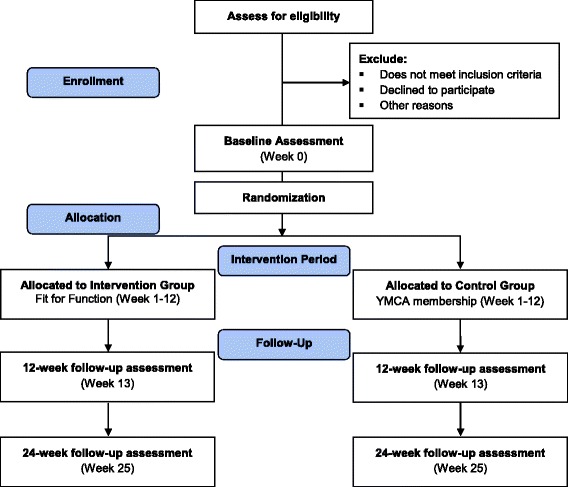
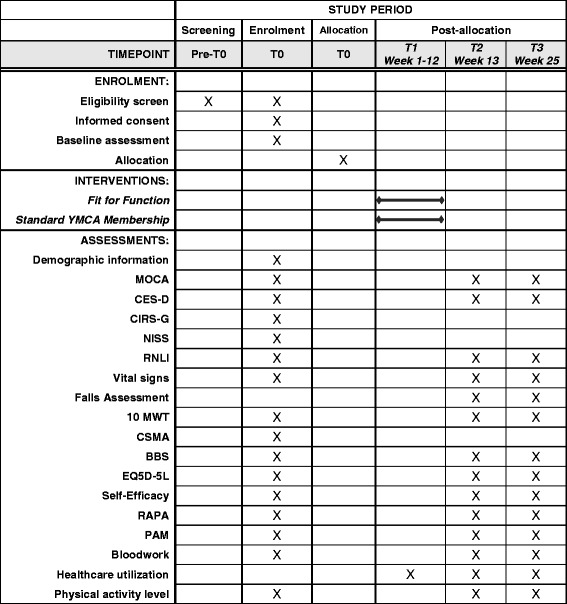
METHODS/DESIGN: This single-blinded, randomized controlled trial (RCT) of 216 participants with stroke will compare the effectiveness of a 12-week YMCA community-based wellness program (FIT for FUNCTION) specifically designed for community-dwelling persons with stroke to persons who receive a standard YMCA membership. The primary outcome will be community reintegration using the Reintegration to Normal Living Index at 12 and 24 weeks. Secondary outcomes include measurement of physical activity level using the Rapid Assessment of Physical Activity and accelerometry; balance using the Berg Balance Scale; lower extremity function using the Short Physical Performance Battery; exercise capacity using the 6-min walk test; grip strength and isometric knee extension strength using hand held dynamometry; and health-related quality of life using the European Quality of Life 5-Dimension Questionnaire. We are also assessing cardiovascular health and lipids; glucose and inflammatory markers will be collected following 12-h fast for total cholesterol, insulin, glucose, and glycated hemoglobin. Self-efficacy for physical activity will be assessed with a single question and self-efficacy for managing chronic disease will be assessed using the Stanford 6-item Scale. The Patient Activation Measure will be used to assess the patient's level of knowledge, skill, and confidence for self-management. Healthcare utilization and costs will be evaluated. Group, time, and group × time interaction effects will be estimated using generalized linear models for continuous variables, including relevant baseline variables as covariates in the analysis that differ appreciably between groups at baseline. Cost data will be treated as non-parametric and analyzed using a Mann-Whitney U test.
This is a RCT with broad study eligibility criteria intended to recruit a wide spectrum of individuals living in the community with stroke. If positive benefits are demonstrated, results will provide strong research evidence to support the implementation of structured, community-based exercise and education/self-management programs for a broad range of people living in the community with stroke.
ClinicalTrials.gov, NCT02703805 . Registered on 14 October 2014.
现有证据表明,基于社区的运动项目有助于改善功能障碍、功能和健康状况,这对于中风患者来说非常必要。然而,这些研究存在局限性,包括偏倚风险、可行性和成本问题。
方法/设计:这项针对216名中风患者的单盲随机对照试验(RCT),将比较专门为社区居住的中风患者设计的为期12周的基督教青年会(YMCA)社区健康项目(功能适应性训练)与获得标准YMCA会员资格的患者的效果。主要结局将是在12周和24周时使用重返正常生活指数来衡量社区重新融入情况。次要结局包括使用快速身体活动评估和加速度计测量身体活动水平;使用伯格平衡量表测量平衡能力;使用简短身体性能测试测量下肢功能;使用6分钟步行试验测量运动能力;使用手持测力计测量握力和等长膝关节伸展力量;以及使用欧洲生活质量五维度问卷测量与健康相关的生活质量。我们还将评估心血管健康和血脂;在禁食12小时后收集血糖和炎症标志物,以检测总胆固醇、胰岛素、血糖和糖化血红蛋白。身体活动自我效能将通过一个单一问题进行评估,慢性病管理自我效能将使用斯坦福6项量表进行评估。患者激活量表将用于评估患者自我管理的知识、技能和信心水平。将评估医疗保健利用情况和成本。对于连续变量,将使用广义线性模型估计组、时间和组×时间交互效应,在分析中将相关基线变量作为协变量,这些协变量在基线时各组之间存在明显差异。成本数据将被视为非参数数据,并使用曼-惠特尼U检验进行分析。
这是一项具有广泛研究纳入标准的随机对照试验,旨在招募社区中各种中风患者。如果证明有积极益处,结果将提供有力的研究证据,以支持为社区中广泛的中风患者实施结构化的基于社区的运动和教育/自我管理项目。
ClinicalTrials.gov,NCT02703805。于2014年10月14日注册。