Department of Neurology, School of Medicine, National Yang-Ming University, Taipei, Taiwan.
The Neurological Institute, Taipei Veterans General Hospital, Taipei, Taiwan.
J Headache Pain. 2018 Jan 15;19(1):4. doi: 10.1186/s10194-018-0834-6.
Despite evidently distinct symptoms, tension-type headache (TTH) and migraine are highly comorbid and exhibit many similarities in clinical practice. The purpose of this study was to investigate whether both types of headaches are similar in brain morphology.
Consecutive patients with TTH and age- and sex-matched patients with migraine and healthy controls were enrolled for brain magnetic resonance imaging examination. Patients with TTH were excluded if they reported any headache features or associated symptoms of migraine. Changes in gray matter (GM) volume associated with headache diagnosis (TTH vs. migraine) and frequency (episodic vs. chronic) were examined using voxel-based morphometry. The correlation with headache profile and the discriminative ability between TTH and migraine were also investigated for these GM changes.
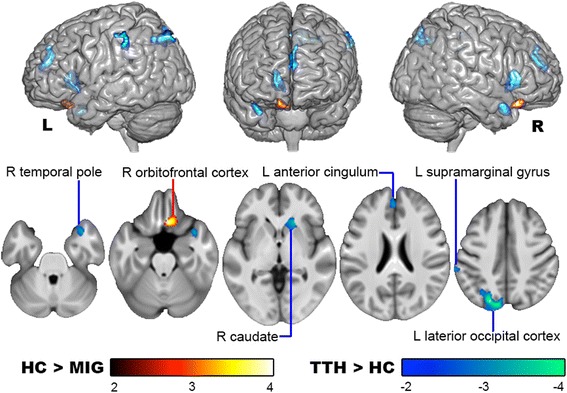
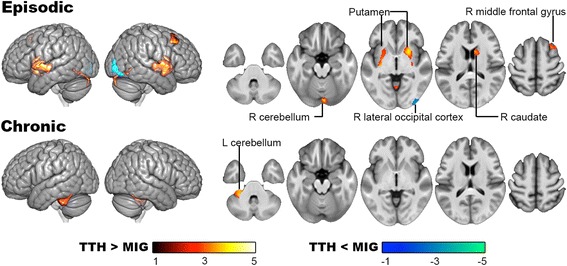
In comparison with controls (n = 43), the patients with TTH (25 episodic and 24 chronic) exhibited a GM volume increase in the anterior cingulate cortex, supramarginal gyrus, temporal pole, lateral occipital cortex, and caudate. The patients with migraine (31 episodic and 25 chronic) conversely exhibited a GM volume decrease in the orbitofrontal cortex. These GM changes did not correlate with any headache profile. A voxel-wise 2 × 2 factorial analysis further revealed the substantial effects of headache types and frequency in the comparison of GM volume between TTH and migraine. Specifically, the migraine group (vs. TTH) had a GM decrease in the superior and middle frontal gyri, cerebellum, dorsal striatum, and precuneus. The chronic group (vs. episodic group) otherwise demonstrated a GM decrease in the bilateral insula and anterior cingulate cortex. In receiver operating characteristic analysis, the GM volumes of the left superior frontal gyrus and right cerebellum V combined had good discriminative ability for distinguishing TTH and migraine (area under the curve = 0.806).
TTH and migraine are separate headache disorders with different characteristics in relation to GM changes. The major morphological difference between the two types of headaches is the relative GM decrease of the prefrontal and cerebellar regions in migraine, which may reflect a higher allostatic load associated with this disabling headache.
尽管紧张型头痛(TTH)和偏头痛的症状明显不同,但它们高度共病,并在临床实践中表现出许多相似之处。本研究的目的是探讨这两种类型的头痛在脑形态学上是否相似。
连续纳入 TTH 患者、年龄和性别匹配的偏头痛患者和健康对照者进行脑磁共振成像检查。如果 TTH 患者报告任何偏头痛特征或相关症状,则将其排除在外。使用基于体素的形态计量学检查与头痛诊断(TTH 与偏头痛)和频率(发作性与慢性)相关的灰质(GM)体积变化。还研究了这些 GM 变化与头痛特征的相关性以及 TTH 和偏头痛之间的鉴别能力。
与对照组(n=43)相比,TTH 患者(25 例发作性和 24 例慢性)的前扣带回皮质、缘上回、颞极、外侧枕叶皮质和尾状核 GM 体积增加。相反,偏头痛患者(31 例发作性和 25 例慢性)的眶额皮质 GM 体积减少。这些 GM 变化与任何头痛特征均无相关性。基于体素的 2×2 析因分析进一步揭示了 TTH 和偏头痛之间 GM 体积比较中头痛类型和频率的显著影响。具体而言,偏头痛组(与 TTH 相比)的额上回和中回、小脑、背侧纹状体和楔前叶 GM 减少。慢性组(与发作性组相比)的双侧岛叶和前扣带回皮质 GM 减少。在受试者工作特征分析中,左额上回和右小脑 V 区 GM 体积的组合对区分 TTH 和偏头痛具有良好的鉴别能力(曲线下面积=0.806)。
TTH 和偏头痛是两种不同特征的头痛障碍,与 GM 变化有关。这两种类型的头痛之间的主要形态差异是偏头痛中前额叶和小脑区域的相对 GM 减少,这可能反映了与这种致残性头痛相关的更高的适应负荷。