Zhang Qiongmin, Wu Qizhu, Zhang Junran, He Ling, Huang Jiangtao, Zhang Jiang, Huang Hua, Gong Qiyong
Department of Medical Information Engineering, School of Electrical Engineering and Information, Sichuan University, Chengdu, Sichuan, China.
Monash Biomedical Imaging, Monash University, Melbourne, Victoria, Australia.
PLoS One. 2016 Sep 30;11(9):e0163875. doi: 10.1371/journal.pone.0163875. eCollection 2016.
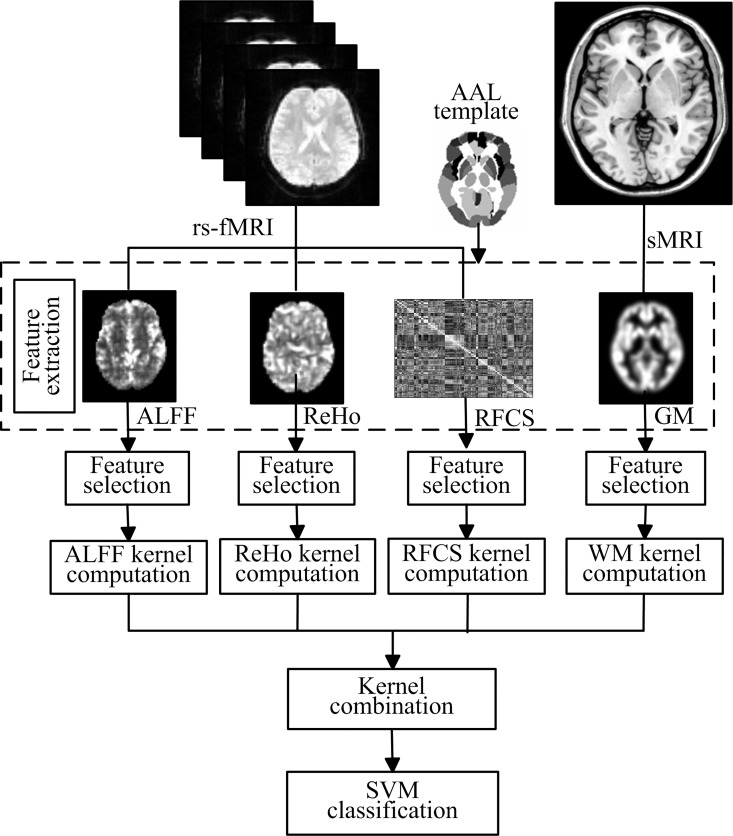
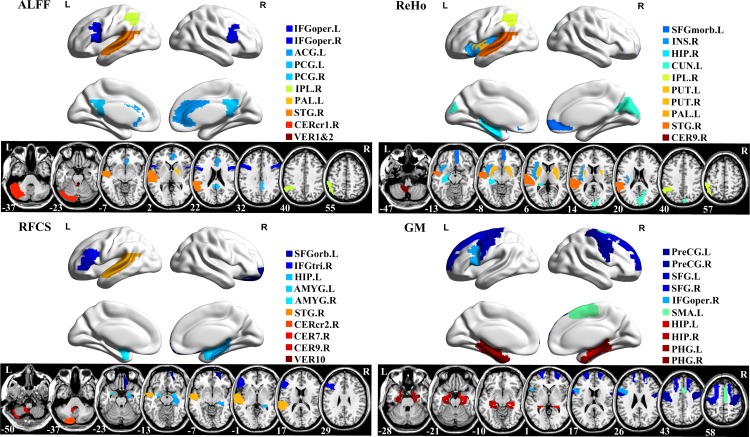
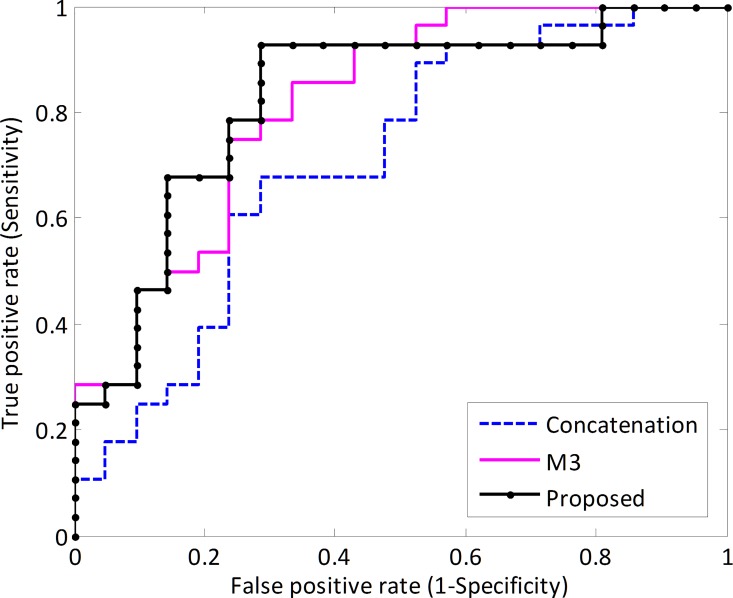
Magnetic resonance imaging (MRI) is by nature a multi-modality technique that provides complementary information about different aspects of diseases. So far no attempts have been reported to assess the potential of multi-modal MRI in discriminating individuals with and without migraine, so in this study, we proposed a classification approach to examine whether or not the integration of multiple MRI features could improve the classification performance between migraine patients without aura (MWoA) and healthy controls. Twenty-one MWoA patients and 28 healthy controls participated in this study. Resting-state functional MRI data was acquired to derive three functional measures: the amplitude of low-frequency fluctuations, regional homogeneity and regional functional correlation strength; and structural MRI data was obtained to measure the regional gray matter volume. For each measure, the values of 116 pre-defined regions of interest were extracted as classification features. Features were first selected and combined by a multi-kernel strategy; then a support vector machine classifier was trained to distinguish the subjects at individual level. The performance of the classifier was evaluated using a leave-one-out cross-validation method, and the final classification accuracy obtained was 83.67% (with a sensitivity of 92.86% and a specificity of 71.43%). The anterior cingulate cortex, prefrontal cortex, orbitofrontal cortex and the insula contributed the most discriminative features. In general, our proposed framework shows a promising classification capability for MWoA by integrating information from multiple MRI features.
磁共振成像(MRI)本质上是一种多模态技术,可提供有关疾病不同方面的补充信息。到目前为止,尚未有研究报道尝试评估多模态MRI在区分有无偏头痛个体方面的潜力,因此在本研究中,我们提出了一种分类方法,以检验多种MRI特征的整合是否能提高无先兆偏头痛(MWoA)患者与健康对照之间的分类性能。21名MWoA患者和28名健康对照参与了本研究。采集静息态功能MRI数据以得出三种功能测量指标:低频波动幅度、局部一致性和局部功能相关强度;并获取结构MRI数据以测量局部灰质体积。对于每个测量指标,提取116个预定义感兴趣区域的值作为分类特征。首先通过多核策略对特征进行选择和组合;然后训练支持向量机分类器以在个体水平上区分受试者。使用留一法交叉验证方法评估分类器的性能,最终获得的分类准确率为83.67%(敏感性为92.86%,特异性为71.43%)。前扣带回皮质、前额叶皮质、眶额皮质和脑岛贡献了最具判别力的特征。总体而言,我们提出的框架通过整合来自多种MRI特征的信息,对MWoA显示出有前景的分类能力。