Department of Neurology and Neurosurgery, Brain Center Rudolf Magnus, University Medical Center Utrecht and Utrecht University, 3584 CX, Utrecht, The Netherlands.
Biomedical MR Imaging and Spectroscopy Group, Center for Image Sciences, University Medical Center Utrecht and Utrecht University, 3584 CX, Utrecht, The Netherlands.
Sci Rep. 2018 Jan 16;8(1):856. doi: 10.1038/s41598-018-19302-4.
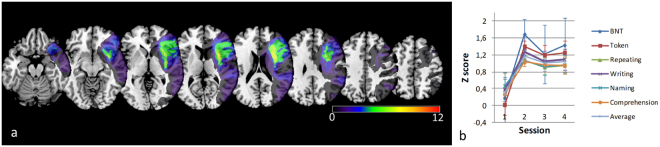
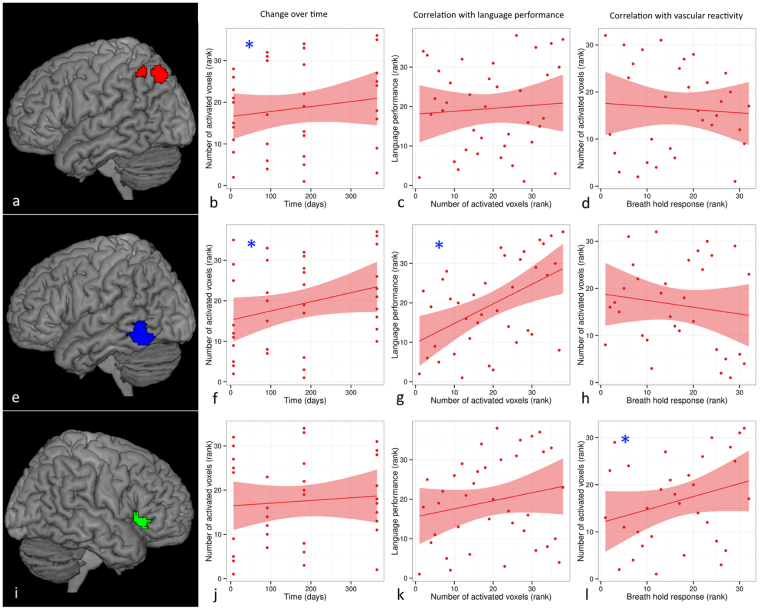
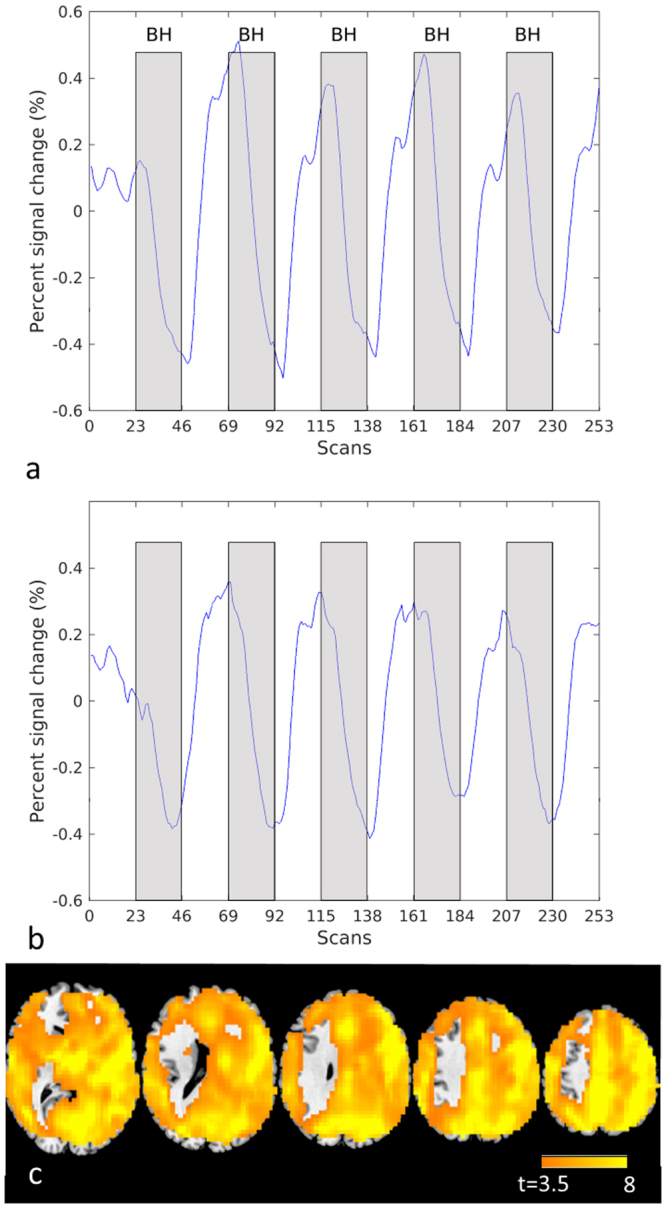
Knowledge of spatiotemporal patterns of language network changes may help in predicting outcome in aphasic stroke patients. Here we assessed language function and performed functional MRI four times during one year to measure language network activation and cerebrovascular reactivity (with breath-holding) in twelve left-hemispheric stroke patients, of whom two dropped out before the final measurement, and eight age-matched controls. Language outcome was related to increase of activation in left and right posterior inferior temporal gyrus over the first year, while activation increase in right inferior frontal gyrus was inversely correlated to language recovery. Outcome prediction improved by addition of early language-induced activation of the left posterior inferior temporal gyrus to a regression model with baseline language performance as first predictor. Variations in language-induced activation in right inferior frontal gyrus were primarily related to differences in vascular reactivity. Furthermore, several language-activation changes could not be linked to alterations in language proficiency nor vascular reactivity, and were assumed to be caused by unspecified intersession variability. In conclusion, early functional neuroimaging improves outcome prediction of aphasia after stroke. Controlling for cerebrovascular reactivity and unspecified intersession variability may result in more accurate assessment of the relationship between activation pattern shifts and function after stroke.
语言网络变化的时空模式知识可能有助于预测失语症中风患者的预后。在这里,我们评估了语言功能,并在一年内进行了四次功能磁共振成像测量,以测量 12 名左半球中风患者的语言网络激活和脑血管反应性(屏息),其中两名在最后一次测量前退出,还有 8 名年龄匹配的对照组。语言预后与第一年左右下颞叶激活的增加有关,而右额下回的激活增加与语言恢复呈负相关。通过将左侧下颞叶的早期语言诱导激活添加到以基线语言表现为第一预测因子的回归模型中,预后预测得到改善。右侧额下回语言诱导激活的变化主要与血管反应性的差异有关。此外,一些语言激活的变化不能与语言熟练程度或血管反应性的变化联系起来,被认为是由未指定的会话间变异性引起的。总之,早期功能神经影像学可提高中风后失语症的预后预测。控制脑血管反应性和未指定的会话间变异性可能会更准确地评估中风后激活模式变化与功能之间的关系。