Maciejewska Dominika, Michalczyk Małgorzata, Czerwińska-Rogowska Maja, Banaszczak Marcin, Ryterska Karina, Jakubczyk Karolina, Piotrwski Jakub, Hołowko Joanna, Drozd Arleta, Wysokińki Paweł, Ficek Krzysztof, Wilk Krzysztof, Lubkowska Anna, Cięszczyk Paweł, Bertrand Jerzy, Stachowska Ewa
Department of Biochemistry and Human Nutrition, Pomeranian Medical University, Szczecin, Poland.
Department of Sports Nutrition, Academy of Physical Education in Katowice, Katowice, Poland.
J Hum Kinet. 2017 Dec 28;60:63-75. doi: 10.1515/hukin-2017-0090. eCollection 2017 Dec.
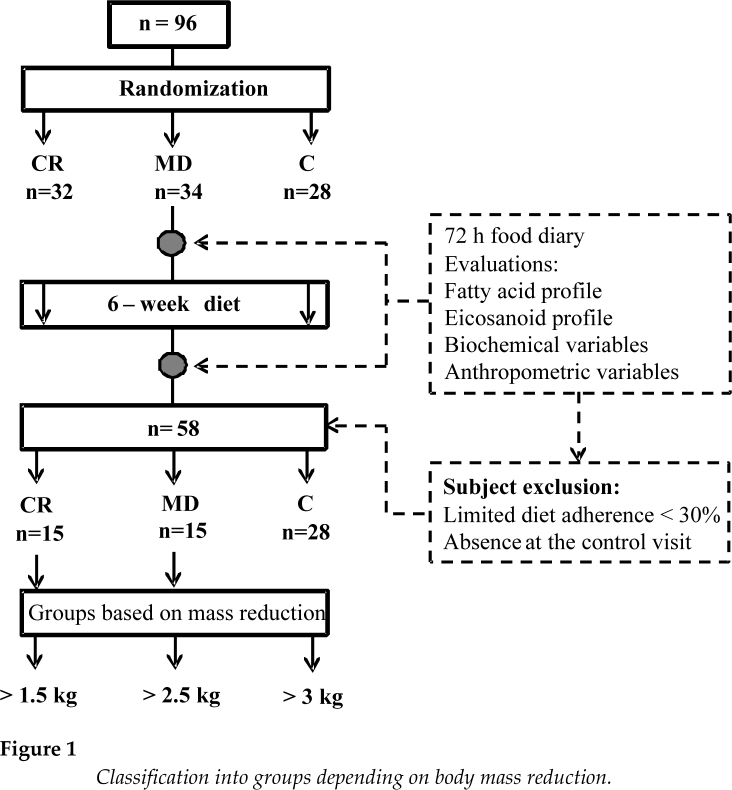
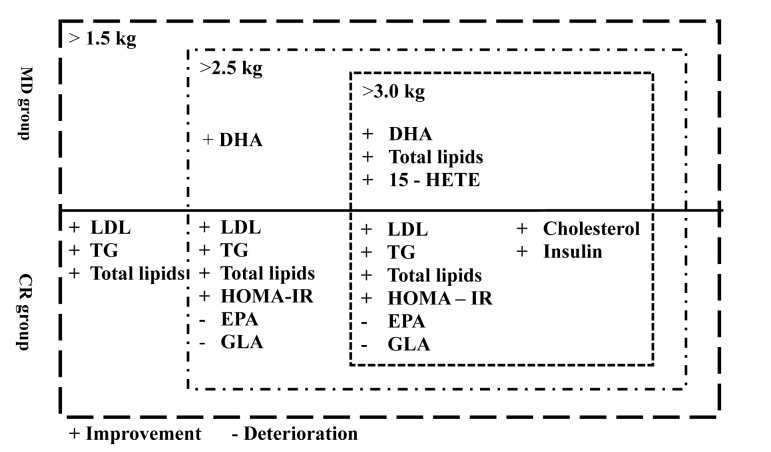
The aim of the study was to investigate the efficacy of 6 week Mediterranean diet or 30% calorie restriction on the fatty acid profile and eicosanoids (hydroxyoctadecadienoi acids and hydroxyeicosatetraenoic acids) concentration. Furthermore, basic biochemical variables such as insulin, glucose, HOMA-IR, and a lipid profile were estimated. The study enrolled 94 Caucasian former athletes aged 20-42, with body height of 179 ± 16.00 cm and body mass of 89.26 ± 13.25 kg who had not been active for at least 5 years. The subjects were randomly assigned to one of the three intervention groups: CR group - the 30% calorie restriction (n = 32), MD group - the Mediterranean diet (n = 34), and C group - a control group (n = 28). The pattern of nutrition was analysed before and after the experiment using the 72 h food diaries. In order to evaluate the effect of diet intervention, the following variables were measured: anthropometrics, basic biochemical variables (insulin, fasting glucose, HOMA-IR, lipid profile), fatty acids and their blood derivatives profiles. The CR group showed significantly lower levels of several biochemical variables, i.e., BMI, total cholesterol LDL, TG, total lipids, insulin and HOMA - IR (p < 0.05). Subjects consuming the MD diet significantly decreased their BMI and reduced the level of total lipids (p < 0.05). We did not find any significant changes in the C group. The analysis of the fatty acid profile revealed that the CR group had a significantly decreased EPA level (p < 0.05). The MD group showed a significantly increased level of the DHA (p < 0.05) and improvement in the omega - 3 index (p < 0.05). Subjects following the MD also showed significantly lower concentrations of 15 - hydroxyicosatetraenoic acid (15-HETE). We did not observe any significant differences between the CR and C groups. Within short time, calorie restriction helps to improve lipid variables and insulin resistance. The MD diet seems to be more advantageous in the decrease of inflammation, but does not improve basic biochemical variables. We can conclude that calorie restriction can be a good choice for former athletes, although EPA and DHA supplementation is needed.
本研究的目的是调查为期6周的地中海饮食或30%的热量限制对脂肪酸谱和类二十烷酸(羟基十八碳二烯酸和羟基二十碳四烯酸)浓度的影响。此外,还评估了胰岛素、葡萄糖、稳态模型评估的胰岛素抵抗(HOMA-IR)和血脂谱等基本生化指标。该研究招募了94名年龄在20至42岁之间的白种人退役运动员,他们身高179±16.00厘米,体重89.26±13.25千克,且至少5年未进行过体育活动。受试者被随机分配到三个干预组之一:CR组——30%的热量限制组(n = 32),MD组——地中海饮食组(n = 34),C组——对照组(n = 28)。使用72小时食物日记分析实验前后的营养模式。为了评估饮食干预的效果,测量了以下变量:人体测量学指标、基本生化指标(胰岛素、空腹血糖、HOMA-IR、血脂谱)、脂肪酸及其血液衍生物谱。CR组的几个生化指标水平显著降低,即体重指数(BMI)、总胆固醇、低密度脂蛋白、甘油三酯、总脂质、胰岛素和HOMA-IR(p < 0.05)。食用地中海饮食的受试者BMI显著降低,总脂质水平降低(p < 0.05)。我们未在C组中发现任何显著变化。脂肪酸谱分析显示,CR组的二十碳五烯酸(EPA)水平显著降低(p < 0.05)。MD组的二十二碳六烯酸(DHA)水平显著升高(p < 0.05),ω-3指数有所改善(p < 0.05)。遵循地中海饮食的受试者15-羟基二十碳四烯酸(15-HETE)的浓度也显著降低。我们未观察到CR组和C组之间有任何显著差异。短期内,热量限制有助于改善血脂变量和胰岛素抵抗。地中海饮食在减轻炎症方面似乎更具优势,但不能改善基本生化指标。我们可以得出结论,热量限制对退役运动员可能是个不错的选择,不过需要补充EPA和DHA。