Chiwaridzo Matthew, Chikasha Tafadzwa Nicole, Naidoo Nirmala, Dambi Jermaine Matewu, Tadyanemhandu Cathrine, Munambah Nyaradzai, Chizanga Precious Trish
Rehabilitation Department, University of Zimbabwe, College of Health Sciences, P.O Box A178, Avondale, Harare Zimbabwe.
Division of Physiotherapy, University of Cape Town, School of Health and Rehabilitation Sciences, Faculty of Health Sciences, Cape Town, South Africa.
Arch Physiother. 2017 Feb 28;7:3. doi: 10.1186/s40945-017-0031-y. eCollection 2017.
In Zimbabwe, a recent increase in the volume of research on recurrent non-specific low back pain (NSLBP) has revealed that adolescents are commonly affected. This is alarming to health professionals and parents and calls for serious primary preventative strategies to be developed and implemented forthwith. Early identification initiatives should be prioritised in order to curtail the condition and its progression. In an attempt to be proactive in minimising the prevalence of recurrent NSLBP, this study was conducted to evaluate the content validity and test-retest reliability of a survey questionnaire with the aim of proffering a valid and reliable questionnaire which can be used in non-clinical settings to identify adolescents with recurrent NSLBP in Harare, Zimbabwe and determine the possible factors associated with the condition.
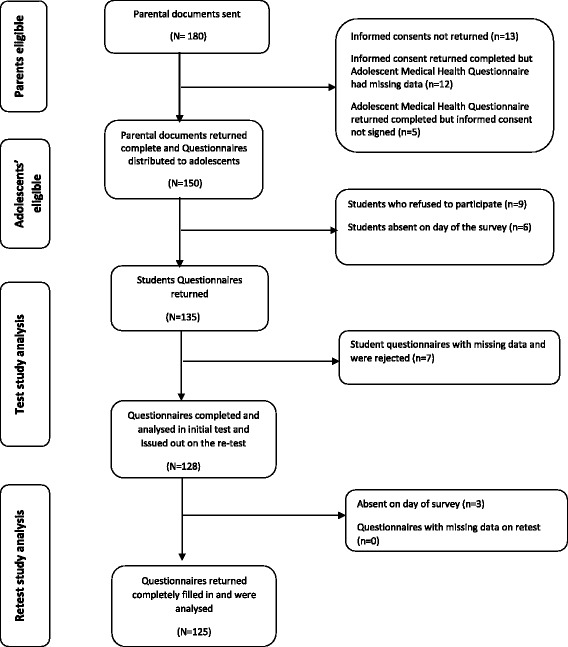
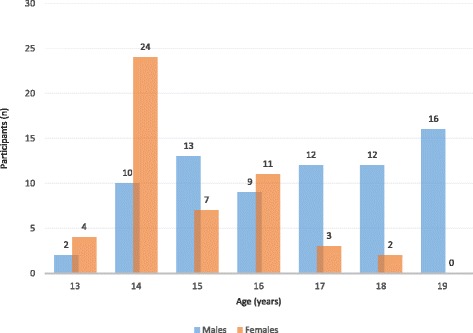
The study was conducted in two parts. The first part assessed content validity of the questionnaire using four experts derived from academia and clinical practice. The second part evaluated the reliability of the questionnaire among 125 high school-children aged between 13 and 19 years in a test-retest study.
Twenty-six (26) out of thirty questions in the questionnaire had an Item Content Validity index of 1.00, demonstrating complete agreement among content experts. Overall, the Scale Content Validity Index for the questionnaire was 0.97. Item completion for the reliability study was satisfactory. The questionnaire items had kappa values ranging from 0.17 (slight agreement) to 1 (perfect agreement). High levels of reliability were found for the questions on school bag use (=0.94), sports participation (=0.97), and lifetime prevalence (=0.89).
Excellent content validity and slight to perfect test-retest reliability was found for the Low Back Pain (LBP) questionnaire. These results are comparable to findings of other studies evaluating the psychometric properties of LBP questionnaires. Cognisant of the limitations of the study, the results of this study suggest that the LBP questionnaire could be used in local studies investigating LBP among adolescents although questions enquiring on functional limitations and sciatica may need further consideration.
在津巴布韦,近期关于复发性非特异性下腰痛(NSLBP)的研究数量有所增加,结果显示青少年是该病的常见患者群体。这引起了卫生专业人员和家长的警觉,因此迫切需要制定并立即实施有效的一级预防策略。应优先开展早期识别工作,以控制病情及其发展。为积极降低复发性NSLBP的患病率,本研究旨在评估一份调查问卷的内容效度和重测信度,以期提供一份有效且可靠的问卷,用于在非临床环境中识别津巴布韦哈拉雷患有复发性NSLBP的青少年,并确定与该病相关的可能因素。
本研究分两部分进行。第一部分使用来自学术界和临床实践的四位专家评估问卷的内容效度。第二部分在一项重测研究中,对125名年龄在13至19岁之间的高中生评估问卷的信度。
问卷中的30个问题中有26个的项目内容效度指数为1.00,表明内容专家之间完全一致。总体而言,该问卷的量表内容效度指数为0.97。信度研究的项目完成情况令人满意。问卷项目的kappa值范围为0.17(轻度一致)至1(完全一致)。关于书包使用(=0.94)、体育活动参与(=0.97)和终生患病率(=0.89)的问题具有较高的信度。
腰痛(LBP)问卷具有出色的内容效度和轻度至完美的重测信度。这些结果与其他评估LBP问卷心理测量特性的研究结果相当。鉴于本研究的局限性,本研究结果表明,LBP问卷可用于当地关于青少年腰痛的研究,不过,询问功能受限和坐骨神经痛的问题可能需要进一步考量。