O'Hara Jamie, Walsh Shaun, Camp Charlotte, Mazza Giuseppe, Carroll Liz, Hoxer Christina, Wilkinson Lars
Faculty of Health and Social Care, University of Chester, Chester, UK.
HCD Economics, The Innovation Centre, Daresbury, WA4 4FS, UK.
Health Econ Rev. 2018 Jan 16;8(1):1. doi: 10.1186/s13561-018-0185-7.
Target joints are a common complication of severe haemophilia. While factor replacement therapy constitutes the majority of costs in haemophilia, the relationship between target joints and non drug-related direct costs (NDDCs) has not been studied.
Data on haemophilia patients without inhibitors was drawn from the 'Cost of Haemophilia across Europe - a Socioeconomic Survey' (CHESS) study, a cost assessment in severe haemophilia A and B across five European countries (France, Germany, Italy, Spain, and the United Kingdom) in which 139 haemophilia specialists provided demographic and clinical information for 1285 adult patients. NDDCs were calculated using publicly available cost data, including 12-month ambulatory and secondary care activity: haematologist and other specialist consultant consultations, medical tests and examinations, bleed-related hospital admissions, and payments to professional care providers. A generalized linear model was developed to investigate the relationship between NDDCs and target joints (areas of chronic synovitis), adjusted for patient covariates.
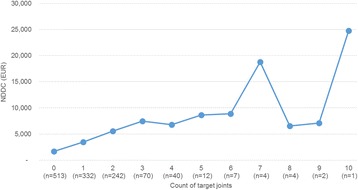
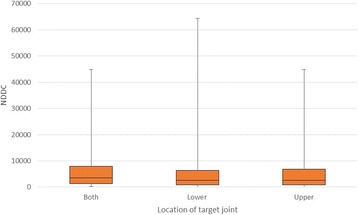
Five hundred and thirteen patients (42% of the sample) had no diagnosed target joints; a total of 1376 target joints (range 1-10) were recorded in the remaining 714 patients. Mean adjusted NDDCs for persons with no target joints were EUR 3134 (standard error (SE) EUR 158); for persons with one or more target joints, mean adjusted NDDCs were EUR 3913 (SE EUR 157; average mean effect EUR 779; p < 0.001).
Our analysis suggests that the presence of one or more target joints has a significant impact on NDDCs for patients with severe haemophilia, ceteris paribus. Prevention and management of target joints should be an important consideration of managing haemophilia patients.
目标关节是重度血友病的常见并发症。虽然因子替代疗法占血友病治疗费用的大部分,但目标关节与非药物相关直接成本(NDDCs)之间的关系尚未得到研究。
无抑制物的血友病患者数据来自“欧洲血友病成本——一项社会经济调查”(CHESS)研究,这是一项对五个欧洲国家(法国、德国、意大利、西班牙和英国)的重度甲型和乙型血友病进行的成本评估,139名血友病专家为1285名成年患者提供了人口统计学和临床信息。使用公开可得成本数据计算NDDCs,包括12个月的门诊和二级医疗活动:血液科医生及其他专科顾问会诊、医学检查、与出血相关的住院治疗以及向专业护理提供者支付的费用。建立广义线性模型以研究NDDCs与目标关节(慢性滑膜炎区域)之间的关系,并对患者协变量进行调整。
513名患者(样本的42%)未诊断出目标关节;其余714名患者共记录到1376个目标关节(范围为1至10个)。无目标关节患者的平均调整后NDDCs为3134欧元(标准误(SE)为158欧元);有一个或多个目标关节的患者,平均调整后NDDCs为3913欧元(SE为157欧元;平均平均效应为779欧元;p<0.001)。
我们的分析表明,在其他条件相同的情况下,一个或多个目标关节的存在对重度血友病患者的NDDCs有显著影响。目标关节的预防和管理应成为血友病患者管理的重要考虑因素。