Faculty of Health and Social Care, University of Chester, Chester, UK.
HCD Economics, Daresbury, UK.
Health Qual Life Outcomes. 2018 May 2;16(1):84. doi: 10.1186/s12955-018-0908-9.
Joint damage remains a major complication associated with haemophilia and is widely accepted as one of the most debilitating symptoms for persons with severe haemophilia. The aim of this study is to describe how complications of haemophilia such as target joints influence health-related quality of life (HRQOL).
Data on hemophilia patients without inhibitors were drawn from the 'Cost of Haemophilia across Europe - a Socioeconomic Survey' (CHESS) study, a cost-of-illness assessment in severe haemophilia A and B across five European countries (France, Germany, Italy, Spain, and the UK). Physicians provided clinical and sociodemographic information for 1285 adult patients, 551 of whom completed corresponding questionnaires, including EQ-5D. A generalised linear model was developed to investigate the relationship between EQ-5D index score and target joint status (defined in the CHESS study as areas of chronic synovitis), adjusted for patient covariates including socio-demographic characteristics and comorbidities.
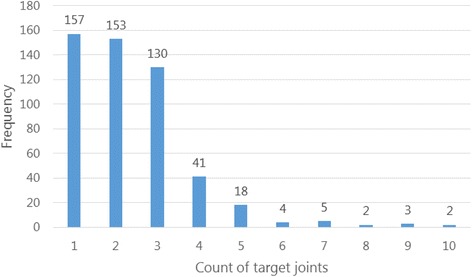
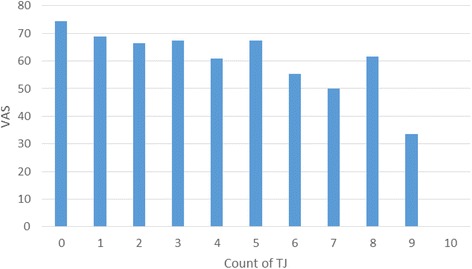
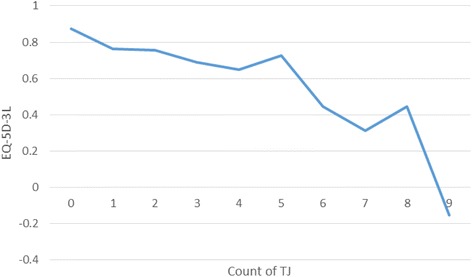
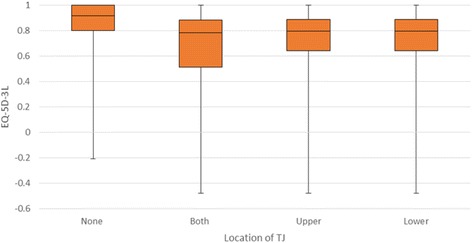
Five hundred and fifteen patients (42% of the sample) provided an EQ-5D response; a total of 692 target joints were recorded across the sample. Mean EQ-5D index score for patients with no target joints was 0.875 (standard deviation [SD] 0.179); for patients with one or more target joints, mean index score was 0.731 (SD 0.285). Compared to having no target joints, having one or more target joints was associated with lower index scores (average marginal effect (AME) -0.120; SD 0.0262; p < 0.000).
This study found that the presence of chronic synovitis has a significant negative impact on HRQOL for adults with severe haemophilia. Prevention, early diagnosis and treatment of target joints should be an important consideration for clinicians and patients when managing haemophilia.
关节损伤仍是血友病相关的主要并发症,也是严重血友病患者致残的主要症状之一。本研究旨在描述血友病相关并发症(如靶关节)如何影响健康相关生活质量(HRQOL)。
本研究数据来源于“欧洲血友病成本调查-社会经济学评估”(CHESS)研究,该研究为在法国、德国、意大利、西班牙和英国五国开展的严重血友病 A 和 B 的疾病经济负担评估,纳入了无抑制剂的血友病患者。医生为 1285 名成年患者提供了临床和社会人口学信息,其中 551 名患者完成了相应的问卷,包括 EQ-5D。为研究 EQ-5D 指数评分与靶关节状态(CHESS 研究中定义为慢性滑膜炎区域)之间的关系,我们建立了广义线性模型,调整了患者协变量,包括社会人口统计学特征和合并症。
共 515 名患者(样本的 42%)提供了 EQ-5D 评分;样本中共记录了 692 个靶关节。无靶关节患者的 EQ-5D 指数平均得分为 0.875(标准差[SD] 0.179);有 1 个或多个靶关节的患者指数平均得分为 0.731(SD 0.285)。与无靶关节相比,有 1 个或多个靶关节与较低的指数评分相关(平均边际效应(AME)-0.120;SD 0.0262;p<0.000)。
本研究发现,慢性滑膜炎的存在对严重血友病成人的 HRQOL 有显著的负面影响。预防、早期诊断和治疗靶关节应成为临床医生和患者管理血友病时的重要考虑因素。